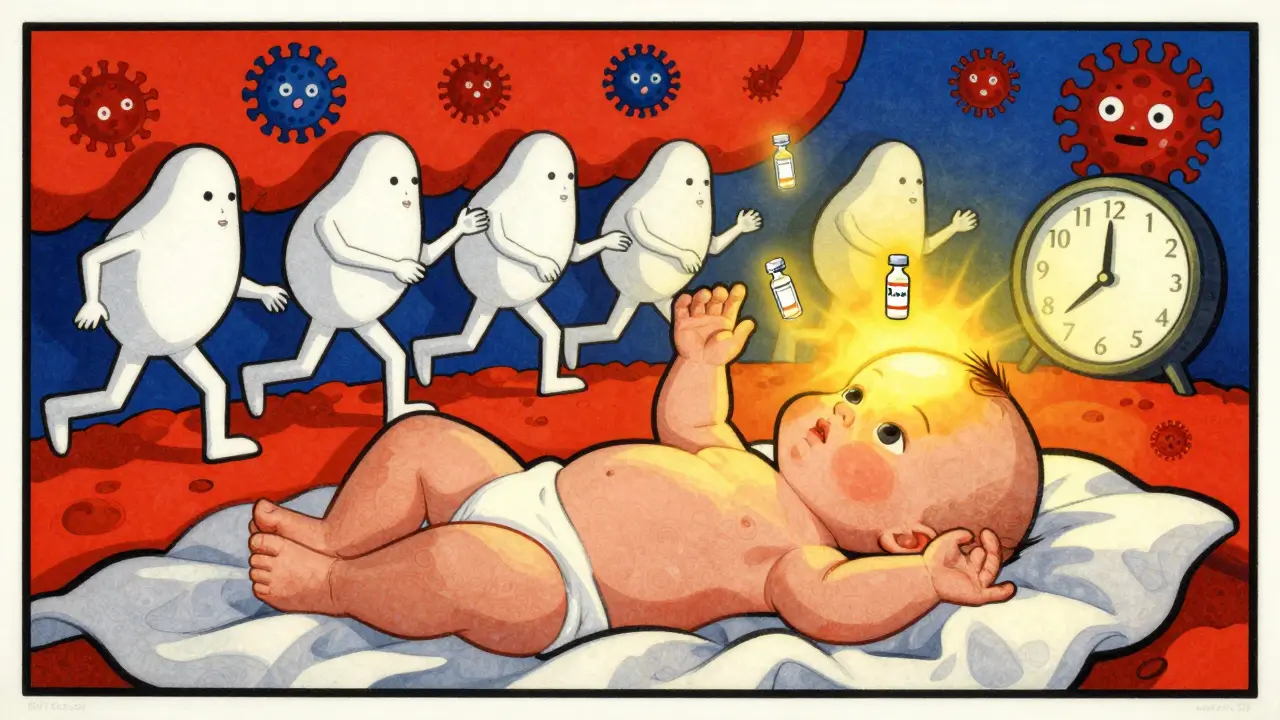
When your child gets vaccinated, it’s normal to feel anxious if they develop a fever. Many parents reach for fever reducers like acetaminophen or ibuprofen right away-sometimes even before the shot. But here’s the thing: giving fever medicine before a vaccine might actually weaken how well it works. This isn’t just a theory. It’s backed by solid research from the CDC, Children’s Hospital of Philadelphia, and multiple peer-reviewed studies. The good news? You don’t need to panic. There’s a clear, simple way to handle it.
Why Fever After Vaccines Happens
Fever after vaccination isn’t a sign something went wrong-it’s a sign the immune system is doing its job. When a vaccine enters the body, it tricks the immune system into thinking a real infection is coming. In response, the body raises its temperature. That’s not dangerous. It’s protective. For most kids, this fever is mild, lasts less than 48 hours, and goes away on its own.Some vaccines are more likely to cause fever than others. According to the Vaccine Education Center at Children’s Hospital of Philadelphia, about 24 to 35 out of every 100 babies who get Prevnar 13 (the pneumococcal vaccine) will develop a fever within a week. With Pediarix (which combines DTaP, polio, and hepatitis B), that number jumps to 28 to 39 out of 100. The MenB vaccine, used in the UK and other countries, is especially known for causing high fevers-so much so that health officials there recommend giving paracetamol after the shot.
Most fevers start within 12 hours of vaccination and peak around day one. Temperatures above 102°F (39°C) are the ones that usually prompt parents to act. But if your child’s temperature is between 100°F and 102°F, you don’t need to medicate. Their body is handling it fine.
The Problem with Giving Medicine Too Early
In the early 2000s, it was common advice to give acetaminophen before or right after vaccines to prevent discomfort. But studies published after 2009 changed everything. A landmark study in The Lancet showed that kids who got fever reducers before vaccination had lower antibody responses. That means their bodies didn’t build as strong a defense against the diseases the vaccines were meant to protect against.Follow-up research confirmed this. One 2016 study compared two groups: one that got acetaminophen right after vaccination (prophylactic), and another that only got it if fever developed after 6-8 hours. The group that waited had significantly higher antibody levels across multiple vaccine components. The same pattern showed up with ibuprofen. Giving medication before or within the first few hours after the shot appears to dampen the immune system’s reaction.
Here’s what that means in real terms: Your child still gets protection-even with reduced antibody levels. But if those levels dip below the protective threshold, they might not be fully shielded. That’s why experts now say: don’t give fever medicine unless it’s really needed.
When to Wait-and When to Act
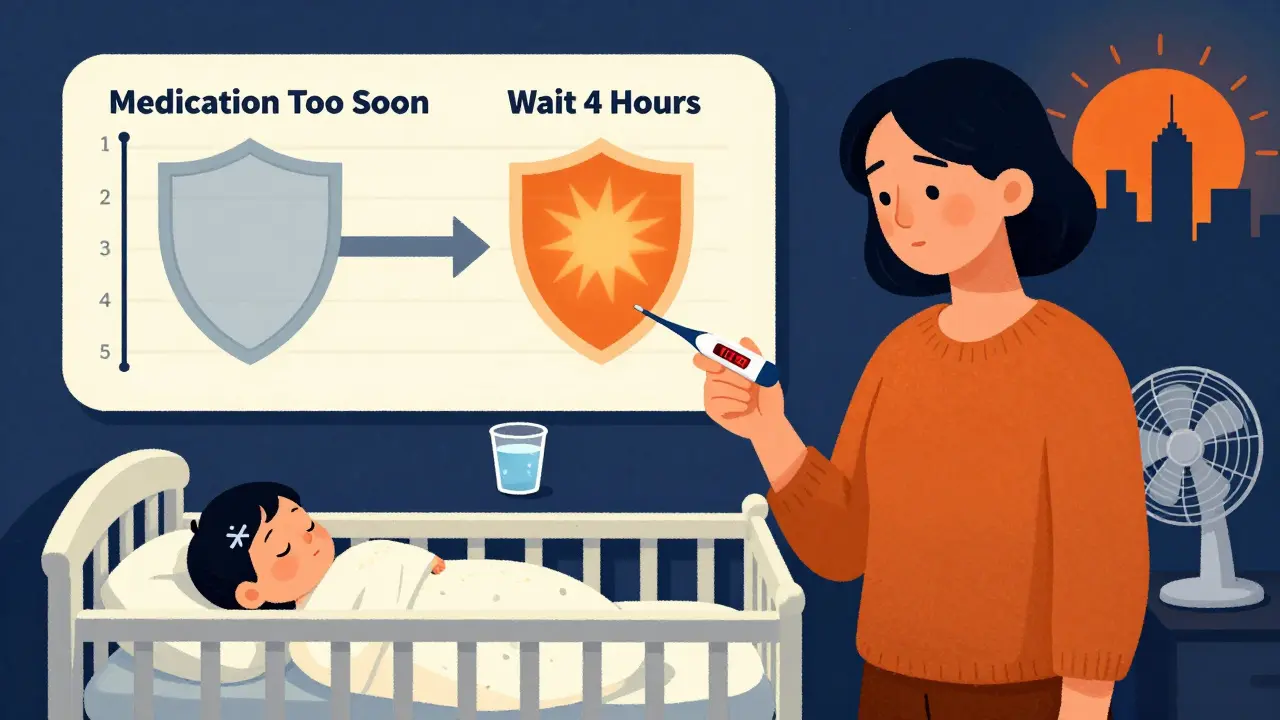
The key timing rule is simple: wait at least four hours after vaccination before giving any fever reducer. Multiple studies, including one referenced by The Pediatrician Mom (PMID: 3059756), show that giving medication after this window doesn’t interfere with the immune response. By then, the body has already started building its defense.So here’s your step-by-step guide:
- After vaccination, monitor your child’s temperature. Use a digital thermometer under the armpit or rectally for babies under 3 months.
- If their temperature is below 102°F (39°C), skip the medicine. Keep them lightly dressed, offer fluids, and let their body do its work.
- If their temperature reaches or exceeds 102°F, or if they seem unusually fussy, lethargic, or uncomfortable, then give a fever reducer.
- Wait at least four hours after the shot before giving the first dose.
This approach balances comfort with effectiveness. You’re not ignoring symptoms-you’re just giving the vaccine time to work.
Medication Rules: What to Use and How Much
Not all fever reducers are the same-and not all are safe for every age.Acetaminophen (Tylenol) is the go-to for most children. But it’s not approved for infants under 12 weeks old. If your baby is younger than that and has a fever, call your doctor. For older babies and kids, dosing is based on weight:
- Infants 6-11 months (18-23 lbs / 8-10 kg): 1.25 mL of infant acetaminophen (160 mg/5 mL)
- Give every 4-6 hours as needed
- Do not exceed 4 doses in 24 hours
Ibuprofen (Advil, Motrin) is also effective but comes with stricter age limits. It’s not recommended for babies under 6 months. For older infants:
- Infants 6-11 months (18-23 lbs / 8-10 kg): 2.5 mL of infant ibuprofen (100 mg/5 mL)
- Give every 6-8 hours as needed
- Do not exceed 4 doses in 24 hours
Never give aspirin to anyone under 20. It’s linked to Reye syndrome, a rare but deadly condition that affects the liver and brain.
Special Case: The MenB Vaccine
The UK’s National Health Service (NHS) is the only major health system that recommends giving paracetamol after the MenB vaccine-at 8 weeks and 16 months. Why? Because this vaccine causes high fevers in up to 60% of infants. The risk of febrile seizures is higher, so the NHS weighs the benefit of preventing extreme fever against the small risk of slightly lower antibody levels. They decided the trade-off is worth it.This exception doesn’t apply to other vaccines. Don’t assume you should give medicine after every shot. Stick to the general rule unless your doctor says otherwise.
What About a Fever Before the Shot?
If your child already has a low-grade fever (under 102°F) before vaccination, don’t cancel the appointment. The CDC says mild illness doesn’t affect how well the vaccine works. Even a runny nose or slight cough won’t interfere. Vaccines are designed to work even when the immune system is already active.Only delay vaccination if your child has a moderate to severe illness-like a high fever over 102°F, vomiting, or extreme lethargy. Otherwise, go ahead. Delaying leaves them unprotected longer.
Non-Medication Ways to Help
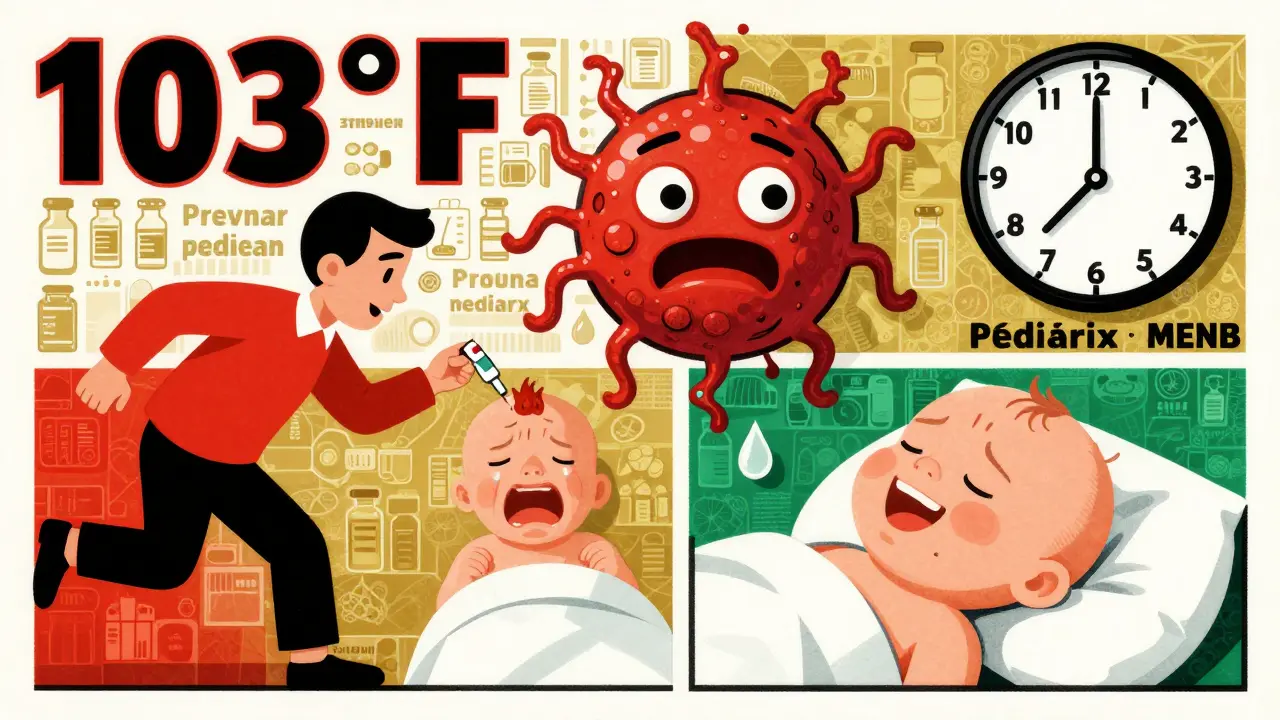
Medicine isn’t the only tool. Sometimes, simple care is all your child needs:- Offer extra fluids-water, breast milk, or formula
- Dress them in light clothing, not heavy blankets
- Keep the room cool but not cold
- Let them rest
- Use a lukewarm sponge bath only if they’re uncomfortable-never cold water or alcohol
These steps support the body’s natural response without interfering with immunity.
What the Experts Say
Dr. Paul Offit from Children’s Hospital of Philadelphia is clear: “Giving medication prior to a vaccine visit is not recommended because they may decrease the child’s immune response.” The CDC echoes this: “Routine prophylactic administration of antipyretics is not recommended.”But they also agree: if your child is clearly uncomfortable or has a high fever, treat it. The goal isn’t to make them suffer-it’s to avoid doing harm by acting too soon.
Research continues. Scientists are still studying whether certain vaccine combinations are more sensitive to antipyretics, or whether higher doses of acetaminophen cause more interference. For now, the safest, most evidence-backed approach remains: wait four hours, then treat only if needed.
Bottom Line
Vaccines save lives. Fever reducers are helpful-but timing matters. Don’t give them before or immediately after vaccination. Wait at least four hours. Only use them if your child’s temperature is above 102°F or they’re clearly distressed. Stick to weight-based doses. Avoid aspirin. And remember: a mild fever is a sign your child’s body is learning how to fight off disease. Let it do its job.Should I give my child acetaminophen before their vaccines?
No. Giving acetaminophen before vaccination can reduce how well the vaccine works. Studies show children who received fever medicine before shots had lower antibody responses. Wait until at least four hours after the vaccine, and only give it if they develop a fever over 102°F or seem very uncomfortable.
Can I give ibuprofen after a vaccine?
Yes, but not before 6 months of age. Ibuprofen is safe for infants older than 6 months, but only if given at least four hours after vaccination. Use the correct dose based on weight-usually 2.5 mL for babies 6-11 months weighing 18-23 lbs. Never give ibuprofen to babies under 6 months.
Is a fever after vaccination dangerous?
No, not usually. Most post-vaccine fevers are mild, last 1-2 days, and go away on their own. Fevers under 102°F don’t need treatment. Only worry if the fever is above 102°F, lasts more than 48 hours, or if your child is lethargic, not drinking, or having seizures. In those cases, contact your doctor.
Why does the NHS recommend paracetamol after MenB vaccine?
The MenB vaccine causes high fevers in up to 60% of infants, increasing the risk of febrile seizures. The NHS decided the benefit of preventing severe fever outweighs the small risk of slightly reduced immunity. This is an exception-only for MenB at 8 and 16 weeks. Don’t use this advice for other vaccines.
What if my baby is under 12 weeks and has a fever after vaccination?
Call your doctor immediately. Acetaminophen is not recommended for infants under 12 weeks. A fever in a young baby can signal a serious infection, even after vaccination. Don’t give any medication without medical advice.
Comments
bill cook February 27, 2026 at 06:57
Ugh I just gave my kid Tylenol before the shots because I couldn't handle crying. Now I feel like a bad parent. Why didn't anyone tell me this sooner? Feels like I just sabotaged his immunity for nothing.
Why do doctors even recommend it if it ruins the vaccine? I'm so mad.
My sister's kid had a seizure after the MenB shot and now I'm terrified to even look at a syringe.
Why can't they just make vaccines that don't cause fevers? Why does my kid have to suffer?
Why are we even doing this? I swear if my kid gets sick again I'm done with vaccines.
Someone please tell me I'm not the only one who did this.
I'm gonna go cry now.
Byron Duvall March 1, 2026 at 01:49
Yeah right. 'Solid research.' Like the CDC is gonna tell you the truth.
They're just pushing this so Big Pharma can sell more vaccines and more Tylenol later.
Remember when they said smoking was safe? Or that lead paint was fine?
They change their minds every 5 years. I bet this 'study' was funded by a vaccine maker.
My kid got fever after shots and I gave him ibuprofen. He's still healthy. So what's the problem?
They're just trying to control parents. Wake up people.
Also, why is acetaminophen banned under 12 weeks? Sounds like a cover-up to me.
Someone's hiding something. Always is.
Katherine Farmer March 2, 2026 at 11:28
How delightfully naive of the author to assume all parents are rational actors capable of adhering to a four-hour window.
My child, a 9-month-old with a 103°F fever and a history of febrile convulsions, did not wait politely for the immune system to 'do its job.'
She screamed for 14 hours. Her eyes rolled back. I had to rush her to A&E.
Yes, the NHS recommends paracetamol for MenB precisely because they’ve accepted the empirical reality: some children are not 'average.'
And yet here we are, in the land of abstract immunological principles, ignoring the screaming infant in the room.
It’s not about 'weakening' the response-it’s about preventing brain damage.
Also, why is this article so patronizing? 'Let your body do its job.' No, sweetheart, my job is to keep my child alive, not to be a lab rat in your elegant hypothesis.
Real medicine is not a philosophy seminar.
It’s triage. It’s comfort. It’s survival.
And if you think a 102°F fever is 'mild,' you’ve never held a child convulsing in your arms at 3 a.m.
Sumit Mohan Saxena March 3, 2026 at 10:37
Thank you for this detailed and scientifically accurate post. The evidence is unequivocal: prophylactic antipyretics reduce seroconversion rates across multiple vaccine platforms, as demonstrated in randomized controlled trials published in The Lancet and Pediatrics.
It is critical to emphasize that the immune response is not binary-it is a dynamic, dose-dependent process.
Antibody titers below the protective threshold may still confer partial immunity, but the risk of breakthrough infection increases, especially with highly transmissible pathogens like measles or pertussis.
For infants under 12 weeks, fever is a medical emergency regardless of etiology, and acetaminophen is contraindicated not because of vaccine interference, but due to immature hepatic metabolism.
Weight-based dosing is non-negotiable; miscalculations lead to toxicity or underdosing.
Parents should always consult their pediatrician before administering ibuprofen to infants under 6 months.
Non-pharmacological interventions remain the first-line approach: hydration, light clothing, and ambient temperature control are physiologically supportive without immunological interference.
Let me reiterate: fever is a beneficial response, but parental anxiety is real, and the goal is not to eliminate discomfort, but to prevent iatrogenic harm.
Education, not fear, is the solution.
Brandon Vasquez March 3, 2026 at 21:21
Just wanted to say thanks for laying this out clearly.
My daughter got her 12-month shots last week and I didn’t give her anything until 5 hours later.
She had a 101.5 fever and was a little clingy but slept fine.
Next day, back to normal.
Didn’t need meds.
Feeling good about that choice.
Wish more parents knew this.
Vikas Meshram March 5, 2026 at 03:19
Correction: The CDC does not say 'mild illness doesn't affect vaccine efficacy'-they say 'mild illness does not contraindicate vaccination.' Big difference. You're conflating immunological response with clinical indication. Also, you said 'never give aspirin under 20'-it's under 18. And you wrote 'paracetamol' but then used 'acetaminophen'-they're the same drug, but in the US we don't say paracetamol. It's just Tylenol. Also, the MenB vaccine in the UK is Bexsero, not MenB. Don't be lazy with terminology. This article is full of sloppy language. I'm a microbiologist. I know these things. You're making parents confused.
Ben Estella March 5, 2026 at 22:59
So let me get this straight. We're supposed to let our kids burn alive because some lab rat in Philly says 'it's better for immunity'?
What's next? Let 'em get the measles so their 'immune system learns'?
My kid ain't your experiment.
You wanna play scientist? Go to a hospital.
I'm not waiting four hours for my kid to turn purple.
And don't even get me started on how the UK 'knows better'-they're a socialist country that thinks vaccines are a public service.
Here in America, we protect our kids. Not some 'evidence.'
My kid. My call.
Period.
Jimmy Quilty March 6, 2026 at 16:00
Wait wait wait. So if I give Tylenol after 4 hours, I'm 'safe'? But what if I give it at 3 hours 59 minutes? Is that a crime?
Did the CDC run a randomized trial on 0.01 second precision?
What if my kid cries at 3 hours 30 minutes and I give it to calm them down? Is that 'sabotaging' their immune system?
And why is the NHS the only one recommending it? Are they all just brainwashed?
Also, I read somewhere that paracetamol might interfere with the development of T-cells. Is that true?
Or is this just another fear tactic to make parents feel guilty?
Because I'm not buying it.
My kid got a fever. I gave medicine. He's fine.
End of story.
Science? Pfft.
Miranda Anderson March 8, 2026 at 04:58
I just want to say how much I appreciate how thoughtful and calm this post is. It’s rare to see something so grounded in science without being cold or judgmental. I have two kids, and I’ve been through this twice. The first time, I panicked and gave Tylenol right after the shots because I thought I was being a good mom. The second time, I waited. And honestly? The difference was night and day. My older one had a fever that spiked to 103.5 and was screaming-I gave him medicine after four hours and he was asleep by midnight. My younger one had a 101.2 and slept like a rock all night. No meds. Just cuddles and water. I didn’t even realize how much anxiety I was carrying until I let go of the need to ‘fix’ the fever immediately. It’s wild how much we’re taught to fear normal biological processes. I’m not saying don’t medicate if needed-I did. I’m just saying, sometimes the bravest thing you can do is just hold your kid and trust that their body knows what to do. And that’s okay. More than okay. It’s kind of beautiful, actually.