Drug Interaction Alert Checker
Check Your Medications
Enter your current medications to see if they contain dangerous combinations mentioned in the article. This tool focuses on high-risk interactions highlighted in the study.
Imagine taking two common medications - one for your cholesterol, another for an infection - and not realizing together they could shut down your muscles, wreck your kidneys, or even kill you. This isn’t science fiction. It’s happening in pharmacies right now, and most people have no idea.
Why Some Drug Combos Are Deadly
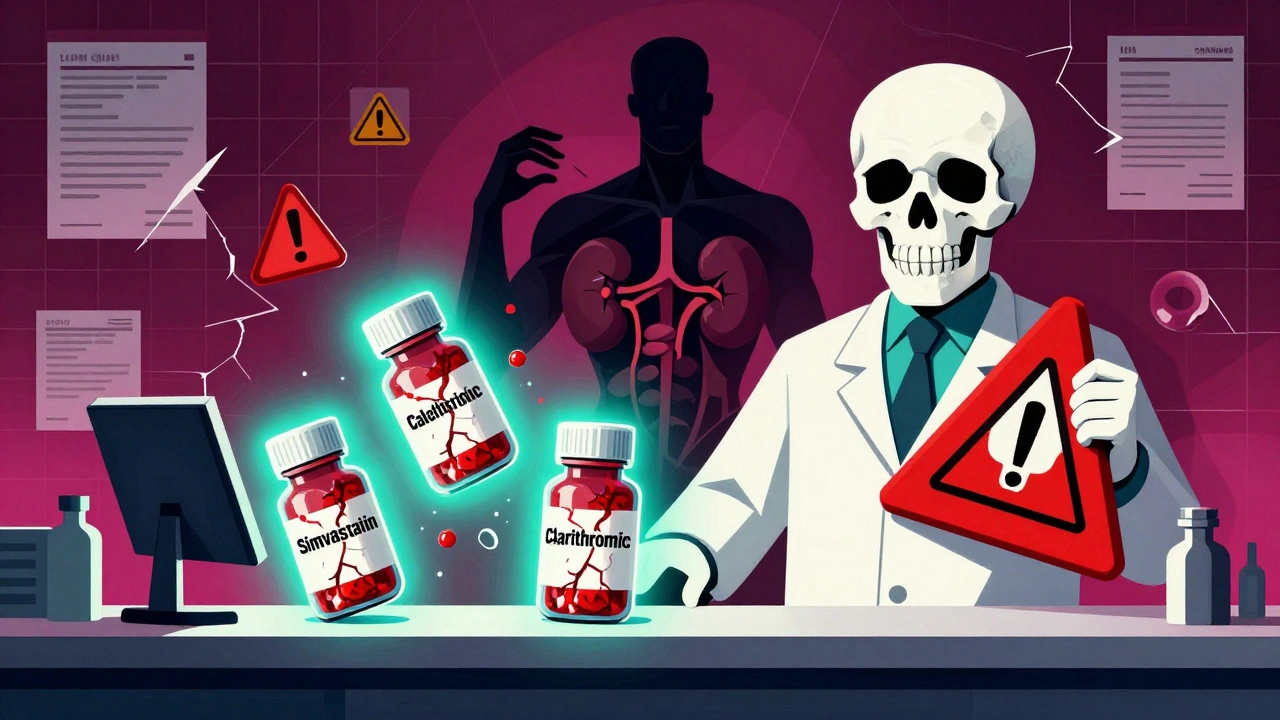
Not all drug interactions are the same. Some cause mild stomach upset. Others? They’re silent killers. The most dangerous ones happen when one drug blocks or boosts how your body processes another. This isn’t guesswork. It’s chemistry - and it’s predictable.Take simvastatin (a cholesterol drug) and clarithromycin (an antibiotic). Alone, they’re safe. Together? They trigger rhabdomyolysis - a condition where muscle tissue breaks down so fast your kidneys can’t handle the waste. Creatine kinase levels can spike to 10,000 U/L. Normal is under 200. This isn’t rare. Studies show it happens in over 1 in 100 patients when these two are mixed. And it’s not just muscle pain. It leads to kidney failure. Death.
Then there’s colchicine (for gout) paired with verapamil (a blood pressure pill). Colchicine is already toxic at high doses. Verapamil blocks the body’s way of flushing it out. The result? Toxic buildup. Nausea, vomiting, organ failure. One study found patients on this combo were 12 times more likely to end up in the ICU.
And don’t forget tizanidine (a muscle relaxer) with ciprofloxacin (an antibiotic). The antibiotic shuts down the enzyme that breaks down tizanidine. Blood levels of the muscle relaxer can jump 300%. That means sudden, dangerous drops in blood pressure - and loss of consciousness. People have passed out while driving. Others have fallen and broken bones. All because two common prescriptions were given without checking the interaction.
The Pharmacist’s Dilemma: Alert Fatigue
You’d think pharmacies have systems to catch this. They do. But here’s the problem: they’re flooded with warnings.Back in 2016, a Chicago Tribune investigation tested 255 pharmacies. They walked in with prescriptions for five known deadly combinations. Only 48% of pharmacists caught them. Half missed life-threatening risks. Why?
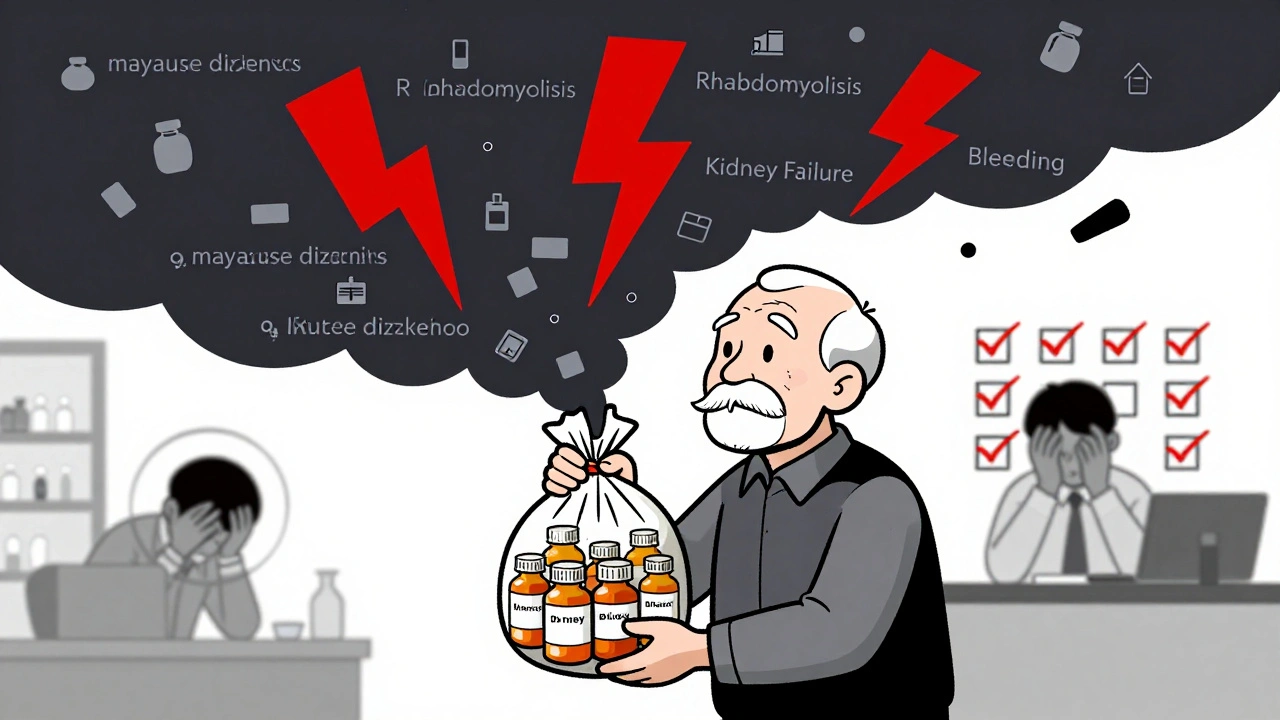
Because computer systems spit out 10, 20, even 50 alerts per prescription. Most are for minor stuff - like “this pill might cause mild dizziness.” Pharmacists get trained to ignore noise. Over time, they stop listening. It’s called alert fatigue. And it’s killing people.
One pharmacist at a CVS in Evanston dispensed clarithromycin and simvastatin together - no warning. No question. Just filled the script. The system flagged it. But the pharmacist clicked past it. Why? Because the system had flagged 17 other things that day. Most were irrelevant. So they tuned out.
The Real Victims: Older Adults and Polypharmacy
The people most at risk? Those over 65. On average, they take 4.5 prescription drugs daily. Some take 10 or more. That’s not just risky - it’s a statistical minefield.The FDA says older adults suffer adverse drug events at seven times the rate of younger people. Why? Their livers and kidneys don’t clear drugs as fast. Their bodies react differently. And they’re often seeing multiple doctors - each prescribing something new, without knowing what the others ordered.
One real case: a 72-year-old woman on warfarin (a blood thinner) was prescribed amiodarone (for heart rhythm). The pharmacist didn’t catch it. Amiodarone slows how warfarin breaks down. Her INR - a measure of blood clotting - shot up overnight. She bled internally after a minor fall. She didn’t survive.
That interaction? It’s textbook. The American Academy of Family Physicians says when amiodarone is added to warfarin, you must cut the warfarin dose by 30-50% and check INR weekly for weeks. Yet, in that case? No one did.
Other High-Risk Combinations You Should Know
Here are five more combinations that should trigger alarms - not just from your pharmacist, but from you too:- Clarithromycin + Ergotamine (for migraines): Causes ergotism - blood vessels clamp shut. Fingers and toes turn black. Limbs can be lost. Death follows if not caught.
- Norgestimate/ethinyl estradiol (birth control) + griseofulvin (antifungal): The antifungal speeds up how your body breaks down estrogen. Contraceptive failure rates jump to over 30%. Pregnancies happen. Birth defects follow.
- Digoxin + Verapamil: Verapamil reduces how fast digoxin leaves your body. Levels rise 60-75%. Result? Severe bradycardia - heart rate drops below 40. Can cause cardiac arrest.
- Opioids + Benzodiazepines: The FDA issued a warning in 2016 after seeing a 500% spike in co-prescriptions. Together, they slow breathing to a stop. Thousands have died this way.
- Warfarin + Fluvastatin, Lovastatin, Rosuvastatin, Simvastatin: These statins block warfarin’s breakdown. Risk of bleeding skyrockets. Atorvastatin and pravastatin? Much safer alternatives.
What You Can Do - Before You Pick Up Your Script
You don’t have to wait for your pharmacist to catch it. You can protect yourself.Here’s what to do:
- Keep a full list of every medication you take - including supplements, OTC painkillers, and herbal products. Update it every time something changes.
- Ask your pharmacist every time you get a new prescription: “Could this interact with anything else I’m taking?” Don’t say “Is it safe?” Say “Could it interact?” That’s more specific.
- Use one pharmacy for all your prescriptions. Chain pharmacies may have better tech, but independent ones often know your history better. Either way, keep it all in one place.
- Check your pills. If you’re on warfarin and your doctor adds a new statin, ask which one. Avoid simvastatin, lovastatin, rosuvastatin. Ask for atorvastatin or pravastatin instead.
- Speak up if something feels off. Unexplained muscle pain, dizziness, irregular heartbeat, sudden bruising - these aren’t normal. Call your pharmacist or doctor immediately.
Why This Isn’t Getting Fixed
Pharmacies like CVS and Walgreens promised changes after the 2016 report. They added mandatory checks for high-risk combos. Staff got training. But the core problem remains: the systems haven’t changed enough.Most software still throws every possible interaction at the pharmacist - even ones with zero clinical impact. A 2022 report found 30% of community pharmacies still don’t use systems that filter alerts by severity. That means a pharmacist might get 50 warnings. Only two matter. The rest? Noise.
Some places are fixing it. Professor John Horn’s team worked with 12 health systems to build smarter alert systems. They cut irrelevant warnings by 78%. And guess what? They caught 89% of dangerous interactions - up from 48%. The solution isn’t more alerts. It’s smarter ones.
But that takes time, money, and willpower. And in a system where pharmacists process a prescription in 2.3 minutes on average? There’s no room for deep thinking. Just clicking.
What’s Next? AI and Better Systems
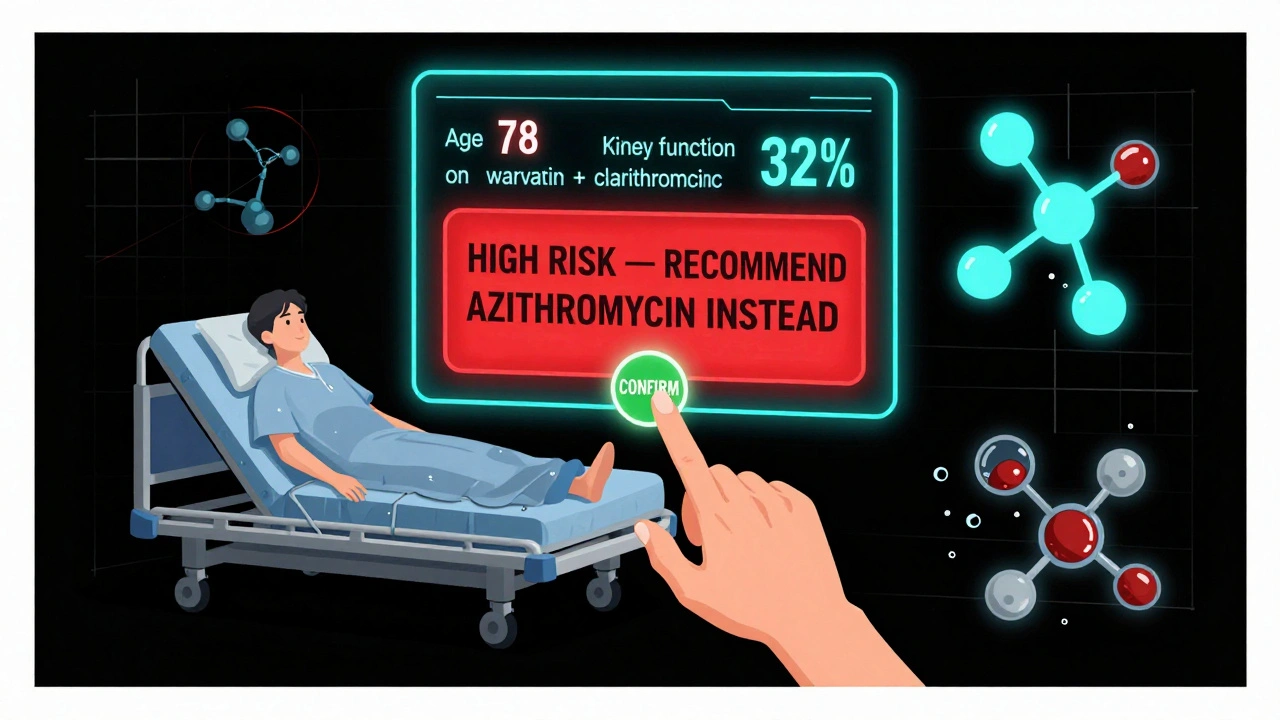
The FDA’s 2023-2025 Digital Health Plan includes funding for AI tools that don’t just check drug names - they look at your age, kidney function, liver health, and other meds. That’s the future.Imagine a system that says: “Patient is 78, has kidney disease, on warfarin, now adding clarithromycin. High risk of bleeding and kidney failure. Recommend alternative antibiotic.” That’s not science fiction. It’s possible. And it’s needed.
The CDC estimates mandatory pharmacist counseling on high-risk drugs could prevent 150,000 adverse events a year. That’s 150,000 people who wouldn’t end up in the ER. Or worse.
But until then - you’re your own best defense.
Frequently Asked Questions
Can over-the-counter drugs cause dangerous interactions too?
Absolutely. Common OTC painkillers like ibuprofen or naproxen can increase bleeding risk when taken with warfarin. Even St. John’s Wort - a popular herbal supplement - can make birth control fail or reduce the effect of antidepressants. Always tell your pharmacist about everything you take, even if it’s not prescription.
Why don’t doctors catch these interactions before prescribing?
Many doctors rely on electronic prescribing systems that flag interactions, but they’re often the same flawed systems pharmacists use. Plus, doctors see dozens of patients a day. They may miss a new drug on your list. That’s why pharmacists are the last line of defense - and why you need to speak up.
Are generic drugs safer or riskier than brand names when it comes to interactions?
The active ingredient is the same, so the interaction risk is identical. Simvastatin is simvastatin - whether it’s Zocor or a generic. The brand doesn’t change how it affects your liver enzymes or kidney clearance. Always check the generic name, not the brand.
How long after starting a new drug should I watch for side effects?
Some reactions happen fast - within hours or days. Others build up over weeks. For high-risk combos like warfarin and amiodarone, the danger peaks around 2-4 weeks. That’s why weekly blood tests are needed. If you feel worse after starting a new med, don’t wait. Call your pharmacist.
What if my pharmacist says there’s no interaction - should I trust them?
Trust, but verify. Ask them to check the specific drugs you’re taking - not just the names, but the doses and how long you’ve been on them. If they seem unsure, ask them to consult a drug database or call a clinical pharmacist. You have the right to ask for a second check.
Comments
Anthony Breakspear December 2, 2025 at 22:57
Man, I had no idea some of these combos could be literal death traps. My grandma was on simvastatin and got prescribed clarithromycin for a sinus thing - thank god her pharmacist caught it. I swear, if she’d have filled it at the big chain, she’d be gone. These systems are broken, and people are paying with their lives. Why are we still letting pharmacists drown in noise when we could just build smarter alerts? It’s not rocket science.
Allan maniero December 3, 2025 at 18:43
I’ve been a pharmacist for 22 years, and this post hits home harder than most. We get 40 alerts a shift - 38 of them are ‘this might cause mild drowsiness’ or ‘take with food.’ By the time the real red flags show up, your brain just shuts off. I once had to explain to a 70-year-old why his new antibiotic could kill him, and he looked at me like I was lying. He’d been on the statin for 5 years. No one ever told him. It’s not the meds - it’s the system. We’re not lazy. We’re exhausted.
Carolyn Woodard December 3, 2025 at 21:34
It’s fascinating how pharmacokinetics operates on such a precise biochemical level - CYP3A4 inhibition, P-glycoprotein efflux, hepatic first-pass metabolism - and yet our clinical infrastructure remains fundamentally reactive rather than predictive. The current alert paradigm is an epistemological failure: it treats pharmacovigilance as a binary flag system rather than a probabilistic risk model calibrated to individual phenotypes. We need AI-driven, patient-specific risk stratification, not just drug-drug lookup tables.
Girish Padia December 4, 2025 at 00:42
people are stupid for not asking. why do you think the system is broken? because you don't care enough to read the label or ask your doctor. it's not the pharmacist's job to babysit your meds.
Chelsea Moore December 4, 2025 at 18:26
THIS IS WHY I STOPPED TRUSTING PHARMACIES!!! THEY’RE ALL IN BED WITH BIG PHARMA!!! THEY WANT YOU TO DIE SO THEY CAN SELL YOU MORE DRUGS!!! I SAW A MAN FALL OVER AT CVS LAST YEAR - HE WAS ON SIMVASTATIN AND CLARITHROMYCIN - AND NO ONE SAID A WORD!!!
John Biesecker December 6, 2025 at 03:49
Bro this is wild 😳 I just got prescribed tizanidine last week and I’m on cipro for a UTI… should I panic? 🤔 I’m gonna call my pharmacist right now. Thanks for the heads up - you just might’ve saved my life. 🙏
Genesis Rubi December 7, 2025 at 06:30
Yeah well in America we don’t need smart systems. We need people to stop being lazy. In Germany, they check your meds like a military operation. Here? You get a bag of pills and a smile. We’re soft. And soft people die. Fix yourself, not the system.
Doug Hawk December 7, 2025 at 19:29
Interesting that the FDA's 2023 digital health plan mentions AI but doesn't mandate interoperability with EHRs or require pharmacogenomic data integration. Without CDS hooks into genomic profiles and renal/liver function metrics, any AI tool is just a glorified lookup table. We're optimizing the wrong layer of the stack.
Zoe Bray December 9, 2025 at 15:55
It is imperative to underscore that the current pharmacovigilance architecture is predicated upon a fundamentally flawed assumption: that human cognitive capacity can sustainably process high-volume, low-signal alert streams without significant degradation in decision-making fidelity. The phenomenon of alert fatigue is not merely a behavioral quirk - it is a systemic cognitive overload failure. Consequently, the imperative lies not in increasing the number of alerts, but in implementing context-aware, risk-stratified, and patient-specific clinical decision support mechanisms grounded in evidence-based pharmacokinetic modeling.
John Morrow December 10, 2025 at 19:20
Let’s be honest - the real issue isn’t the software. It’s the fact that 87% of prescribers don’t bother reviewing a patient’s full med list before writing a script. They’re incentivized to move patients through. The pharmacist is the scapegoat for a broken care continuum. And don’t get me started on how insurers refuse to pay for medication therapy management services. We’re treating symptoms, not systems.
Kristen Yates December 11, 2025 at 23:08
I’m from a small town in Alabama. We don’t have fancy tech. But our pharmacist knows everyone’s name, their kids, what they eat, and what they’re on. When my mom got a new script, he sat down with her and her list. No computer. Just a notebook and a calm voice. Maybe the answer isn’t AI - it’s just someone who cares enough to listen.
Sandi Allen December 12, 2025 at 00:33
MARK MY WORDS - THIS IS ALL A BIG PHARMA COVER-UP!!! THEY KNOW THESE DRUGS KILL - BUT THEY MAKE MORE MONEY WHEN YOU NEED HOSPITALS, TRANSPLANTS, AND LIFELONG DIALYSIS!!! THE FDA IS IN THEIR POCKET!!! I SAW A DOCUMENT LEAKED IN 2018 - THEY TOLD PHARMACIES TO IGNORE 80% OF ALERTS TO SAVE MONEY!!!