When Cancer Is Localized, What’s the Best Way to Treat It?
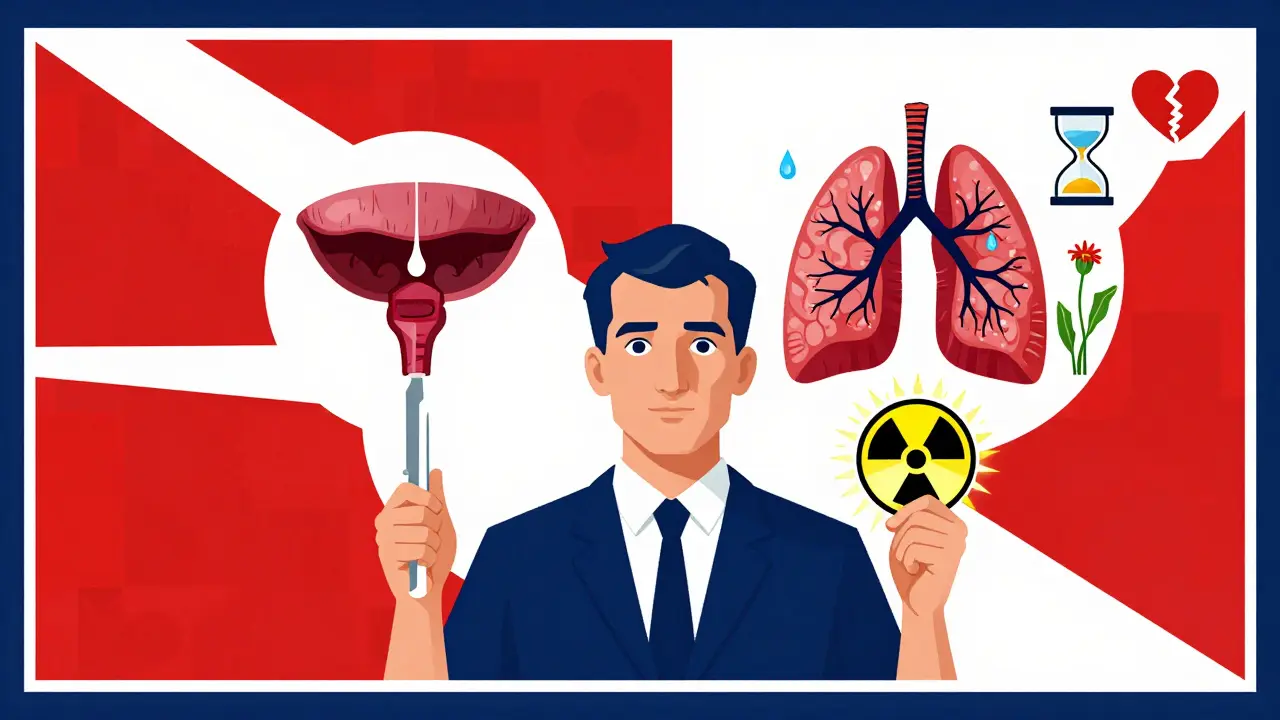
If you’ve been told you have localized cancer-meaning it hasn’t spread beyond its original site-you’re likely facing one of the most important decisions of your health journey: radiation or surgery? Both are proven ways to control cancer in its early stages, but they’re not the same. One removes the tumor. The other destroys it from the inside. Neither is universally better. The right choice depends on your cancer type, your body, your life, and what matters most to you.
For prostate cancer, which affects about 1 in 8 men in the U.S., and for early-stage lung cancer, which is the leading cause of cancer death nationwide, radiation and surgery are both standard options. But the outcomes, side effects, and daily realities of each are wildly different. You don’t just pick one because it’s popular. You pick one because it fits you.
Surgery: Remove It, Know It, Move On
Surgery means cutting out the cancer. For prostate cancer, that’s a radical prostatectomy-removing the entire prostate gland. For lung cancer, it’s removing part or all of a lung lobe. The goal is simple: take the tumor out and send it to the lab so doctors can see exactly what they’re dealing with. That’s called pathological staging, and it gives you certainty.
For prostate surgery, you’re usually in the hospital for 1 to 3 days. Recovery takes about 4 to 6 weeks before you feel back to normal. Robotic-assisted surgery is now common, meaning smaller cuts, less blood loss, and faster healing. But it’s still major surgery. You’ll likely deal with urinary leakage for months, and erectile dysfunction is common, especially in the first year. A 2020 NIH study found that 14% of men with low-risk prostate cancer still had urinary leakage 10 years after surgery. For high-risk cases, that number jumps to 25%.
In lung cancer, surgery is even more intense. A lobectomy-removing a lobe of the lung-can mean a hospital stay of 3 to 7 days. Recovery takes 6 to 8 weeks. Some people need oxygen support for weeks after. But if you’re healthy enough for surgery, the survival numbers are strong. A 2022 analysis of over 30,000 lung cancer patients found that those who had surgery had a 71.4% five-year survival rate. That’s nearly 16 percentage points higher than those who got radiation instead.
But here’s the catch: not everyone can have surgery. If you have heart disease, COPD, or other serious health issues, the risks may outweigh the benefits. That’s where radiation becomes the real alternative.
Radiation: No Knife, No Hospital, But a Long Road
Radiation therapy doesn’t cut. It kills cancer cells with high-energy beams. Modern machines can target tumors with 1- to 2-millimeter precision. You don’t feel anything during treatment. No pain. No scars. No overnight stays.
But it’s not quick. For prostate cancer, traditional radiation means coming in every weekday for 7 to 9 weeks. That’s 35 to 45 visits. Each session takes 15 to 30 minutes. If you live far from a treatment center, that’s a huge time and travel burden. Some patients skip appointments because of it. Others burn out.
There’s a newer option: stereotactic body radiation therapy (SBRT). For early-stage lung cancer and some prostate cases, SBRT delivers the full dose in just 1 to 5 sessions. No daily trips. No months of treatment. One study showed SBRT patients had a 55.9% five-year survival rate for lung cancer-lower than surgery, but still strong, especially for those who can’t have an operation.
Side effects are different. Instead of urinary leakage, you might get bowel problems. The same NIH study found that 4% of radiation patients had serious bowel issues after 10 years, compared to just 3% of surgical patients. But for high-risk prostate cancer patients getting radiation plus hormone therapy, that number jumped to 7%. And while erectile dysfunction is less common with radiation than surgery, it still happens-often slowly over time.
One thing radiation doesn’t give you: a removed tumor to examine. You never know for sure if every cancer cell is gone. You rely on PSA tests, scans, and time to tell you if it worked.
Prostate Cancer: The Numbers Don’t Tell the Whole Story
The big 2016 ProtecT trial followed 1,643 men with localized prostate cancer for 10 years. It found no big difference in survival between surgery, radiation, or just watching. Survival rates were all above 95%. That sounds like they’re all equal.
But look closer. Disease progression was higher in the radiation group (13.4%) than in the surgery group (12.9%). And both were far better than active monitoring (24.7%). That’s important. If you want to avoid the cancer coming back, surgery and radiation both beat doing nothing.
Then there’s the 2010 UCSF study of 91,000 men. It found that for high-risk prostate cancer, surgery gave a 15-year survival rate of 62%. Radiation? Just 52%. Why the difference? The ProtecT trial mostly included low-risk patients. UCSF’s study had more high-risk cases. That’s the key. Your risk level changes everything.
Low-risk? You might do fine with either. High-risk? Surgery often wins. And if you’re young and active, you might prefer surgery because it gives you a clean break. If you’re older or value avoiding a hospital stay, radiation makes sense.
Lung Cancer: Surgery Still Leads-But Radiation Saves Lives Too
For early-stage non-small cell lung cancer, surgery is still the gold standard-if you’re healthy enough. The 71.4% five-year survival rate from the 2022 study is hard to beat. Radiation can’t match that. But here’s the reality: only about half of lung cancer patients are even eligible for surgery. Many have other health problems. Some are too frail. Others refuse the risks.
That’s where SBRT shines. For patients who can’t have surgery, SBRT gives a 40-50% five-year survival rate. That’s not as good as surgery, but it’s better than chemotherapy alone. And for someone who thought they had no options, it’s life-changing.
Doctors at the American Association for Thoracic Surgery say: if you’re operable, get surgery. If you’re not, SBRT is your best shot. No gray area. That’s why guidelines from the National Comprehensive Cancer Network (NCCN) are so clear: surgery for operable patients. SBRT for everyone else.
Side Effects: What You’ll Actually Live With
Survival numbers matter. But so do the daily realities.
After surgery, you might need to wear pads for months. You might not be able to have sex for a year. You’ll need physical therapy to get your strength back. You’ll feel like you’ve been through a war.
After radiation, you might have to go to the bathroom more often. You might get diarrhea. You might feel tired every day for weeks. Your skin might burn. You’ll miss work. You’ll cancel plans. You’ll wonder if it’s worth it.
Neither is easy. But they’re different kinds of hard. Surgery is intense for a few weeks. Radiation is draining for months. One leaves a scar. The other leaves fatigue.
And here’s something no one talks about enough: your mental health. Surgery feels final. You did something. You took action. Radiation feels like waiting. You’re getting treated, but you’re not cured. Not yet. That uncertainty can wear on you.
What Experts Say: It’s Not One Size Fits All
Dr. Matthew Cooperberg, who led the UCSF prostate cancer study, said it plainly: “There’s relatively little high-quality evidence on which to base current treatments.” Translation: we’re still learning.
Dr. Christopher King, a radiation oncologist at Cedars-Sinai, says: “Talk with a surgeon and a radiation oncologist before you make your decision.” That’s not just advice-it’s the standard. The American Society of Clinical Oncology says every patient with localized prostate cancer should see both types of specialists before choosing.
Why? Because your doctor might be biased. Surgeons see the benefits of cutting. Radiation oncologists see the benefits of beams. Neither sees the full picture unless they talk to each other. And you need both voices.
Practical Life Factors: Time, Money, and Your Routine
Let’s be real. Treatment isn’t just medical. It’s logistical.
Surgery: one event. You recover at home. You’re done in a month. But you need someone to drive you, help you cook, change your bandages. You can’t work for weeks.
Radiation: 35 visits. That’s 35 days of driving, parking, waiting, sitting in a waiting room. If you live in a rural area, that’s a 2-hour drive each way. Can you take that much time off? Can you afford gas and childcare? Can you handle the mental toll of repeating the same routine for two months?
SBRT cuts that down to 1-5 days. But it’s not available everywhere. Not every hospital has the machine. Not every insurance covers it for prostate cancer yet.
What’s Next? Focal Therapy, Proton Beams, and Personalized Treatment
The future is getting smarter. Focal therapy for prostate cancer targets only the tumor, not the whole gland. It’s still experimental, but early results show less incontinence and better sexual outcomes. The PARTICLE trial, expected to finish in 2025, is comparing it to standard treatments.
Proton beam therapy is another option. It delivers radiation with even less damage to surrounding tissue. But it’s expensive. And not proven to be better than modern photon radiation for most cases.
Right now, the best tool isn’t a new machine. It’s a conversation. A detailed one. With your surgeon. With your radiation oncologist. With your family. With yourself.
Final Thought: There’s No Perfect Choice. Only the Right One for You.
You’re not choosing between good and bad. You’re choosing between two different kinds of trade-offs. One gives you certainty, but with physical changes. The other gives you less disruption, but more uncertainty.
Don’t pick based on fear. Don’t pick because your friend had one and did fine. Don’t pick because your doctor pushed it.
Pick because you’ve heard both sides. Because you’ve looked at your life-your job, your family, your energy, your fears. Because you know what matters more: keeping your bladder intact, or knowing the cancer is gone for good.
There’s no rush. Take the time. Get the second opinion. Ask for the data. Look at the side effect charts. Talk to people who’ve been there.
Because when it comes to your body, the right choice isn’t the one with the best survival rate. It’s the one you can live with.
Is radiation or surgery better for prostate cancer?
Neither is universally better. For low-risk prostate cancer, both radiation and surgery offer nearly identical survival rates. Surgery has a slightly lower chance of cancer returning, but causes more urinary leakage and erectile dysfunction. Radiation causes more bowel issues over time but avoids surgery-related recovery. The best choice depends on your age, risk level, and personal priorities.
Can I choose radiation if I’m healthy enough for surgery?
Yes. Many patients choose radiation even when surgery is an option. It’s often preferred by older patients, those who want to avoid hospital stays, or those worried about sexual or urinary side effects. The American Society of Clinical Oncology recommends seeing both a surgeon and a radiation oncologist before deciding-no matter your health status.
Why is surgery better for lung cancer than radiation?
For medically operable patients with early-stage lung cancer, surgery removes the tumor entirely and gives the best long-term survival-71.4% at five years. Radiation (SBRT) is still effective but has a lower survival rate at 55.9%. Surgery also allows doctors to examine the removed tissue, giving clearer information about cancer spread. Radiation is the go-to option for patients who can’t have surgery due to health problems.
How long does radiation treatment take compared to surgery recovery?
Traditional radiation for prostate cancer takes 7-9 weeks of daily treatments. SBRT for lung or prostate cancer can be done in 1-5 sessions over 1-2 weeks. Surgery involves one procedure, but recovery takes 4-8 weeks depending on the type. Radiation spreads out the burden; surgery concentrates it. Both require time off work and support at home.
Are there side effects of radiation that show up years later?
Yes. Radiation can cause long-term bowel problems, including chronic diarrhea or rectal bleeding. For prostate cancer, it can lead to gradual erectile dysfunction that worsens over 5-10 years. These side effects often appear slowly and may not be obvious right after treatment. Regular follow-ups are key to managing them.
What if I’m not sure which treatment to pick?
Ask for a multidisciplinary tumor board review. Most major cancer centers have teams of surgeons, radiation oncologists, medical oncologists, and nurses who review your case together. They’ll give you a balanced recommendation based on your cancer type, stage, age, and personal goals. Don’t make the decision alone-get the full team involved.
Comments
Lydia H. January 20, 2026 at 10:30
I appreciate how this post laid out the trade-offs without pushing one option. It’s not about which is 'better'-it’s about which version of hard you’re willing to live with. I’ve seen friends choose both, and the ones who took time to reflect, not rush, ended up happier.
Jacob Hill January 21, 2026 at 20:11
I’m a prostate cancer survivor-radiation, 8 years ago. I didn’t want surgery because I work in construction, and I couldn’t afford to be out for two months. The bowel stuff? Yeah, it’s real. But I’ve been PSA-free since year 2. And I can still drive my truck. No pads. No shame. Just life.
Lewis Yeaple January 23, 2026 at 13:17
It is imperative to underscore that the comparative efficacy metrics presented herein are derived from cohort studies with inherent selection biases. The 71.4% five-year survival statistic for surgical intervention in non-small cell lung carcinoma is statistically significant (p < 0.001) when compared to SBRT, yet confounding variables such as comorbidities, tumor heterogeneity, and institutional expertise are frequently underreported in public discourse.
Jackson Doughart January 24, 2026 at 11:46
I’ve sat in too many oncology waiting rooms to say this lightly: the real decision isn’t between radiation and surgery. It’s between who you are now and who you’re willing to become after. One path asks you to heal fast. The other asks you to endure slowly. Neither is easier. Both are brave.
Malikah Rajap January 25, 2026 at 02:30
I just want to say-why do we even frame this as a binary? What about focal therapy? What about proton beams? What about the fact that most people don’t even know what SBRT stands for? We’re talking about people’s lives here, and we’re giving them bullet points like it’s a Netflix choice. Please, someone, make this less scary.
sujit paul January 26, 2026 at 13:27
You know what they don't tell you? That the FDA and Big Pharma are pushing radiation because it's more profitable. Surgery is a one-time fee. Radiation? 45 visits. 45 payments. 45 chances to upsell you on 'supportive care.' I've seen it. The system is rigged. Ask your doctor if they get kickbacks from the machine vendor.
Tracy Howard January 28, 2026 at 08:54
I’m Canadian, and honestly, I’m shocked Americans are even debating this. In Canada, if you’re eligible for surgery, you get it. Period. Radiation is for those who can’t handle the operation-not because they ‘prefer’ it. We don’t romanticize suffering here. We fix things. And if you’re too frail? We palliate. No false hope. Just dignity.
Astha Jain January 28, 2026 at 08:56
I read this whole thing and still dont know what to do. Like, is SBRT even real? Or is it just a fancy name for the same old thing? Also, why is everyone talking about prostate? What about breast? I have that too.
Phil Hillson January 29, 2026 at 22:13
Surgery is just cutting stuff out like a caveman. Radiation is just pretending you’re a microwave. Both are just ways to make doctors feel like they’re doing something while you’re still gonna die in 10 years anyway. Just eat turmeric and pray.
Josh Kenna January 31, 2026 at 17:00
I had radiation for prostate cancer. It was brutal. Not the treatment-the waiting. Every day, I’d drive 45 minutes, sit in that waiting room, stare at the same magazine, wonder if I was gonna be the one who didn’t make it. I cried in the parking lot every time. But I’m alive. And I don’t regret it. Just… please, if you’re going through this, don’t do it alone.
Valerie DeLoach February 1, 2026 at 06:48
This is why we need more patient navigators. Not just doctors. Real people who sit with you, help you understand the numbers, translate the jargon, and remind you that your life outside the clinic matters too. My mom chose radiation because she didn’t want to miss her granddaughter’s recital. That’s not weakness. That’s wisdom.
Christi Steinbeck February 1, 2026 at 19:05
You’ve got this. I know it feels like the whole world is on your shoulders right now. But you’re not just a patient-you’re a person with a story. Choose the path that lets you keep writing it. And if you need someone to scream into the void with? I’m here.
Aman Kumar February 1, 2026 at 22:52
The oncology-industrial complex thrives on ambiguity. The data is manipulated. The trials are funded by device manufacturers. You think they want you cured? No. They want you returning. For maintenance. For boosters. For follow-ups. The real cure? Fasting. Meditation. And rejecting the paradigm entirely.