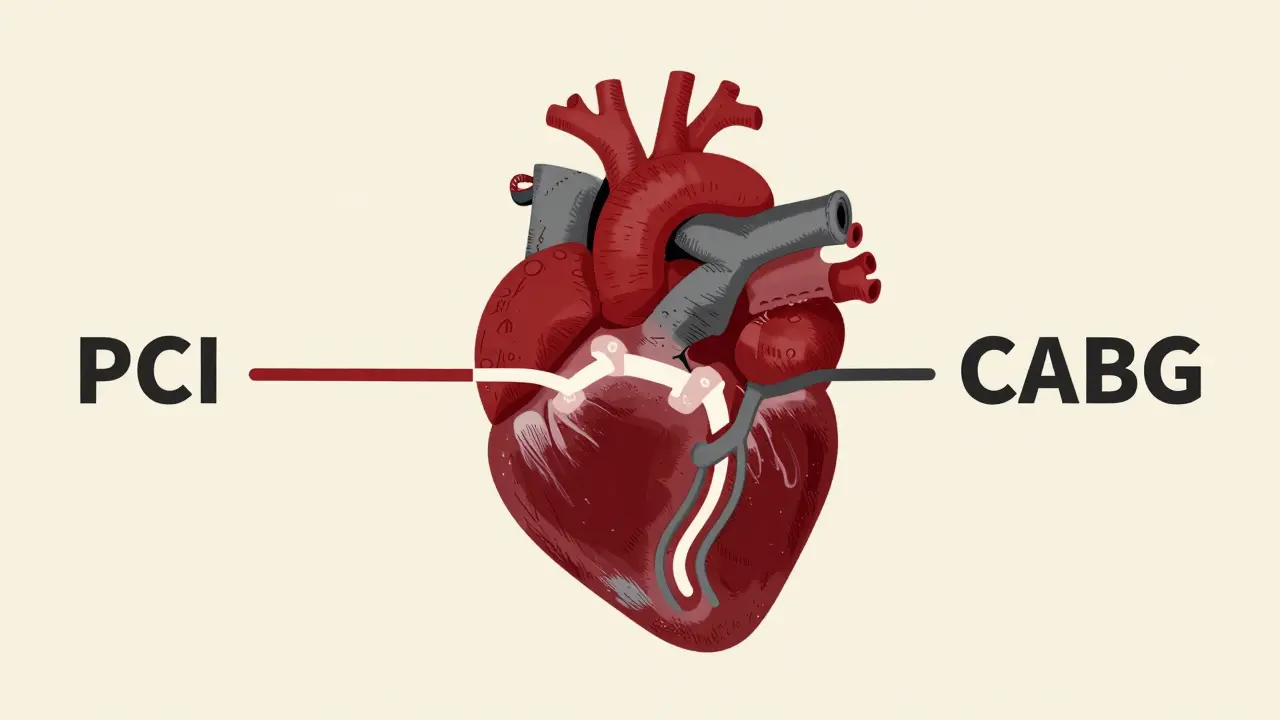
When we talk about fixing blocked arteries, we're talking about PCI vs CABG. These are the two heavy hitters in coronary revascularization. PCI (Percutaneous Coronary Intervention) is the minimally invasive approach, while CABG (Coronary Artery Bypass Grafting) is the surgical gold standard. One clears the road; the other builds a detour.
The Basics: How Do They Actually Work?
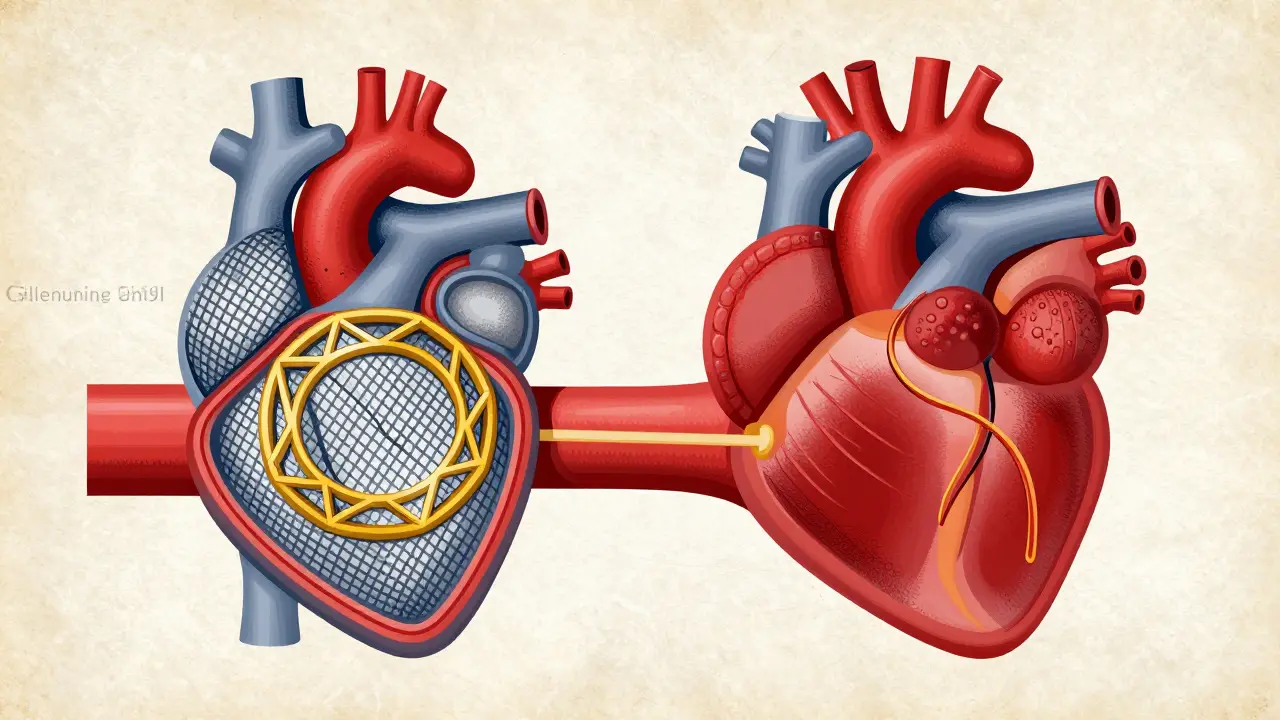
If you've never heard these terms, think of your coronary arteries as the plumbing for your heart. When plaque builds up, the flow slows down, causing chest pain or even a heart attack. PCI is essentially a plumbing job. A cardiologist threads a catheter through an artery in your arm or leg up to the heart. They use a tiny balloon to push the plaque against the artery wall and then place a drug-eluting stent (a small mesh tube) to keep the passage open. Modern stents release medication over time to prevent the artery from narrowing again.
CABG, often called "heart bypass surgery," is more like civil engineering. Instead of clearing the blockage, a surgeon takes a healthy blood vessel from another part of your body-usually the internal mammary artery in the chest or a vein from the leg-and sews it around the blockage. This creates a brand-new path for the blood to reach the heart muscle. While PCI is faster, CABG is often more durable for complex cases.
Comparing the Experience: Recovery and Risks
The most immediate difference you'll feel is in the recovery timeline. PCI is a "quick hit." Most patients are in the lab for a couple of hours and can go home within 24 hours. You're usually back to your normal routine in a few days. On the flip side, CABG is a major undertaking. You'll likely spend 5 to 7 days in the hospital and face a 6 to 8-week recovery period. You can't drive or lift heavy objects for weeks while your sternum heals.
However, there's a trade-off in long-term reliability. PCI patients have a higher chance of needing a "do-over." Data shows that 5-10% of people with modern stents need another procedure within five years. CABG is much more permanent; arterial grafts have a patency rate (meaning they stay open) of 85-90% over a decade. If you choose the bypass, you're trading a tough recovery now for a lower chance of returning to the hospital later.
| Feature | PCI (Stenting) | CABG (Bypass Surgery) |
|---|---|---|
| Invasiveness | Minimally Invasive | Major Surgery |
| Hospital Stay | < 24 Hours (Typical) | 5-7 Days |
| Recovery Time | A few days | 6-8 Weeks |
| Long-term Durability | Lower (higher repeat rate) | Higher (better graft survival) |
| Primary Risk | Restenosis (re-narrowing) | Stroke or Infection |
How Doctors Decide: The SYNTAX Score and the Heart Team
You might wonder, "Why wouldn't everyone just take the easier option (PCI)?" The answer lies in the complexity of the disease. Doctors use a tool called the SYNTAX score to map out the blockages. Think of it as a complexity map. If your score is low (under 22), PCI is usually the way to go. If it's high (over 32), CABG is significantly safer and more effective.
This is why the "Heart Team" approach is so critical. You shouldn't just see a surgeon or just a cardiologist. A multidisciplinary team-including an interventional cardiologist and a cardiac surgeon-discusses your specific anatomy, your age, and your other health issues. For example, if you have diabetes and blockages in multiple vessels, the evidence (like the FREEDOM trial) strongly favors CABG. In these patients, bypass surgery actually saves more lives and prevents more heart attacks over five years compared to stents.
Deep Dive: When is one clearly better than the other?
There are a few "red flags" that push the decision in one direction. If you have a blockage in the left anterior descending (LAD) artery-the "widow-maker"-and you also have diabetes, CABG is almost always the preferred choice. The survival benefit is simply too large to ignore.
Conversely, if you are very elderly, have severe lung disease, or are otherwise too frail to survive a general anesthetic, PCI is the clear winner. It allows us to open the artery without the stress of a full-body operation. It's about balancing the risk of the procedure against the long-term benefit of the result.
The Quality of Life Equation
Beyond the clinical data, there's the human element. In the short term, PCI wins by a landslide. You're back at work and walking the dog almost immediately. But if we look a year down the road, the ROSETTA trial suggests that CABG patients often report better symptom relief. They aren't waking up with the same lingering chest tightness that some stent patients experience when the artery narrows again.
It's a classic case of "short-term pain for long-term gain." A bypass patient might struggle for two months with sternal pain or a bit of "brain fog" after being on a heart-lung machine, but they often find they can return to more active lifestyles-like hiking or traveling-without the anxiety of whether their stent is still holding up.

What's Next? The Future of Heart Repair
We are moving toward a "best of both worlds" scenario. Surgeons and cardiologists are starting to use hybrid approaches. Imagine getting a minimally invasive bypass for your most critical artery (the LAD) and then getting stents for the smaller, less critical blockages. This reduces the surgery time while maintaining the long-term survival benefit of a graft.
We're also seeing the rise of robotic surgery, which aims to make CABG less invasive by using tiny incisions instead of cracking the chest open. While these aren't available everywhere yet, they represent the direction the industry is heading: maximizing the durability of the surgery while minimizing the trauma to the body.
Will I need more stents if I choose PCI?
It is possible. While modern drug-eluting stents are very effective, about 5-10% of patients experience "restenosis," where the artery narrows again, requiring a second procedure. This is significantly more common than the failure of a surgical bypass graft.
Is CABG more dangerous than PCI?
In the immediate short term, yes. Because it is a major surgery involving general anesthesia and often a heart-lung machine, there is a higher risk of complications like infection or stroke. However, for complex disease, CABG actually reduces the long-term risk of death and heart attack compared to PCI.
How long does a bypass graft actually last?
It depends on the source. Arterial grafts (like the internal mammary artery) are incredibly durable, with 85-90% remaining open after 10 years. Vein grafts (taken from the leg) are less durable, with about 60-70% remaining open over the same period.
What is a Heart Team?
A Heart Team is a group of specialists-usually an interventional cardiologist and a cardiac surgeon-who review your imaging and health history together. This ensures the decision is based on a balanced view of both stenting and surgery, rather than the bias of a single specialist.
Can I switch from PCI to CABG later?
Yes. If a stent fails or if new blockages develop, surgery can still be an option. However, having previous stents can sometimes make the subsequent surgery slightly more complex, which is why getting the right choice the first time is so important.
Next Steps for Patients
If you're trying to decide, start by asking your doctor for your SYNTAX score. It's a concrete number that helps remove the guesswork. If you have diabetes, ask specifically about the survival benefits of CABG versus PCI for your specific artery layout.
For those who are high-risk surgical candidates, ask about "off-pump" CABG, which doesn't use a heart-lung machine and can be safer for some. No matter the path, remember that the goal is the same: getting your heart the blood it needs to keep you active and healthy for years to come.