Medication Benefit vs. Risk Calculator
How This Tool Works
This calculator helps you understand the potential benefits versus risks of taking a medication based on your individual factors. It uses evidence-based data from medical studies to estimate your personalized risk score.
Remember: This tool is designed to complement your conversation with your doctor, not replace it. Always discuss these results with your healthcare provider.
Your Personalized Results
Benefits
Risks
Your results will appear here.
When a doctor says you need a new medication, do you really understand why? Or are you just nodding along because you trust them? For millions of people, the answer is the latter - and that’s where patient decision aids come in. These aren’t fancy apps or flashy gadgets. They’re simple, evidence-based tools designed to help you make smarter, more informed choices about your medications. And the data shows they’re working - reducing confusion, preventing unnecessary prescriptions, and cutting down on dangerous mistakes.
What Exactly Are Patient Decision Aids?
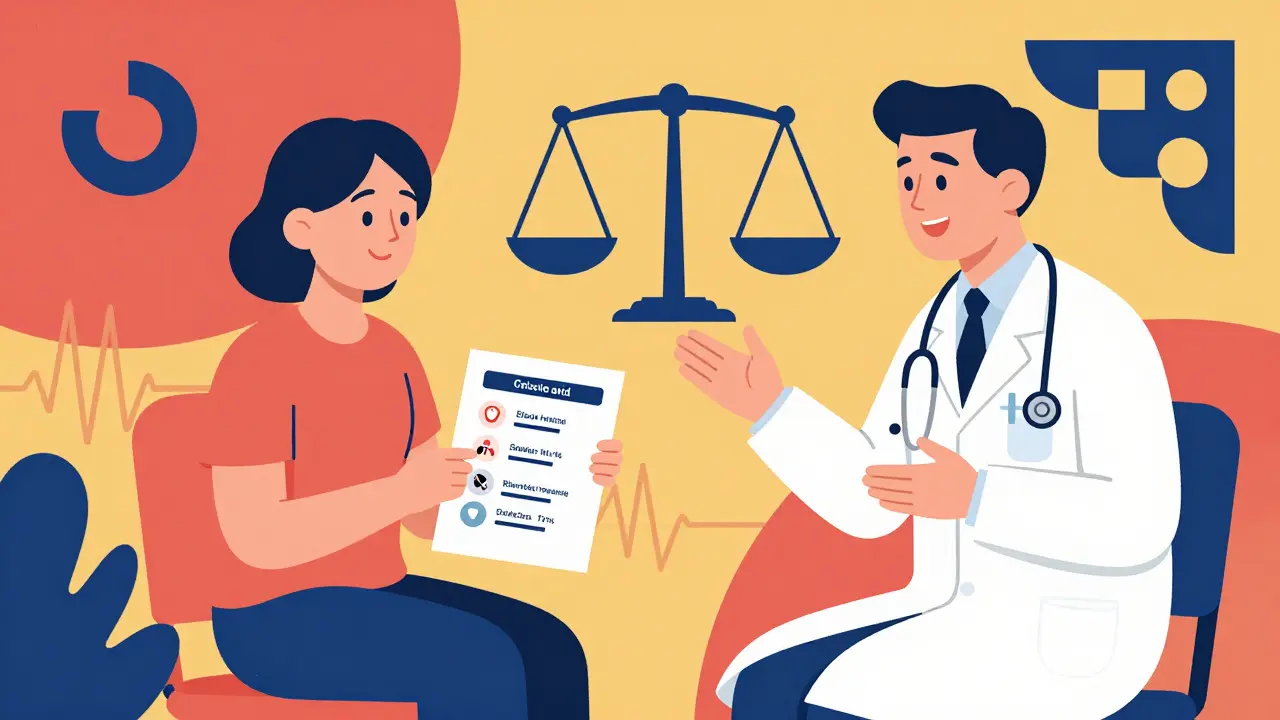
Patient decision aids (PDAs) are structured tools - paper, websites, or apps - that give you clear, balanced info about your medication options. They don’t push you toward one choice. Instead, they lay out the facts: what each option does, how likely it is to help, what side effects you might face, and even what happens if you do nothing. Think of them as a cheat sheet for your next doctor visit.
They’re built using standards set by the International Patient Decision Aids Standards (IPDAS) Collaboration. That means every good PDA includes:
- Clear description of all treatment choices
- Realistic numbers on benefits and risks (not vague terms like “high risk”)
- Exercises to help you figure out what matters most to you - cost, side effects, convenience
- Plain language, no medical jargon
Over 150 validated decision aids are available today, mostly focused on chronic conditions like diabetes, high blood pressure, and heart disease - places where medication choices are complex and personal.
How Do They Actually Improve Medication Safety?
Medication errors aren’t just about mixing up pills. They’re about taking something you don’t need, skipping doses because you’re scared of side effects, or refusing a drug that could save your life - all because you didn’t understand the trade-offs.
PDAs fix this by turning passive patients into active participants. Here’s what the evidence says:
- Knowledge jumps by 13.28 points on average compared to just getting verbal advice (based on 52 studies).
- Decisional conflict drops by 8.7 points - meaning people feel less anxious and unsure about their choice.
- Adherence improves by 17.3% at six months for diabetes meds when decision aids are used.
- 35% of patients change their mind about starting statins after using the ‘Statin Choice’ aid - often choosing to avoid medication they didn’t really need.
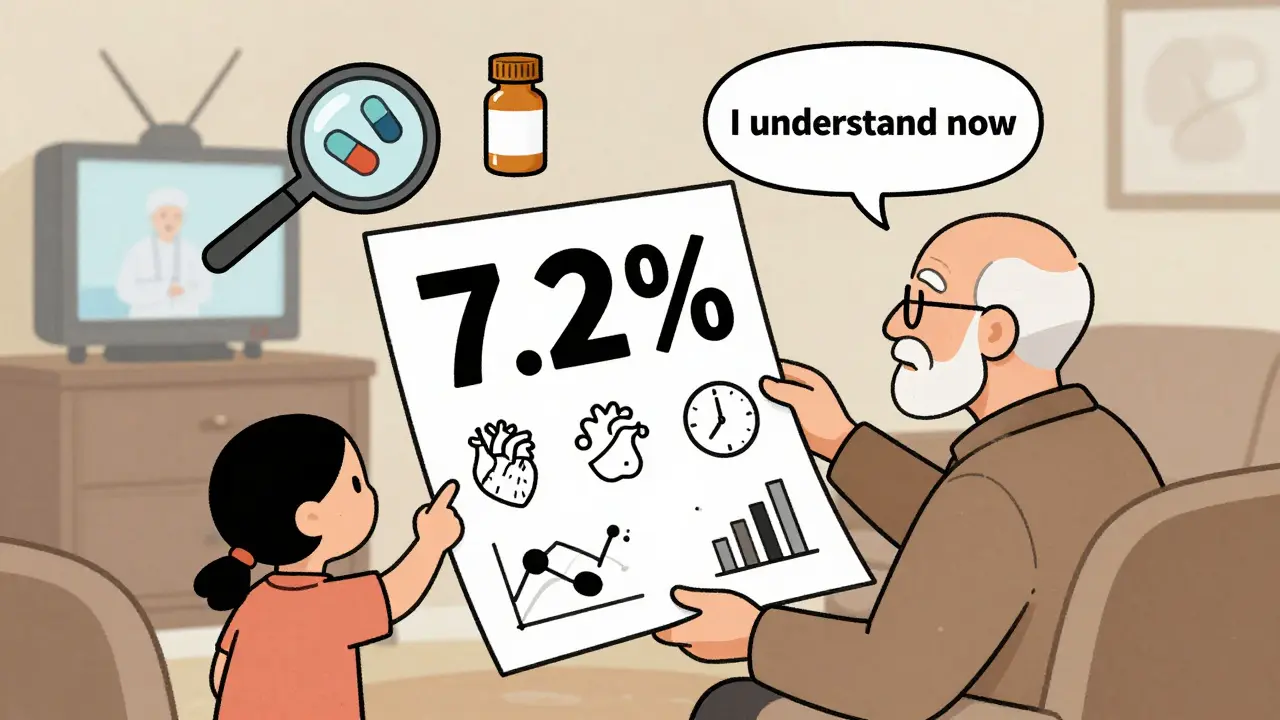
One patient on Reddit put it simply: “The statin decision aid showed my real 10-year heart attack risk was 7.2%, not the ‘high risk’ my doctor mentioned. That stopped me from starting a drug I didn’t need.”
That’s medication safety in action. Not because someone made a mistake - but because the patient finally understood the numbers behind the recommendation.
Real-World Impact: From Clinics to Daily Life
The Mayo Clinic saw a direct link between using PDAs and better outcomes. After adding decision aids into their diabetes care pathway, medication adherence jumped from 58% to 75% in just six months. That’s not a small win - it’s the difference between managing a condition and ending up in the hospital.
Dr. Sarah Chen, a primary care doctor in Michigan, shared how her clinic used the Diabetes Medication Choice aid: “We cut insulin hesitation from 42% to 18% in six months. But it took time. Each session added 8 minutes.”
That’s the trade-off. PDAs work - but they require time. In a 15-minute appointment, fitting one in isn’t easy. That’s why successful clinics now hand out aids before the visit - via patient portals, email, or mailed packets. The conversation then shifts from “What should I do?” to “Which option fits your life?”
Who Benefits Most? And Who Doesn’t?
PDAs aren’t magic. They work best when:
- The decision is preference-sensitive - meaning there’s no single “right” answer (like statins, insulin, or blood thinners).
- The patient has time to process the info.
- The clinician is trained to use the tool, not just hand it out.
But here’s the catch: people with low health literacy, limited English, or cognitive challenges often don’t benefit as much - unless the tool is adapted. A flashy app with animations won’t help someone who can’t read. That’s why the best PDAs include audio, visuals, and simple language. Some even use the “teach-back” method: “Can you explain this back to me in your own words?”
Dr. Richard Hoffman, a VA researcher, puts it bluntly: “The benefits aren’t uniform. If you don’t tailor the tool to the person, you’re just adding noise.”
How Are They Used Today? (And How to Get One)
Most PDAs are free and publicly available. The Ottawa Hospital Research Institute hosts a library with 107 tools covering conditions from arthritis to prostate cancer. You can access them at decisionaid.ohri.ca - no login needed.
Here’s how to start using them:
- Ask your doctor if there’s a decision aid for your medication choice.
- Check the Ottawa Library or the Agency for Healthcare Research and Quality (AHRQ) site for validated tools.
- Review it before your appointment - don’t wait until the day of.
- Bring it with you. Circle what matters most to you: side effects? Cost? Long-term health?
- Use it to start the conversation: “I read this. It says my risk is X. What do you think?”
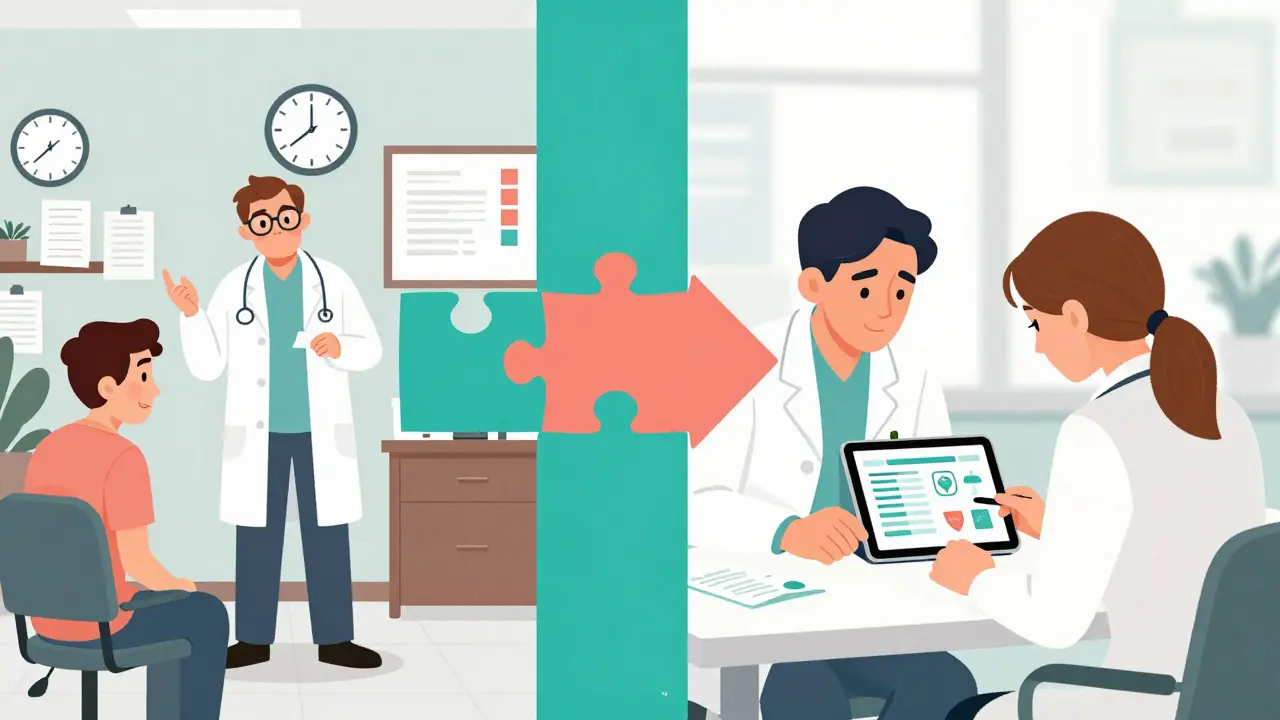
Many health systems now integrate these tools directly into electronic health records (EHRs) via FHIR APIs. That means your doctor can pull up a tailored aid right during your visit - no extra work.
Why Isn’t Everyone Using Them?
Despite the evidence, adoption is still uneven. In 2015, only 12% of U.S. primary care doctors used decision aids. By 2022, that rose to 37%. Progress - but not enough.
Why? Three big reasons:
- Time. Clinicians are stretched thin. Adding 3-8 minutes per visit feels impossible.
- Reimbursement. Medicare and most insurers don’t pay extra for using decision aids. So clinics don’t prioritize them.
- Training. You can’t just hand out a pamphlet. Clinicians need to learn how to guide the conversation - not just present options.
But things are changing. Twenty-nine U.S. states now have laws requiring decision aids for certain procedures. Medicare Advantage plans have included shared decision-making as a quality metric since 2020. And by 2027, experts predict 75% of high-stakes medication decisions will involve a validated aid.
The Bottom Line: More Control, Fewer Mistakes
Patient decision aids don’t replace your doctor. They don’t make you the expert. But they do give you the tools to understand your options - and speak up.
When you know your real risk of a heart attack is 7.2%, not “high,” you can make a choice that fits your life. When you see that a medication reduces your stroke risk by 15% but gives you a 1 in 20 chance of muscle pain, you’re not just obeying orders - you’re deciding.
That’s medication safety. Not because a pharmacist double-checked your prescription. But because you understood it - and chose wisely.
Are patient decision aids only for chronic conditions?
No - while most are used for chronic conditions like diabetes or heart disease, they’re also effective for acute decisions like choosing antibiotics, deciding on blood thinners after surgery, or starting psychiatric meds. Any time there’s more than one reasonable option, a decision aid can help.
Can I use a patient decision aid without my doctor?
You can read one anytime - but they’re designed to be used with your provider. The real value comes from discussing what you learned. Using one alone won’t improve adherence or reduce errors as much as using it in a conversation.
Do patient decision aids work for elderly patients?
Yes - but only if they’re designed for them. Many older adults struggle with digital tools or dense text. The best PDAs for this group use large fonts, audio narration, simple graphics, and minimal steps. Paper versions with a clinician’s help often work better than apps.
Are patient decision aids covered by insurance?
Not directly. You won’t get billed for using one. But Medicare Advantage plans now reward providers who use them as part of quality care. Some private insurers are following suit. The tools themselves are free - no cost to patients.
How do I know if a decision aid is trustworthy?
Look for the IPDAS logo or mention of validation. Trusted sources include the Ottawa Hospital Research Institute, the Agency for Healthcare Research and Quality (AHRQ), and the Cochrane Collaboration. Avoid tools from pharmaceutical companies unless they’re independently reviewed - they may be biased toward their own drugs.
Do patient decision aids reduce hospitalizations?
Evidence is promising but not yet definitive. While they improve adherence, knowledge, and reduce unnecessary prescriptions, large studies haven’t yet shown a clear drop in hospitalizations or deaths. That’s the next frontier - and ongoing research is focused on linking decision quality to hard outcomes.
What’s Next for Patient Decision Aids?
The future is personal. New tools powered by AI are starting to pull data from your EHR - your age, lab results, past reactions - and build a custom decision aid just for you. The NIH’s Personalized Medication Decision Support System (2022-2025) is already testing this in clinics. Imagine opening your patient portal and seeing: “Based on your blood pressure, kidney function, and past side effects, here’s what you should consider.”
The FDA is also stepping in. Since 2022, it has begun recognizing certain decision aids as part of medication labeling for complex drugs. That means manufacturers must support them - not just sell pills.
By 2025, CMS plans to expand PDA requirements to 12 more clinical scenarios. And with reimbursement models shifting toward value-based care, clinics that use decision aids will be rewarded - not penalized for taking extra time.
One thing’s clear: the days of “take this pill” are fading. The future is “here’s your option, here’s what it means, and here’s how to choose.” And patient decision aids are leading the way.
Comments
Pat Mun February 12, 2026 at 17:38
Man, I wish I’d had one of these when I was first put on blood pressure meds. I just took the pill because my doc said so, then spent three weeks wondering why I felt like a zombie. Turns out, the side effects were way worse than my actual risk. This whole PDA thing? It’s not just smart-it’s life-changing. I’ve been pushing my whole family to use them now. My mom just started on a new med and she’s actually asking questions for once. No more blind obedience. We’re all getting smarter.
Sophia Nelson February 14, 2026 at 15:03
Stop selling this like it’s magic. I’ve seen these tools in clinics-half the time they’re just a PDF no one reads. And don’t even get me started on the ‘personalized’ AI stuff. Your data gets sucked into some corporate EHR black hole and suddenly you’re getting ads for statins. This isn’t patient empowerment-it’s another way for Big Med to tick boxes while still overprescribing. I’ve been in this system too long to buy into the hype.
Stacie Willhite February 16, 2026 at 04:12
I work as a medical assistant and I’ve watched this shift firsthand. The first time we introduced the statin decision aid, I thought no one would use it. But then Mrs. Ruiz came in-she’d been avoiding statins for years because she thought they’d ‘ruin her kidneys.’ The PDA showed her real numbers, how her kidney function was fine, and even gave her a side effect scale to rate what mattered most. She cried. Not because she was scared-because she finally felt heard. That’s what this is. Not a tool. A bridge.
Jason Pascoe February 17, 2026 at 21:53
As an Aussie who’s seen both our public system and the US mess, I gotta say-this is one area where the States are actually ahead. We’ve got some decent tools, but they’re patchy. Here, you’ve got a national library, clear standards, and real data backing it. I’ve shared the Ottawa site with my sister in Chicago-she’s diabetic and was terrified of insulin. The PDA gave her the courage to ask for a trial. She’s off it now and managing with diet. That’s the power of clarity.
Sonja Stoces February 17, 2026 at 22:27
LOL. You think this is about safety? Nah. This is about liability. Docs use these so they can say, ‘I gave them the info!’ when someone sues because they didn’t take the pill. And don’t get me started on the ‘evidence’-most studies are funded by pharma or hospital systems that benefit from more prescriptions. You think they want you to avoid meds? Please. This is just a new way to make you feel guilty for not taking the drug they already decided you need. 😏
Annie Joyce February 19, 2026 at 07:36
Let me tell you about my uncle. He’s 78, barely uses a smartphone, hates reading. But his nurse printed out the diabetes PDA on thick paper, used big fonts, and sat with him while she read it aloud. Then she asked him: ‘If you had to pick one thing you’d hate most-weight gain, needle pokes, or waking up at 3 a.m. dizzy-which would it be?’ He said ‘dizzy.’ So they switched him to a med that doesn’t cause hypoglycemia. No tech. No app. Just human conversation + a well-made tool. That’s the real win. Not the shiny AI. The slow, patient, ‘I’m right here with you’ stuff.
Rob Turner February 21, 2026 at 04:10
Interesting how we’ve gone from ‘trust your doctor’ to ‘here’s a 40-page PDF’ and now we’re whispering ‘AI will decide for you.’ Where’s the middle ground? I wonder if we’re over-engineering something that’s fundamentally about trust. Maybe the real issue isn’t the tool-it’s the erosion of the doctor-patient relationship. I’ve sat with elders in London who’d rather die than take a pill they didn’t understand. They didn’t need a decision aid. They needed someone to sit with them, hold their hand, and say ‘Let’s figure this out together.’ Tools help-but they don’t replace humanity.
Luke Trouten February 21, 2026 at 20:37
There’s a subtle but crucial distinction here: decision aids don’t make decisions-they clarify values. The data shows improved adherence because patients aren’t just complying; they’re aligning. That’s not just better medicine-it’s better autonomy. When someone chooses to avoid a statin after understanding their 7.2% risk, they’re not rejecting science. They’re integrating it into their personal context. That’s not a flaw in the system. That’s the point. The goal isn’t uniform compliance. It’s informed alignment.
Gabriella Adams February 22, 2026 at 00:58
Let me state this with precision: Patient decision aids are not merely adjuncts-they are ethical imperatives. The principle of informed consent, codified in the Nuremberg Code and reinforced in modern bioethics, demands that patients possess not just information, but comprehensible, balanced, and actionable knowledge. The documented 13.28-point increase in knowledge acquisition is not a statistic-it is a moral imperative fulfilled. To withhold such tools is not merely negligence-it is a violation of patient autonomy. We must institutionalize, fund, and mandate these resources-not as optional enhancements, but as foundational components of clinical care.
Jonathan Noe February 22, 2026 at 01:09
Everyone’s talking about statins and diabetes but what about antibiotics? I had a kid with strep last year. Doc said ‘take the full course.’ But the PDA showed me: 70% of kids get better without antibiotics. And the risk of side effects? 1 in 4. I held off. Kid got better in 3 days. Now I’m the guy who walks in with a printed PDA and says ‘Which one’s the right call?’ And guess what? My doc actually smiled. We’re not fighting anymore. We’re deciding. Together.
Autumn Frankart February 23, 2026 at 06:50
THIS IS A GOVERNMENT TRAP. THEY WANT YOU TO THINK YOU’RE IN CONTROL BUT REALLY THEY’RE JUST PREPARING YOU TO ACCEPT THE DIGITAL HEALTH ID. NEXT THING YOU KNOW YOU’LL BE FORCED TO USE AN APP THAT TRACKS YOUR MEDS AND SENDS DATA TO THE FEDS. THEY’RE USING ‘SAFETY’ TO GET US USED TO SURVEILLANCE. I SAW A VIDEO WHERE A DOCTOR SAID ‘WE’LL MONITOR YOUR ADHERENCE VIA THE PDA’-THAT’S NOT HELPING. THAT’S CONTROLLING. THEY WANT YOU TO BELIEVE YOU’RE CHOOSING… BUT YOU’RE JUST BEING PROGRAMMED. 🤖🚩
Steve DESTIVELLE February 23, 2026 at 13:18
Humanity seeks meaning in systems. We create tools to feel we are not at the mercy of chance. But in the pursuit of clarity we risk replacing mystery with measurement. The body does not speak in percentages. It speaks in silence, in fatigue, in dreams. A decision aid gives numbers but not wisdom. A doctor gives advice but not presence. The real choice is not between pills but between fear and trust. And no algorithm can measure that.
Alyssa Williams February 24, 2026 at 10:19
This is why I love health tech when it’s done right. My grandma used the paper PDA for her blood thinner and now she’s the one reminding me to ask for one when I go in for my migraines. She’s 82 and she’s the most informed person in our family. No app. Just paper, a highlighter, and a whole lot of love. 💕