Statin Timing Advisor
Your Statin Timing Guide
Find out the best time to take your statin based on your medication type and adherence habits.
Your Recommendation
Why this matters
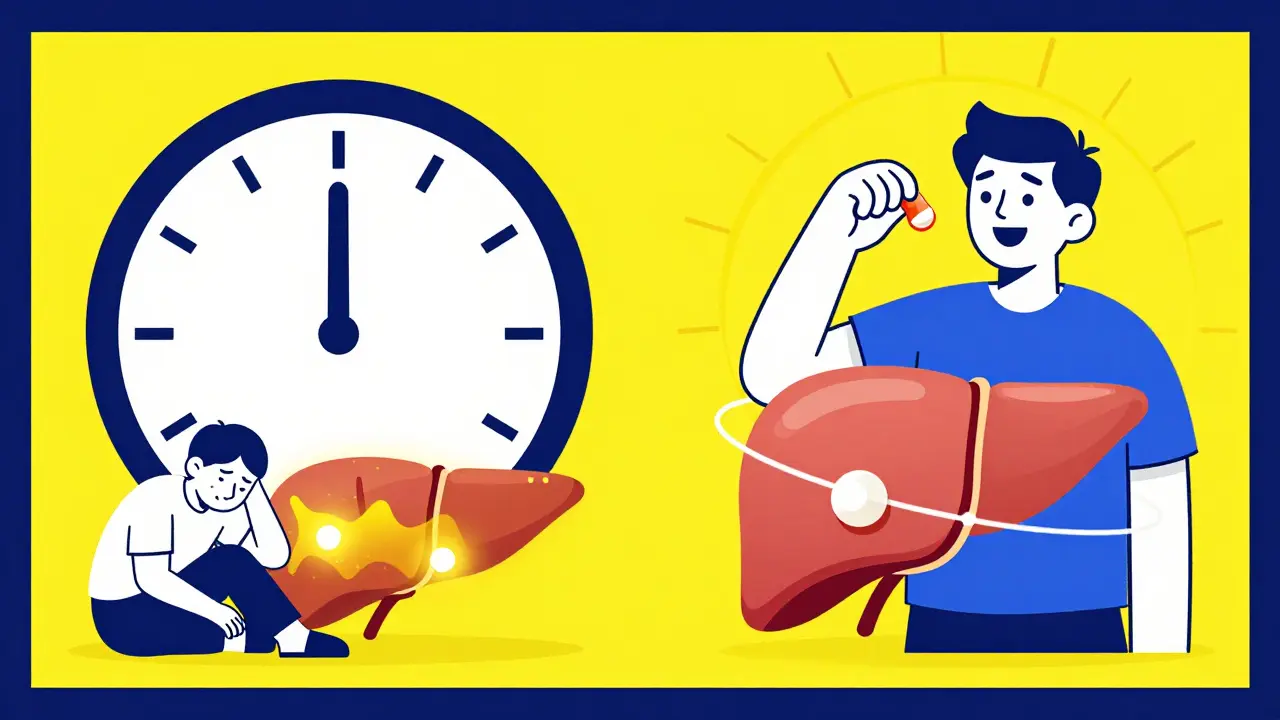
When you’re prescribed a statin, the question of whether to take it at night or in the morning isn’t just about routine-it’s about whether you’re getting the most out of your medication. For decades, doctors told patients to take statins at night because that’s when your body makes the most cholesterol. But today, that advice doesn’t apply to everyone. The truth is simpler than you think: statin timing matters only if you’re on an older type. For most people on modern statins, it doesn’t matter at all.
Why Night Was Once the Gold Standard
The idea that statins should be taken at night came from how your body works. Around midnight, your liver starts cranking out cholesterol. That’s when the enzyme HMG-CoA reductase is most active. The first statins-like simvastatin, lovastatin, and fluvastatin-had short half-lives. That means they didn’t stay in your system long. If you took them in the morning, their effect wore off before your liver hit its peak production. Studies showed clear differences. One 1995 trial found that taking simvastatin at night lowered LDL cholesterol by 13.4% more than taking it in the morning. Another study with 172 patients found that evening dosing cut cholesterol 50% more effectively than morning dosing for the same dose.That’s why guidelines for years said: “Take your statin at bedtime.” It made sense. If you were on one of these older statins, timing was a big deal.
What Changed? The Rise of Long-Acting Statins
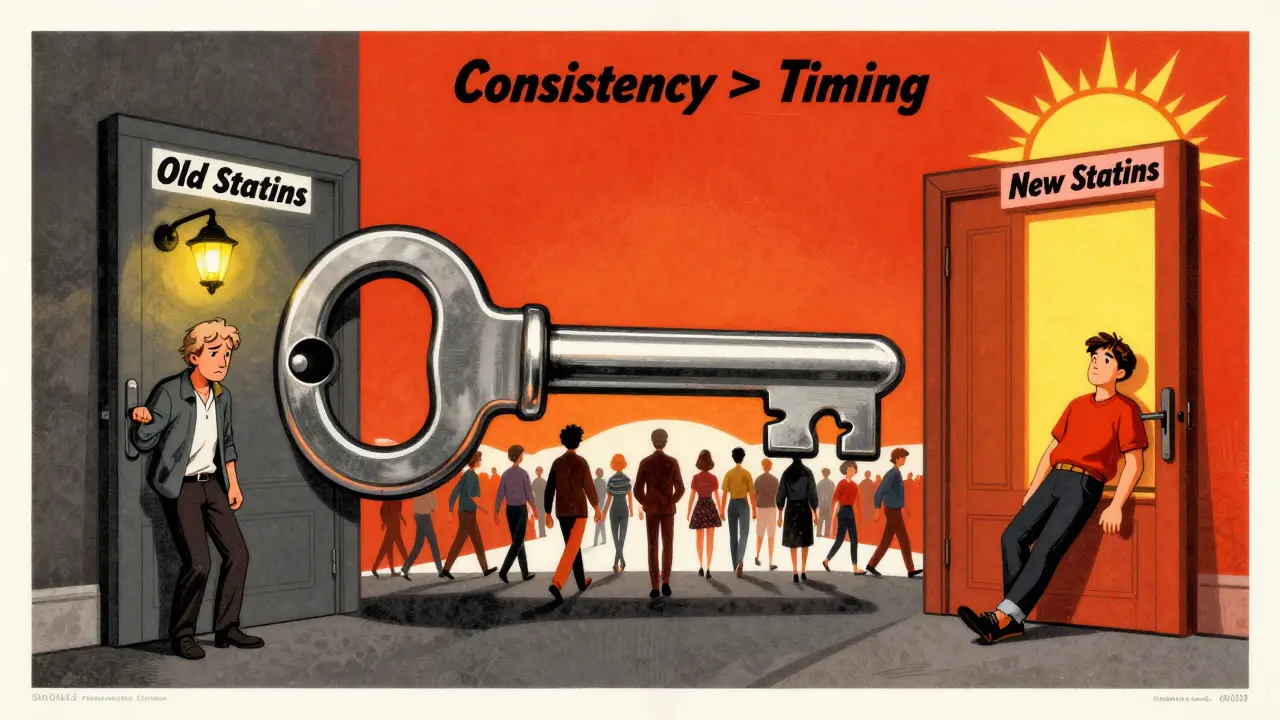
Fast forward to today, and most people aren’t on simvastatin or lovastatin anymore. Around 82% of new statin prescriptions in 2023 were for atorvastatin, rosuvastatin, or pitavastatin. These are long-acting statins. They stick around in your blood for 12 to 20 hours. That means whether you take them at 7 a.m. or 11 p.m., your liver still gets a steady dose of the drug during its peak cholesterol-making hours.A 2017 meta-analysis of 17 studies involving over 3,300 people showed this clearly. For short-acting statins, evening dosing lowered LDL by an extra 7.3-15% compared to morning dosing. But for long-acting statins? The difference was only 0.5-2.5 mg/dL. That’s less than a 3% change. The National Lipid Association says a change under 5-7% isn’t clinically meaningful. In other words, if you’re on rosuvastatin or atorvastatin, taking it in the morning instead of at night won’t hurt your results.
Side Effects: Does Timing Make a Difference?
A lot of people worry that taking statins at night might cause more side effects-like muscle pain or liver issues. But the data says no. A 2021 analysis of over 4.2 million statin prescriptions found no difference in side effects between morning and evening dosing. Muscle aches, elevated liver enzymes, and even the small increased risk of type 2 diabetes occurred at the same rate regardless of when you took the pill.One study even looked at patients who switched from nighttime to morning dosing because they kept forgetting. Not only did adherence improve, but side effects didn’t get worse. If anything, fewer missed doses meant better overall outcomes.
The Real Problem: Forgetting to Take It
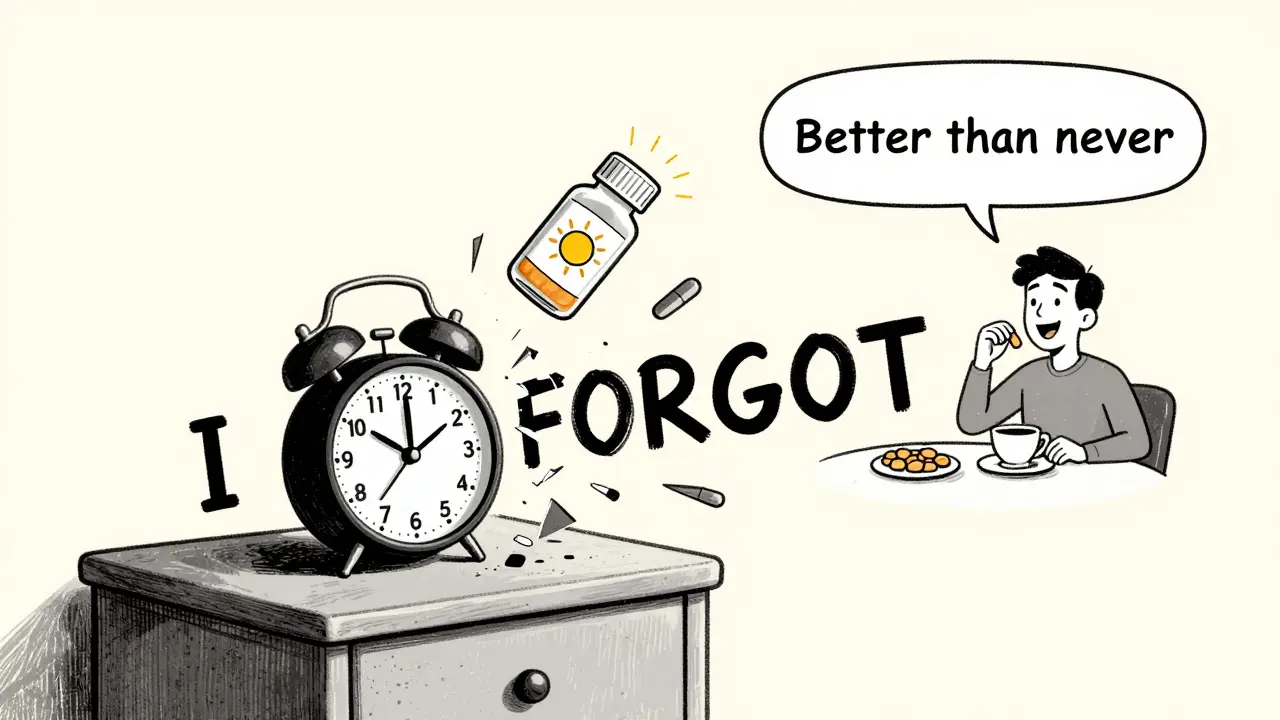
Here’s the kicker: the biggest threat to your cholesterol control isn’t whether you take your statin at night-it’s whether you take it at all. A 2019 Mayo Clinic study of nearly 12,500 people found that those told to take their statin at night had 11.3% lower medication adherence than those taking it in the morning. That’s about 2 extra missed doses per month. For patients on short-acting statins, missing a dose can drop your LDL lowering by up to 20%.Real-world stories back this up. On Reddit, users shared how they forgot their night-time pill, got frustrated, and asked their doctor to switch them to morning. One person said, “I started taking rosuvastatin in the morning with my coffee. I haven’t missed one in six months. My LDL dropped even more than before.”
That’s not an outlier. A 2020 study showed that when patients on simvastatin were given a smartphone reminder to take their pill at 8 a.m., adherence jumped from 76% to 92%. Their LDL reduction was nearly identical to those taking it at night-because they actually took it.
What Should You Do? A Simple Guide
You don’t need to overthink this. Here’s how to decide:- If you’re on simvastatin, lovastatin, or fluvastatin: Evening dosing is still slightly better. But if you keep forgetting, switch to morning. Consistency beats timing.
- If you’re on atorvastatin, rosuvastatin, pitavastatin, or pravastatin: Take it whenever works best for you. Morning, night, with food, without-it doesn’t matter.
- If you’re unsure what you’re on: Check your bottle. The generic name is listed. Or ask your pharmacist. No need to guess.
Doctors used to make a big deal about timing. Now, they don’t. Only 18% of primary care doctors routinely discuss statin timing with new patients, down from 67% in 2010. Why? Because the science moved on. The FDA removed nighttime recommendations from rosuvastatin and atorvastatin labels in 2015. The European Medicines Agency did the same.
What About Future Options?
Pharma companies are working on solutions that could make timing irrelevant even for short-acting statins. Pfizer has a patent for a timed-release simvastatin pill that releases the drug right when your liver needs it-no matter when you swallow it. That’s still in development, but it shows where things are headed: less burden on the patient, more precision built into the medicine.Bottom Line
The night vs. morning statin debate is mostly over. For the vast majority of people today, it doesn’t matter. What matters is this: take your statin every day. Whether it’s with breakfast, lunch, or right before bed, the best time is the one you won’t forget. If you’re on an older statin and keep missing your nighttime dose, talk to your doctor about switching to morning-or switching to a long-acting statin entirely. Your cholesterol doesn’t care what time it is. It just cares that you show up.Is it bad to take statins in the morning instead of at night?
Not for most people. If you’re taking atorvastatin, rosuvastatin, pitavastatin, or pravastatin, morning dosing works just as well as nighttime. Even for older statins like simvastatin, taking it in the morning is better than skipping it entirely. Consistency matters more than clock time.
Do statins cause more side effects at night?
No. Studies analyzing millions of prescriptions show no difference in muscle pain, liver issues, or diabetes risk between morning and evening dosing. Side effects are linked to the drug itself, not the time of day.
Can I switch my statin from night to morning on my own?
If you’re on a long-acting statin like atorvastatin or rosuvastatin, yes-switching won’t hurt. If you’re on simvastatin or lovastatin, talk to your doctor first. They can help you decide whether to switch timing or switch to a different statin altogether.
Why do some doctors still say to take statins at night?
Some doctors learned the old guidelines and haven’t updated their practice. Also, if you’re on a short-acting statin and taking it consistently at night, there’s no reason to change. But if you’re struggling to remember, morning dosing is a smarter choice.
What if I take my statin with food? Does that matter?
For most statins, food doesn’t affect absorption. Lovastatin is the exception-it works better with food. But even then, timing matters more than food. If you forget to take it with dinner, taking it with breakfast the next day is still better than skipping it.
Are there any statins that must be taken at night?
Only if you’re on simvastatin or lovastatin and you want the maximum benefit. But even then, if you can’t stick to nighttime dosing, switching to morning or switching to a long-acting statin is a better long-term strategy.
Will my insurance cover a different statin if I switch?
Most insurance plans cover generic atorvastatin and rosuvastatin, which are often cheaper than brand-name or older statins. Talk to your pharmacist-switching to a long-acting statin can save you money and make your routine easier.