Medication Document Finder
Find your medication's side effect information
Check if your prescription has a patient-friendly Medication Guide or a comprehensive Package Insert. Both documents contain side effect information, but they serve different purposes.
Examples: Accutane, Xarelto, Warfarin, Amoxicillin, Metformin
Medication Guide
Required for high-risk medications. Patient-friendly, written at 6th-8th grade level.
Package Insert
Complete scientific document for healthcare professionals. Contains all reported side effects.
What to Look For
This document contains the most important side effects you need to watch for. It includes:
- • Critical warnings in bold text
- • Symptoms to watch for
- • When to contact your doctor
- • What to avoid while taking the drug
When to Check This Document
For complete side effect details, including rare reactions not found in Medication Guides:
- • When you need to know if a symptom is rare or common
- • When you want to check for drug interactions
- • When your doctor asks for detailed information
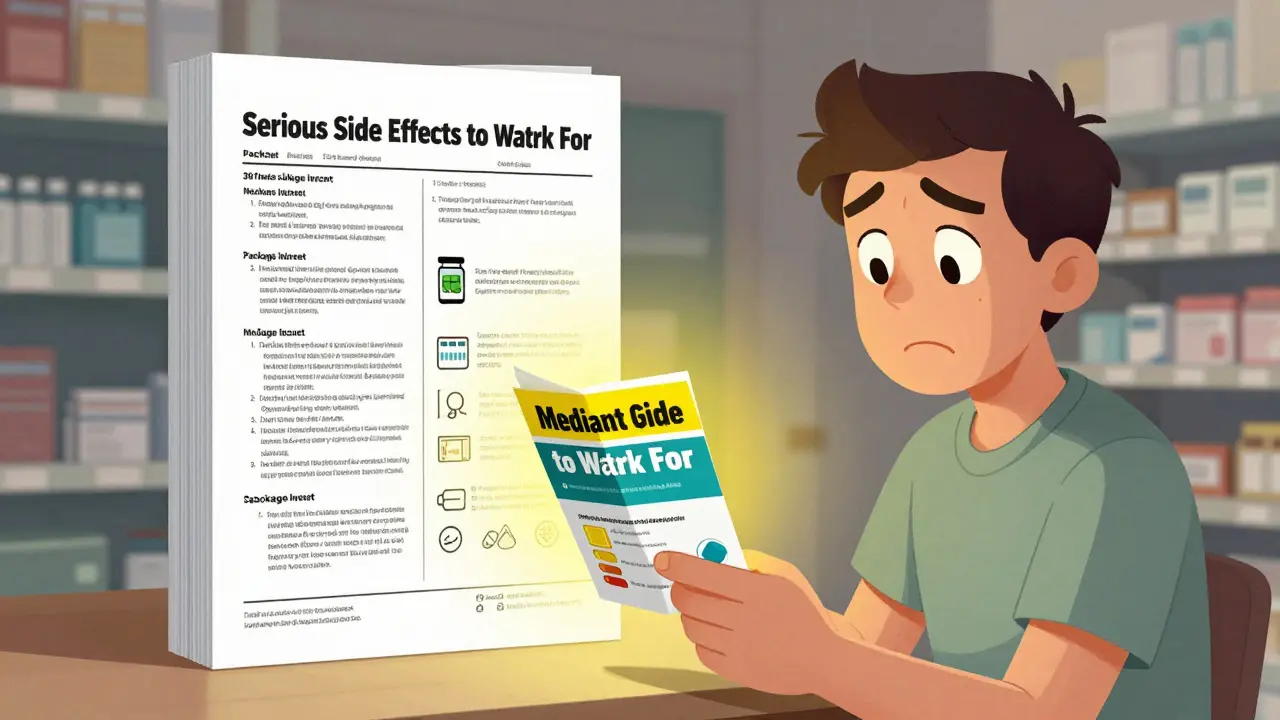
When you pick up a new prescription, you might get a small folded paper. Maybe you’ve seen it before - thick, printed in plain language, with bold headers like "What is the most important information I should know?" and "Serious side effects to watch for." That’s a Medication Guide a patient-focused document required by the FDA for certain high-risk prescription drugs. But if you dig deeper, maybe your doctor printed out a 30-page booklet with tiny text and medical jargon - that’s the Package Insert the full technical label for healthcare providers, containing every known side effect, interaction, and clinical study result. Both contain side effect details, but they’re not the same thing. And knowing which one to look at can make a real difference in how you understand your medication.
What Exactly Is a Medication Guide?
A Medication Guide isn’t just a handout. It’s a legally required document the FDA forces drug makers to give you for specific medicines. The FDA only requires one when a drug has a serious risk that patients need to understand to stay safe. Think: blood clots, liver damage, birth defects, or life-threatening allergic reactions. About 250 out of 20,000+ prescription drugs in the U.S. have these guides. That means most of your meds - like antibiotics or blood pressure pills - don’t come with one.
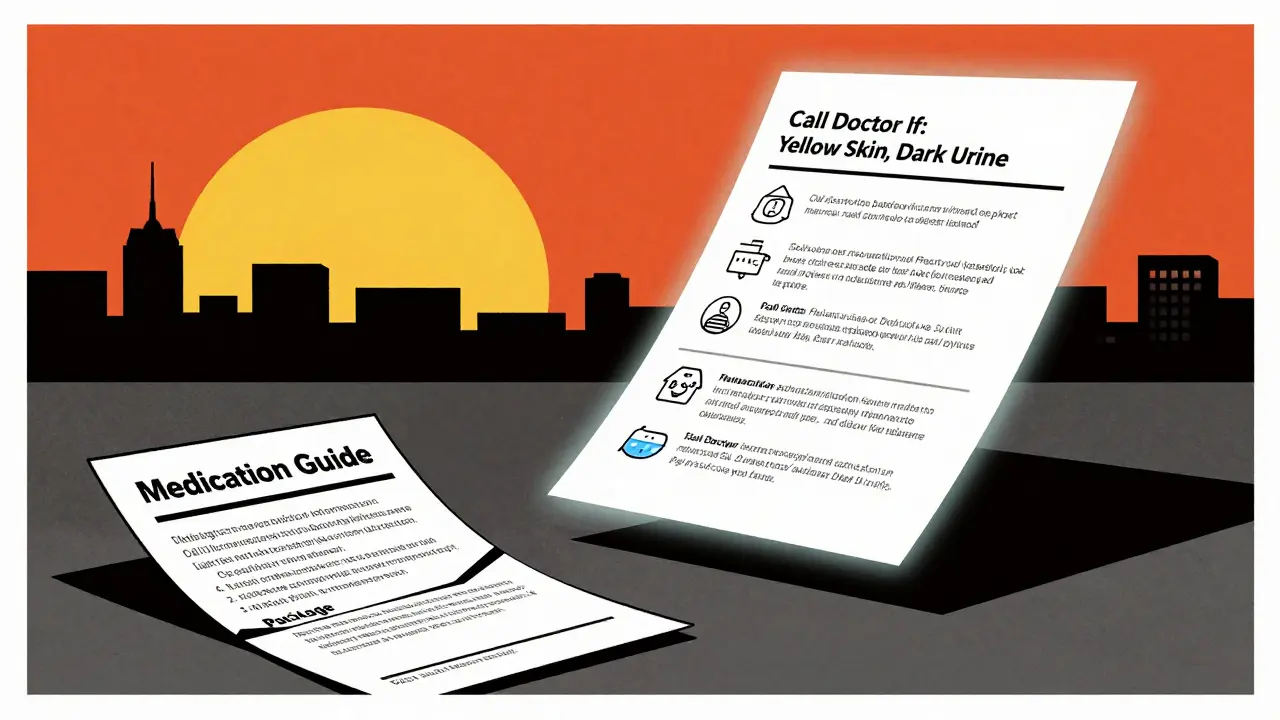
These guides are written to be readable. The FDA demands they be at a 6th- to 8th-grade reading level. No confusing terms like "hepatotoxicity" or "pharmacokinetics." Instead, you’ll see phrases like: "This medicine can cause severe liver damage. Call your doctor right away if you feel very tired, have dark urine, or your skin turns yellow." They’re short - usually 4 to 6 pages - and follow a strict format. Every guide must include sections on the most critical risks, what to do if you have them, and what to avoid while taking the drug.
Legally, pharmacies must give you this guide the first time you fill a prescription for a drug that requires it. But here’s the problem: a 2018 FDA study found only 37% of pharmacists consistently hand them out. Many patients don’t even know they exist. One Reddit user wrote: "I’ve been on Xarelto for 3 years. My pharmacy never gave me the guide. I found it online by accident." If you don’t get it at the pharmacy, you can always download it from the FDA’s website or the drugmaker’s site.
What’s Inside a Package Insert?
The Package Insert - also called Prescribing Information - is the full scientific record of a drug. It’s meant for doctors, pharmacists, and nurses. It’s not designed for patients. You’ll find it in medical databases like DailyMed, or sometimes printed by your doctor’s office. It’s often 10 to 50 pages long, dense with data.
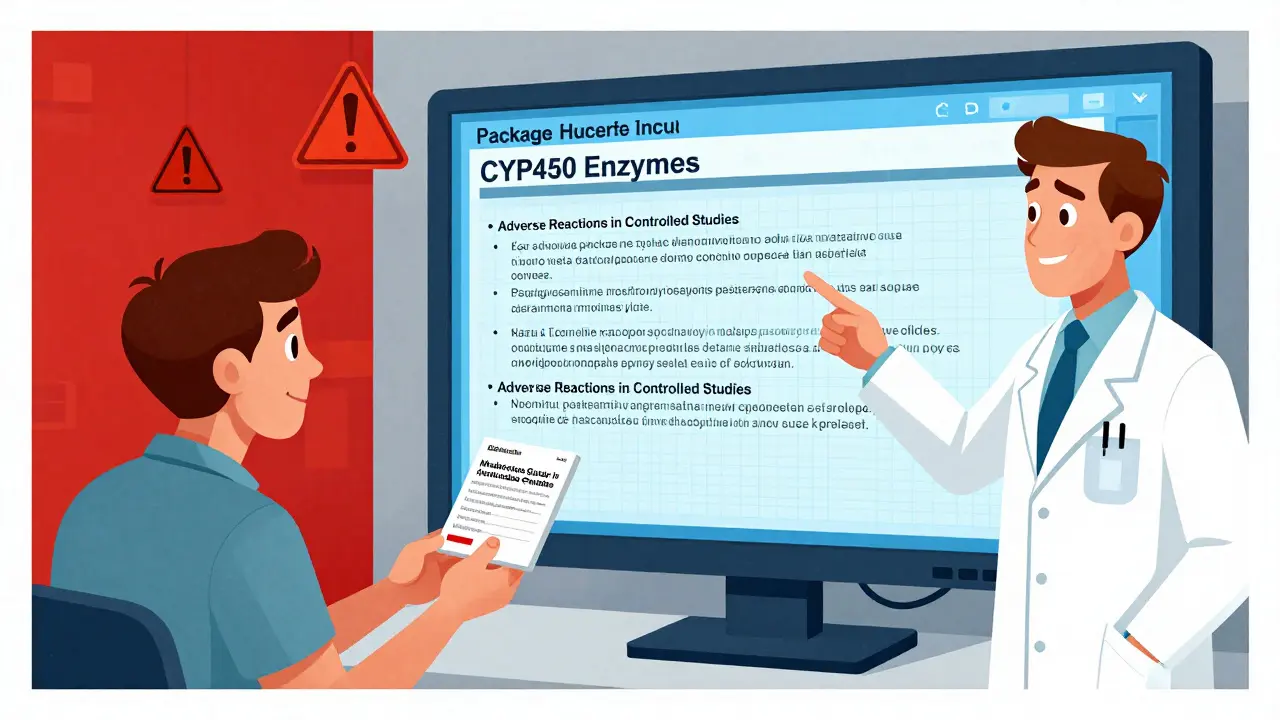
It’s broken into 23 specific sections. You’ll see things like: "Boxed Warning," "Clinical Trials Data," "Adverse Reactions in Controlled Studies," "Drug Interactions with CYP450 Enzymes," and "Use in Pediatric Populations." It lists every side effect ever reported - even rare ones that happened to just one person in a trial of 10,000. For example, a common painkiller might list "dizziness (12%), nausea (8%)," and then also "hallucinations (0.003%)." That last one? You’ll never see it in a Medication Guide. But it’s in the Package Insert.
Readability? The average Package Insert is written at a 12.7 grade level. That’s college freshman level. Most patients can’t understand it. A 2019 study in the Journal of the American Pharmacists Association found that 72% of patients gave up trying to read theirs. They turned to Google instead. And that’s risky - because online sources often mix up side effects, confuse rare with common, or even list symptoms from unrelated conditions.
Where to Find Each Document
Let’s cut through the confusion. Here’s where you can actually find both documents.
Medication Guides:
- At the pharmacy when you pick up your prescription (if required)
- FDA’s official Medication Guides page: fda.gov/medicationguides (search by drug name)
- Drug manufacturer websites - look for "Patient Information" or "Medication Guide"
Package Inserts:
- Ask your pharmacist - they can print one for you
- Go to DailyMed (dailymed.nlm.nih.gov) - it’s free, run by the NIH, and has over 140,000 inserts
- Search "[Drug Name] package insert PDF" on Google
- Check the drugmaker’s professional website (often labeled "Prescribing Information" or "PI")
Pro tip: If you’re trying to understand a side effect you’re experiencing, start with the Medication Guide. It tells you the top risks you need to watch for. Then, if you want to know if your symptom is rare, common, or linked to other drugs, check the Package Insert. It’s the complete picture.
Why the Two Systems Exist - And Why They’re Changing
The FDA created Medication Guides in 1998 because patients were getting hurt - not because they didn’t take their meds, but because they didn’t understand the risks. Isotretinoin (Accutane), for example, causes severe birth defects. Without a clear warning, women got pregnant while on it. The guide changed that. It worked. Studies show Medication Guides cut medication errors by 22% for high-risk drugs.
But the system has holes. Only 8% of prescriptions get a Medication Guide. Most patients never see one. Meanwhile, the Package Insert is buried in medical databases. Most people don’t know it exists. A 2022 survey found 68% of patients search for side effects online - because the official materials are either missing or unreadable.
That’s why the FDA is overhauling the whole system. In May 2023, they proposed a new standard called Patient Medication Information a single, standardized one-page document that will replace both Medication Guides and Patient Package Inserts for all prescription drugs. Starting in 2026, every new prescription will come with a simple, consistent one-page sheet - written in plain language, covering all serious side effects, and required for every drug, not just the high-risk ones.
By 2031, the old Medication Guides and Patient Package Inserts will be gone. This isn’t just a change in format - it’s a shift in philosophy. The FDA now believes: Every patient deserves clear, complete, and consistent side effect information - no matter what drug they’re taking.
What You Should Do Right Now
You don’t have to wait for 2026 to get better information. Here’s what to do today:
- If you got a small folded paper with your prescription - keep it. That’s your Medication Guide. It’s your first line of defense.
- If you didn’t get one, ask your pharmacist: "Is there a Medication Guide for this drug?" If they say no, check the FDA website.
- If you want to know every possible side effect - including the rare ones - go to DailyMed and search your drug. Copy the Package Insert and read the "Adverse Reactions" section.
- Don’t rely on WebMD or Google alone. They’re helpful, but they can be wrong or misleading.
- Keep both documents. Store them with your meds. You’ll thank yourself later.
Side effects aren’t just scary words on a page. They’re signals. And knowing where to find the right information can keep you safe - whether you’re taking a common antibiotic or a high-risk heart medication. The system is changing. But until then, you’ve got the tools. Use them.
Do I always get a Medication Guide with my prescription?
No. Medication Guides are only required for about 250 prescription drugs out of 20,000+ that are available. They’re given only when the FDA determines the drug has serious risks that patients must understand - like birth defects, life-threatening reactions, or risks from skipping doses. If your drug doesn’t require one, you won’t get it. But you can still check the FDA website to see if one exists for your medication.
Can I get a Package Insert from my pharmacy?
Yes. While pharmacies don’t routinely hand out Package Inserts, they are legally required to provide them upon request. Ask your pharmacist for the "Prescribing Information" or "Package Insert." Most pharmacies keep printed copies on hand or can print one from their system. You can also download it for free from DailyMed (dailymed.nlm.nih.gov).
Why does the Package Insert list side effects I never heard of?
Package Inserts include every side effect ever reported - even if it happened to only one person in a clinical trial. This is for healthcare professionals to assess risk in complex cases. A side effect listed as "0.01%" might sound scary, but it’s extremely rare. Medication Guides only include serious side effects that are likely enough to affect your decision to take the drug. Don’t panic over rare entries - focus on the bolded warnings in your Medication Guide.
Will Medication Guides disappear soon?
Yes, eventually. The FDA proposed a new system called Patient Medication Information (PMI) in May 2023. Starting in 2026, all new prescriptions will come with a standardized one-page document that replaces both Medication Guides and Patient Package Inserts. By 2031, the old formats will be fully phased out. This change is meant to make side effect information clearer, more consistent, and available for every drug - not just the high-risk ones.
I’m on a drug that requires a Medication Guide. What’s the most important thing I should do?
Read the "What is the most important information I should know?" section first. It highlights the top risks that could be life-threatening. Then, look at the "Serious side effects" section. Know the symptoms to watch for and when to call your doctor. Don’t wait for a reaction - be proactive. If you don’t have the guide, download it from the FDA website immediately. Many patients miss critical warnings simply because they never saw the guide.
Comments
Dean Jones March 4, 2026 at 13:53
The whole Medication Guide vs Package Insert thing is a perfect example of how the system is designed to confuse people instead of help them. You’ve got this beautifully simple, plain-language guide that tells you what actually matters - like, ‘don’t get pregnant on Accutane’ - and then you’ve got this 40-page PDF written by a robot that lists every single weird thing that ever happened to someone in a trial, even if it was a guy in Finland who ate expired cheese and then had a dream about a squirrel. No one needs that. But they give it to doctors anyway, like it’s some kind of sacred text. Meanwhile, most patients are just Googling symptoms at 2 a.m. and ending up on a forum where someone claims their knee pain was caused by a ghost.
It’s not that the information isn’t there. It’s that the delivery is broken. And now the FDA is finally trying to fix it with this one-page PMI thing? Honestly, it’s about damn time. The fact that we’ve been relying on folded paper handouts since 1998 is wild. We have smartphones. We have AI. We have apps that tell us when our toilet paper is running low. But we still hand out 6-page PDFs like they’re holy relics?
Someone’s gotta stop this madness.
Betsy Silverman March 5, 2026 at 06:57
I love that you mentioned DailyMed. I didn’t even know it existed until my mom got prescribed something last year and I spent an hour digging through medical databases because the pharmacy wouldn’t give her the insert. Turns out, it’s run by the NIH - free, reliable, no ads. I wish more people knew about it. I started printing out the inserts for my family’s meds and keeping them in a binder. Now we have a little ‘medication library’ at home. It’s weirdly satisfying.
Also, I’ve started asking pharmacists for the Medication Guide even if they don’t offer it. Most of them are surprised but happy to help. It’s just a matter of asking. And if they say no? Politely say, ‘I’m sorry, but I’ve read the FDA requires it. Can you please check?’ They usually fold.
Richard Elric5111 March 7, 2026 at 03:43
One cannot help but observe that the current regulatory architecture surrounding pharmaceutical communication reflects a profound epistemological dissonance: the state mandates the dissemination of information deemed critical to patient autonomy, yet systematically obfuscates its accessibility through structural fragmentation and linguistic stratification. The Medication Guide, in its truncated, sanitized form, functions as a performative gesture - a symbolic nod to informed consent, while the Package Insert, buried in the labyrinth of DailyMed, remains an artifact of institutional authority, accessible only to those who possess the cultural capital to navigate its arcane syntax.
Thus, the proposed Patient Medication Information represents not merely a reform, but a paradigm shift - a move from paternalistic disclosure to democratized comprehension. Whether this shift will be implemented with fidelity, however, remains an open question, given the historical inertia of bureaucratic systems and the commercial interests that benefit from opacity.
Chris Beckman March 9, 2026 at 03:17
you spell insert as inesrt like 3 times in this post. also i read the whole thing and still dont know what to do. just tell me which one to read. its not rocket science. also i got my xarelto guide 2 years late and now i think i might have had a stroke and didnt know it. thanks for the info i guess.
John Cyrus March 9, 2026 at 16:59
Medication Guides are useless. They only list the big scary stuff so you don’t sue the drug company. The real risks are in the Package Insert. Like how a lot of antidepressants cause sexual dysfunction - that’s buried in section 8.2 under ‘adverse reactions in controlled trials.’ They don’t even mention it in the guide. Why? Because if patients knew, they’d stop taking them. Same with statins and muscle damage. They say ‘muscle pain’ - not ‘rhabdomyolysis.’ That’s not patient education. That’s corporate damage control.
John Smith March 10, 2026 at 07:12
I’ve been on warfarin for 8 years. Got the guide once. Never again. I printed the full insert, laminated it, and taped it to my fridge next to the grocery list. My wife calls it my ‘death manual.’ She laughs. I don’t. Because last year I had a weird bruise on my thigh and I checked the insert - turns out it was a sign of internal bleeding. I called my doctor. Saved my life. That thing is more important than my car manual. You don’t just throw away a manual because it’s long. You read it. You respect it. This isn’t a suggestion. It’s survival.
Ivan Viktor March 10, 2026 at 09:22
So let me get this straight. The government forces drug companies to give you a 6-page pamphlet that says ‘don’t die’ and then gives doctors a 50-page novel that says ‘here’s every way you could die, including if you sneeze while standing on your head.’
And we wonder why people just Google it and take vitamin C for cancer.
Also, why is the FDA waiting until 2026? My grandma died in 2020 because she thought ‘dizziness’ meant ‘you’re tired.’ It meant ‘your blood pressure dropped so hard you almost died.’ She didn’t know. She never got the guide. We’re all just guessing here.
Zacharia Reda March 11, 2026 at 18:54
Love this post. Seriously. I’m a nurse and I’ve been telling patients for years: ‘Don’t trust WebMD. Don’t trust Reddit. Go to DailyMed.’ Most of them look at me like I’m speaking Klingon. But I’ve had patients come back months later saying, ‘You were right. I found the insert. Turns out my headache was from the interaction with my fish oil.’
One thing I wish more people knew: you can ask for the Package Insert at any pharmacy. They have to give it. No questions. Just say, ‘I’d like the full prescribing info.’ They’ll hand it to you like it’s a receipt. And if they don’t? Tell them you’re going to file a complaint with the state board. That gets results. I’ve done it twice. Both times they printed it within 10 minutes.
Knowledge isn’t power. Knowledge is life.
Helen Brown March 12, 2026 at 08:32
They’re lying. I know it. The guides are fake. The inserts are fake. Everything is fake. The drugs are made to make you sick so you keep buying more. They don’t want you to know the real side effects. The ones they don’t list. The ones that make you forget your own name. The ones that make your eyes turn black. I’ve seen it. I’ve read the truth. They bury it in the back of the insert. But I found it. I copied it. I’m going to post it. Someone needs to know. You’re being lied to. Always.
Stephen Vassilev March 13, 2026 at 19:20
According to my research, the FDA’s ‘Patient Medication Information’ initiative is a Trojan horse. The real goal is to consolidate pharmaceutical data under centralized digital control - enabling real-time monitoring of patient compliance, pharmacovigilance, and predictive analytics on adverse events. This is not about patient safety. This is about surveillance. And once they have your medication history linked to your ID, your insurance, your employer - what’s next? Mandatory dosing schedules? AI-driven dosage adjustments? You think they’re giving you a one-pager? They’re giving you a digital leash.
Mike Dubes March 14, 2026 at 13:01
I’ve been taking metformin for 5 years. Never got a guide. Found it on the FDA site. Read it. Learned I should avoid alcohol. Didn’t know that. Also found the insert. Saw that lactic acidosis is a risk - I had no idea. I’ve been drinking wine with dinner. Whoops. But now I know. So I stopped. That’s all this is - awareness. You don’t need a PhD. You just need to look. And if you’re scared of the big words? Google them. I looked up ‘hepatotoxicity’ once. Turns out it just means ‘liver damage.’ Duh.
Don’t overthink it. Just check. It’s not hard. And if you’re too busy? Ask someone. A pharmacist, a friend, your kid. Someone’s gonna help you. We’re all in this together.
Jeff Card March 14, 2026 at 20:19
I used to ignore these things. Thought they were just paperwork. Then my sister had a reaction to a new antidepressant. She didn’t tell anyone. Thought it was just stress. Turns out, it was a rare side effect listed in the Package Insert - serotonin syndrome. She almost died. We found the insert because I printed it after she went to the ER. That thing saved her life. Not the guide. Not the doctor. The insert. The 47-page, tiny-font, boring-as-hell document. I cried reading it. Because I realized - we were so close to losing her. And we almost didn’t know why.
So now? I print them. For everyone. Even if they don’t ask. I leave them on the counter. I say, ‘Just look at the bold parts. Please.’
It’s not about being smart. It’s about being alive.
Sharon Lammas March 16, 2026 at 10:40
I think about this a lot - how we’re told to trust doctors, trust pharmacies, trust the system - but then given information that’s either missing, hidden, or written in a language we can’t understand. It’s not negligence. It’s structural. The system isn’t designed for us. It’s designed for liability. For compliance. For avoiding lawsuits. And we’re left holding folded paper that might not even be handed to us.
It’s not about being informed. It’s about being allowed to be informed.
And that’s a quiet kind of injustice.
Gretchen Rivas March 17, 2026 at 09:11
Just ask your pharmacist for the guide. If they say no, say, ‘I’m going to the FDA website to check if one exists.’ They’ll hand it to you. I’ve done it 7 times. Always worked. Also - keep them. I have a shoebox full. My mom calls it my ‘medication time capsule.’