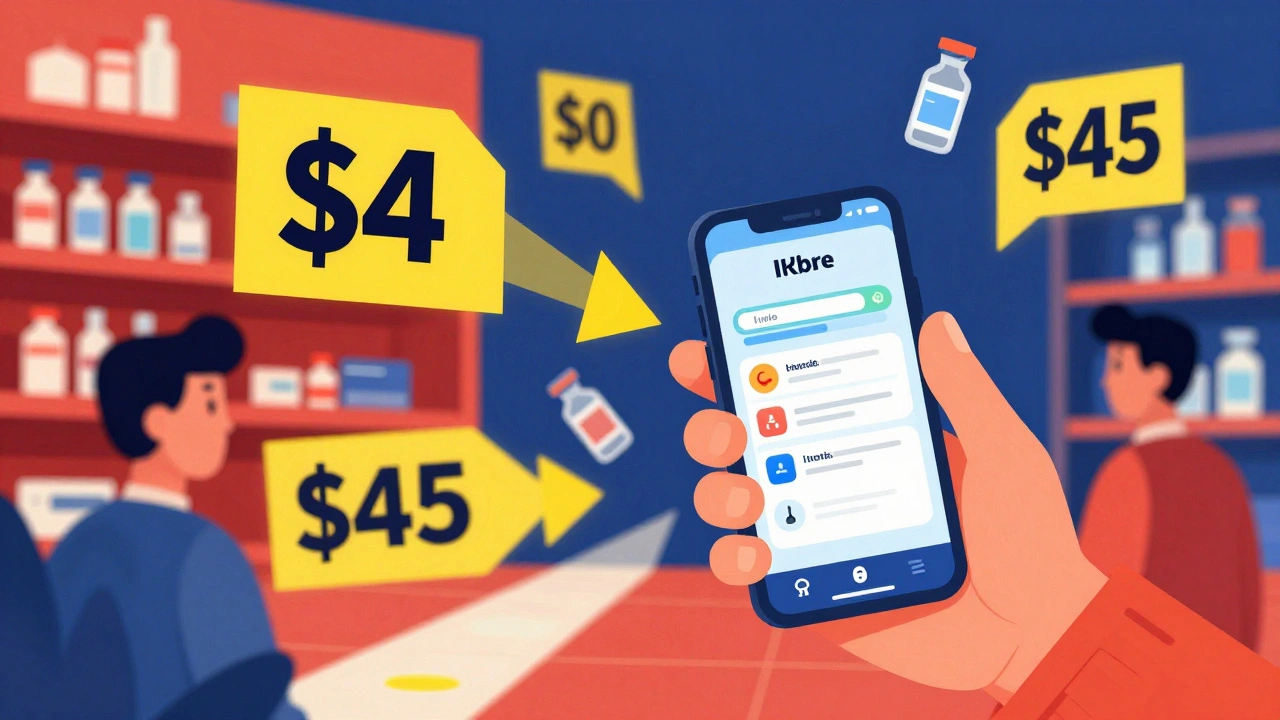
Knowing how much a prescription will cost before you pick it up can save you hundreds - sometimes thousands - of dollars a year. Yet most people still call pharmacies one by one, wait for insurance approvals, or just pay whatever the counter says. It doesn’t have to be that way. With price transparency tools, you can compare drug costs across dozens of pharmacies in minutes, find cheaper alternatives, and avoid surprise bills.
Why Drug Prices Vary So Much
The same 30-day supply of metformin might cost $4 at one pharmacy and $45 at another. That’s not a typo. Prices for brand-name and generic drugs vary wildly because of how insurance contracts, pharmacy networks, and manufacturer rebates work. Your insurance plan may have negotiated a lower rate with one pharmacy but not another. Some pharmacies offer cash discounts that aren’t tied to insurance at all. And then there are drugs that cost $500 one month and $800 the next - with no change in dosage or manufacturer. These price differences aren’t random. They’re the result of complex deals between drug makers, pharmacy benefit managers (PBMs), and insurers. Without tools to cut through the noise, you’re left guessing - and overpaying.What Are Price Transparency Tools?
Price transparency tools are websites and apps that show you what you’ll actually pay out of pocket for a prescription - not the list price, not the wholesale cost, but your real cost based on your insurance plan. These tools pull data directly from your insurer’s network, pharmacy contracts, and federal databases to give you accurate, real-time estimates. They became mandatory in the U.S. after the 2020 Transparency in Coverage Rule. By January 2024, every health insurer had to give members access to an online tool that compares prices for all prescriptions. That means if you’re covered by a large employer plan, Medicare Advantage, or a marketplace plan, you already have access to one - even if you don’t know it yet.Top Tools to Compare Drug Costs Right Now
Not all tools are created equal. Here are the most reliable ones in 2025, based on user feedback, accuracy, and coverage:- Rx Savings Solutions (RxSS): This tool is built into many employer health plans and works directly with your pharmacy benefits manager. It doesn’t just show prices - it suggests cheaper alternatives. In one 2023 study, it found cost-saving options for 83% of users. For example, it might switch you from a brand-name statin to a generic version that works just as well but costs 70% less.
- Optum Rx: If your employer uses UnitedHealthcare, you likely have access to Optum Rx through your myCompass account. It shows real-time pricing across local pharmacies and integrates with your plan’s formulary. Users report saving $200-$500 per prescription on high-cost meds like insulin or blood thinners.
- FAIR Health Consumer: This is one of the few tools that doesn’t require you to log in to your insurance account. Just enter the drug name, dosage, and zip code. It pulls data from millions of claims and gives you a range of prices. Great for people without insurance or those on high-deductible plans.
- Turquoise Health: Used by hospitals and large insurers, this tool gives you access to pricing data for over 4,000 prescriptions. It’s more detailed than consumer-facing tools, with filters for pharmacy type, distance, and insurance status. Best for people who want to dig deep.
- Healthcare Bluebook: Originally designed for medical procedures, it now includes a growing list of common prescriptions. It shows a “Fair Price” benchmark so you know if you’re being overcharged. Useful for drugs like antibiotics, asthma inhalers, or antidepressants.
How to Use These Tools Step by Step
Using these tools is simple - if you know the right steps. Here’s how to get the best results:- Find your insurer’s tool first. Check your insurance website or app. Look for sections labeled “Prescription Savings,” “Drug Pricing,” or “Cost Estimator.” If you’re on an employer plan, ask HR. About 78% of large companies now offer this.
- Enter the exact drug name and dosage. Don’t type “blood pressure pill.” Type “Lisinopril 10 mg.” Small differences in dosage or brand can change the price dramatically.
- Check multiple pharmacies. Tools show prices from nearby stores - CVS, Walgreens, Walmart, local independents. Don’t stop at the first result. The cheapest option might be 2 miles away.
- Look for therapeutic alternatives. If your tool suggests a different drug, check the description. Is it in the same class? Does it have the same effect? Many generics work just as well. For example, switching from brand-name Adderall to generic amphetamine salts can cut costs from $250 to $30 a month.
- Compare out-of-pocket vs. cash price. Sometimes paying cash without insurance is cheaper - especially for generics. Tools should show both. If they don’t, try GoodRx or SingleCare as a backup.
- Call the pharmacy before you go. Prices can change between when you check online and when you pick up. A quick call confirms the final price. One user saved $178 by calling and finding out their local pharmacy had a $30 cash discount not shown on the app.
What These Tools Can’t Do - And How to Work Around It
These tools are powerful, but they’re not perfect. Here are the biggest gaps:- They don’t always include discount programs. GoodRx, SingleCare, and manufacturer coupons aren’t always integrated. Always check these sites separately - especially for expensive drugs like Ozempic or Humira.
- Some tools show list prices, not your real cost. If a tool says “$120 for Xanax,” but your plan has a $20 copay, that’s misleading. Look for labels like “Your Cost” or “Out-of-Pocket.” If it’s not clear, call your insurer.
- Specialty drugs are often excluded. Drugs that need prior authorization, like cancer meds or biologics, may not appear. In those cases, ask your pharmacist or care team for help.
- Prices can be outdated. If the tool shows a price that doesn’t match what you pay at the counter, report it. Most tools have a “Report Inaccurate Price” button.
Real Savings: What People Are Actually Paying
Real people are saving real money:- A user in Texas used Rx Savings Solutions to switch from brand-name apixaban to a generic alternative. Their 90-day cost dropped from $520 to $233 - a $287 saving.
- Another user in Florida found that their $1,850 annual cost for a cholesterol drug dropped to $620 after comparing prices across 12 pharmacies using Optum Rx.
- A retiree in Ohio used FAIR Health to discover that a $4,200 MRI quote could be cut to $450 at a nearby imaging center - a $3,750 difference.
Comments
Ignacio Pacheco December 3, 2025 at 01:10
So let me get this straight - we’re now expected to become pharmaceutical detectives just to afford our blood pressure meds? Cool. I’ll just add ‘cost-optimization specialist’ to my LinkedIn profile next to ‘professional human being’.
Jim Schultz December 3, 2025 at 04:26
Let’s be clear: the fact that you need a spreadsheet, three apps, and a PhD in PBM semantics just to buy metformin is not a feature - it’s a catastrophic systemic failure. RxSS? Optum? FAIR Health? These aren’t tools - they’re bandaids on a hemorrhaging artery. And don’t get me started on the ‘cash price’ loophole - it’s a predatory shell game where pharmacies profit off the uninsured while pretending to be charitable. This isn’t transparency - it’s theater with a 2024 compliance stamp.
parth pandya December 4, 2025 at 11:32
Hey guys i just used fair health for my diabetes med and saved like 70%!! i was shocked!! my local walgreens said $120 but fair health showed $35 at a pharmacy 5 mins away!! dont trust the first price u see!!
Albert Essel December 4, 2025 at 21:22
I appreciate the practical breakdown, but I’d like to emphasize the ethical imperative here. The ability to access accurate, real-time drug pricing shouldn’t be a privilege tied to digital literacy or employer benefits. It’s a basic right in a healthcare system that claims to prioritize patient autonomy. The tools mentioned are helpful, but they’re also symptoms of a deeper failure - one where market forces, not medical need, dictate access to essential medicines.
Kidar Saleh December 6, 2025 at 09:34
Coming from the UK where the NHS covers most prescriptions, I still find this astonishing. You’re telling me an American can pay £2 for a drug that costs £200 across the street? It’s not capitalism - it’s a carnival sideshow with insulin as the main attraction. I’m not surprised. The U.S. healthcare system operates like a video game where the rules change every level and the boss is always the pharmacy counter.
Chloe Madison December 7, 2025 at 09:29
Y’ALL. I JUST USED RX SAVINGS SOLUTIONS AND MY ANTIBIOTIC WENT FROM $98 TO $12. I WAS CRYING. I’M NOT KIDDING. I CALLED THE PHARMACY TWICE TO MAKE SURE IT WASN’T A MISTAKE. THIS IS REAL. THIS IS POWERFUL. IF YOU’RE READING THIS AND YOU’RE ON A PRESCRIPTION - GO CHECK IT. NOW. YOU DESERVE TO NOT BE BROKE JUST TO STAY ALIVE.
Vincent Soldja December 8, 2025 at 01:12
Useful information.
Makenzie Keely December 9, 2025 at 16:48
OMG I JUST REALIZED MY INSURANCE HAS A PRICE TOOL AND I’VE BEEN IGNORING IT FOR TWO YEARS!! I’M GOING TO CHECK MY CHOLESTEROL MED RIGHT NOW!! THANK YOU FOR THIS!! I’M TELLING EVERYONE I KNOW!!
Francine Phillips December 10, 2025 at 03:41
My pharmacy gave me a price yesterday. Today it’s different. I don’t even bother anymore.
Katherine Gianelli December 11, 2025 at 02:19
Look - I know this stuff feels overwhelming. I’ve been there. I’ve sat in the pharmacy parking lot crying because I couldn’t afford my anxiety meds. But you’re not alone. You don’t have to be a genius to use these tools. Just one step. One search. One call. That’s all it takes to take back a little power. And if you need help? Ask someone. A friend. A librarian. A stranger on Reddit. We’ve all got your back.
Joykrishna Banerjee December 11, 2025 at 20:15
Let’s be honest - most of these ‘tools’ are just corporate PR stunts designed to appease regulators while PBMs quietly inflate rebates. You think FAIR Health is neutral? It’s funded by insurers. The ‘cash discount’? That’s just a bait-and-switch to lure uninsured patients into overpaying for ‘premium’ services. And don’t even get me started on generics - they’re often just rebranded generics with different fillers. This whole system is a pyramid scheme dressed in HIPAA-compliant clothing.
Myson Jones December 13, 2025 at 02:52
Thanks for sharing this. I think it’s important to remember that while these tools help, they’re not a substitute for systemic reform. Many people still can’t access them due to tech barriers, language, or lack of internet. We need universal access - not just better apps.
Joel Deang December 14, 2025 at 15:40
omg i just found out my local walmart has my insulin for $25?? i thought it was like 150?? i just ran out the door like a maniac lmao
Roger Leiton December 15, 2025 at 12:35
This is the kind of post that makes me feel like I’m living in the future 😍 I literally used RxSS this morning and it suggested a generic I didn’t even know existed. Now I’m saving $200/month. I’m gonna send this to my mom. She’s been paying $400 for her thyroid med for years. 🙌