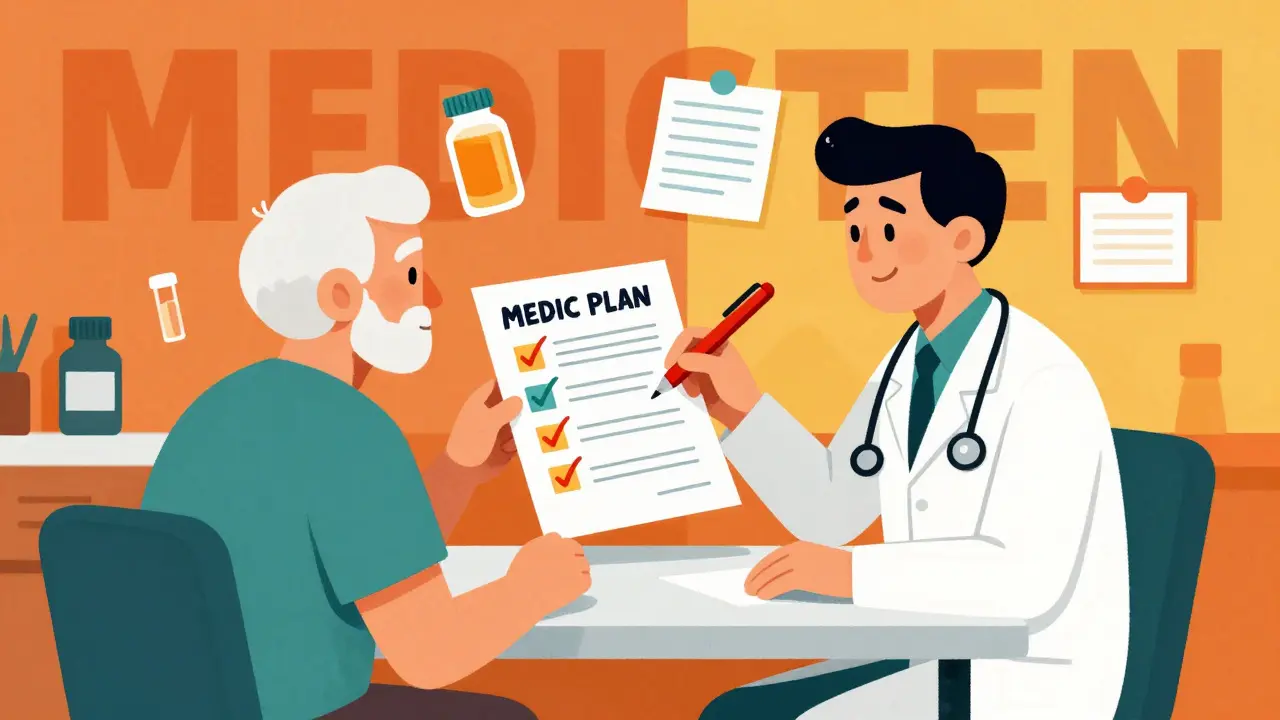
When you walk into a doctor’s office, pharmacy, or clinic, you’re not just there for a quick checkup. You’re there to make sure your medications are working, safe, and actually helping you. But too often, patients forget what they’re taking, providers miss changes, and critical details get lost. That’s where a Medication Action Plan comes in - a simple, structured tool that turns confusion into clarity during every healthcare visit.
What Exactly Is a Medication Action Plan?
A Medication Action Plan (MAP) isn’t just a list of your pills. It’s a living document that answers four key questions: What are you taking? What should you be doing? What have you done? And what happens next? It was formalized by the Centers for Medicare & Medicaid Services (CMS) as part of the Medicare Part D Medication Therapy Management program. The current standard version, CMS1245776, requires specific fields like medication names, dosages, reasons for use, start/stop dates, and clear action steps.In Germany, a similar system called the Medication Plan (MP) has been mandatory since 2016 for anyone taking three or more prescription drugs. Studies show 87.5% of patients using this template could find critical info on their first try - something most people can’t do with a messy pill bottle or a handwritten note.
The goal? Reduce errors. Reduce hospital visits. Reduce guesswork. Research from the Agency for Healthcare Research and Quality (AHRQ) shows consistent use of a MAP can cut adverse drug events by up to 23%.
What’s in a Medication Action Plan Template?
Not all templates are the same, but the best ones share the same core structure. Here’s what you’ll typically find in a fully functional MAP:- What we talked about - A summary of the provider’s key points: new prescriptions, discontinued meds, or changes in health status.
- What I need to do - Clear, specific instructions. Not “take as directed.” But “Take metformin 500mg with breakfast and dinner, starting tomorrow.”
- What I did and when I did it - A simple tracker: checkmarks, dates, or notes on missed doses, side effects, or symptom changes.
- My follow-up plan - Next appointment date, who to call if problems arise, and space for questions you want to ask next time.
Some templates, like the CDC’s MyMedications Action Plan, also require your name, the date it was prepared, and your provider’s contact info. Others, like the one used in Burlington, NC, include symptom-based instructions: “If you have a rash and are scratching, apply this ointment. Wait at least 6 hours before reapplying.”
Crucially, the plan must be signed by both you and your provider. This isn’t just bureaucracy - it’s accountability.
How to Use It Before Your Visit
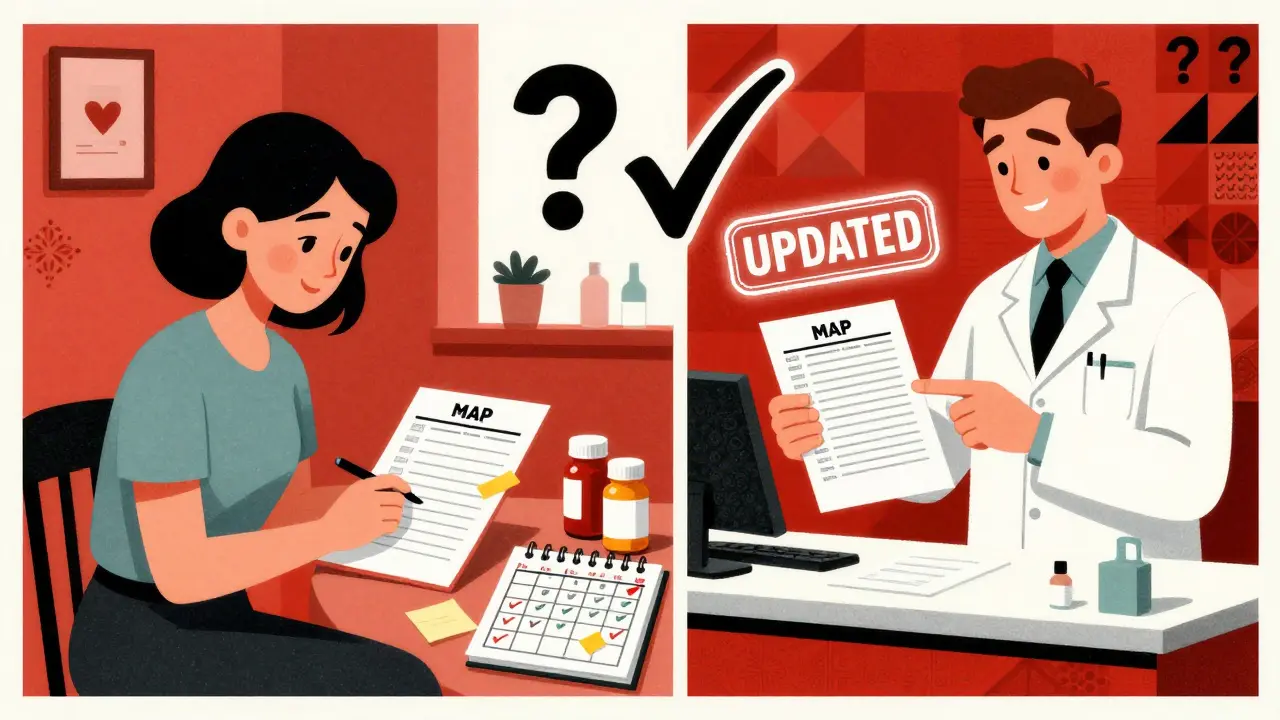
Don’t wait until you’re in the exam room to think about your meds. Start preparing three days before your appointment.- Update your list - Go through every pill bottle, patch, inhaler, or liquid. Cross out anything you stopped taking - and write down when and why. “Stopped lisinopril on Jan 15 - caused cough.”
- Bring the bottles - The CDC says bringing actual containers improves accuracy by 37.2% compared to just remembering. Providers can see expiration dates, dosing instructions, and even pharmacy labels.
- Fill out the “What I did” section - Note if you missed doses, skipped pills because of side effects, or changed your routine. “Took only 3 of 7 doses last week - felt dizzy after lunch.”
- Write down your questions - Use the “Questions I want to ask” box. “Why am I on two blood pressure pills?” “Is this new pill safe with my fish oil?”
Patients who do this consistently are 76.3% more likely to have accurate medication reconciliation than those who don’t, according to a 2016 study.
How to Use It During Your Visit
Your provider should spend the first 5-7 minutes reviewing the MAP. Don’t let them skip it.- Review the “What I did” section together - If you wrote “missed 4 doses,” ask why. Was it cost? Side effects? Confusion? This is where real problems surface.
- Update the plan in real time - If the doctor adds a new med, crosses out an old one, or changes the dose, they should do it on the plan right then. Use a pen. Write the start date. Not “next week.” Not “soon.” The exact date.
- Focus on high-risk meds - For older adults, providers should spend 8-12 minutes reviewing drugs that increase fall risk: benzodiazepines, anticholinergics, sleep aids. Ask: “Is this still necessary?”
- Confirm instructions are specific - If your provider says “take it once a day,” ask: “At what time? With food? Can I take it with my coffee?”
Studies show that plans with specific, measurable actions - like “Take 1 tablet at 8 a.m. and 8 p.m.” - lead to 34% higher adherence than vague ones.
What Happens After the Visit?
The plan isn’t done when you leave the office - that’s when the real work begins.- Keep a copy - Give one to a family member or caregiver. Many patients lose their MAPs. A 2023 Reddit post from a geriatric pharmacist shared that laminated wallet-sized versions worked best for elderly patients.
- Share it with all providers - If you see a specialist, go to the ER, or switch pharmacies, hand them the updated plan. Patients who shared their MAP with multiple providers had 22.8% fewer duplicate prescriptions.
- Update it weekly - Even if you don’t have a visit, take 5 minutes every Sunday to check off what you took, note any side effects, and write down new concerns.
- Use it in emergencies - The CDC recommends carrying a copy to the ER. In a crisis, knowing exactly what you’re on can be life-saving.
Why This Works - Real Stories
Mary Thompson, a 72-year-old from Ohio, told the Medicare Rights Center forum: “I started bringing my MAP to every appointment. My cardiologist caught that I was taking two blood pressure meds that shouldn’t be combined. He changed it right away. That probably saved me from a hospital stay.”On the flip side, a 2022 Health Affairs study found that 28.6% of safety-net clinics couldn’t use MAPs consistently because their electronic records didn’t talk to the paper forms. That’s why paper still matters - especially for older adults. AARP’s 2022 survey found 68.3% of patients over 65 prefer paper over apps.
Pharmacists who spent 5+ minutes teaching patients how to use their MAP saw 78.4% of patients correctly update it before their next visit. Those who got a 30-second handout? Only 32.1% did.
Common Mistakes to Avoid
- Not writing stop dates - The Institute for Safe Medication Practices found 18.7% of reconciliation errors happen because discontinued meds aren’t dated. “Stopped” isn’t enough. “Stopped March 1, 2026” is.
- Using vague language - “Take as directed” is useless. “Take 1 tablet with breakfast, 1 with dinner” is clear.
- Forgetting non-prescription meds - Vitamins, herbal supplements, and over-the-counter painkillers count. They interact too.
- Not reviewing side effects - If you’re tired, dizzy, or have a rash, write it down. It’s not “just aging.” It might be a reaction.
Who Benefits Most?
Anyone on multiple medications - especially those with chronic conditions like diabetes, heart disease, or COPD. But it’s especially critical for:- Seniors taking 5+ drugs
- Patients with low health literacy
- People who see multiple doctors
- Those recently discharged from the hospital
The data is clear: 89.7% of community pharmacies use some form of MAP. Only 62.4% of primary care clinics do. That gap is where patients fall through.
What’s Next?
The future of MAPs is digital - the 21st Century Cures Act requires EHRs to share medication data by 2024. But for now, paper still wins. Simple. Reliable. Accessible.Start small. Bring your list. Bring your bottles. Fill out the plan. Ask questions. Update it. Share it. That’s all it takes to turn a routine visit into a safety net.
Do I need a special template, or can I make my own?
You can make your own - but use a standardized one if you can. Templates from CMS, CDC, or your pharmacy are designed to include all the critical elements needed for safety and reimbursement. A DIY version might miss key fields like stop dates or provider contact info. If you create your own, make sure it includes: medication names (brand and generic), doses, times, reasons, start/stop dates, side effects tracked, and action steps.
What if I can’t read or understand the plan?
Ask for help. Many pharmacies offer free one-on-one sessions to explain your MAP. You can also request a simplified version with larger fonts, icons, or color-coding. Some clinics use pictures or voice recordings. Don’t pretend you understand - misunderstandings lead to errors. The goal is safety, not perfection.
Can I use this if I’m not on Medicare?
Absolutely. While the MAP was formalized under Medicare Part D, it’s a best practice for anyone on multiple medications - regardless of insurance. Primary care clinics, private pharmacies, and specialists are increasingly adopting it. It’s not about the program - it’s about your safety.
How often should I update my Medication Action Plan?
Update it at every visit - even if nothing changed. Then update it weekly on your own. Write down any side effects, missed doses, or new symptoms. The American College of Clinical Pharmacy calls it a “living document.” That means it should change as your health changes.
What if my provider refuses to use the MAP?
Politely insist. Say: “I’ve been using this plan to stay safe with my meds, and I’d like you to review it with me.” Studies show providers who use MAPs spend less time correcting errors later. If they still refuse, ask for a referral to a pharmacist who offers Medication Therapy Management (MTM). Many pharmacies offer this service for free.
Is there a digital version I can use on my phone?
Yes - apps like MyTherapy, Medisafe, and Apple Health can track your meds. But they don’t replace the MAP. The MAP is meant to be shared with providers, printed, and signed. Use the app to stay on track, but bring a printed copy to your visit. Many older adults still prefer paper - and providers are more likely to mark it up in real time.
Comments
Chris Bird March 11, 2026 at 08:17
This is literally the most basic shit anyone on meds should do. I've seen grandmas with 7 pills and no clue what they're for. Just write it down. Bring the bottles. Done. No magic here. If you can't do this, you're one step from the ER.
Tom Bolt March 13, 2026 at 02:54
I appreciate the thoroughness of this post, but there are several grammatical inconsistencies that undermine its credibility. For instance, the phrase 'Write the start date. Not 'next week.' Not 'soon.' The exact date.' lacks proper punctuation and parallel structure. Furthermore, the use of 'MAP' as an acronym without first defining it as 'Medication Action Plan' in the opening paragraph is a failure of editorial rigor. This is a vital topic, and sloppy execution diminishes its impact.
Mike Winter March 14, 2026 at 01:21
There's something quietly profound about a piece of paper holding your health together. We live in a world of digital dashboards and AI assistants, yet the most reliable tool for safety is still ink on a form signed by another human. It’s not about technology-it’s about trust. The act of writing, of signing, of handing it over-that’s ritual. And rituals, when they’re grounded in care, don’t need to be smart. They just need to be real. I wonder if we’ve forgotten that.
Randall Walker March 15, 2026 at 09:06
So... you're telling me the solution to the entire healthcare system is... paper? Like, a literal piece of paper? Wow. I'm just shocked no one thought of this before. Next you'll tell us to wash our hands. And maybe eat vegetables. Oh wait, that's already a thing. I'm so moved. 🙃
Donnie DeMarco March 16, 2026 at 05:57
Bro this is straight fire. I been using this since my last ER trip-turns out i was takin’ my blood pressure pill at night instead of mornin’ and i was feelin’ like a zombie. Now i got it on a sticky note next to my coffee maker. My doc was like ‘damn, you’re the first one who actually showed up with this.’ I told him i ain’t tryna die from a typo. 🙌
Shourya Tanay March 17, 2026 at 21:28
The underlying epistemological framework of the Medication Action Plan aligns with the principles of pharmacovigilance and shared decision-making paradigms. The structured elicitation of adherence metrics, coupled with real-time clinical documentation, mitigates therapeutic inertia and enhances medication reconciliation fidelity. Notably, the inclusion of patient-reported outcomes within the ‘What I Did’ section operationalizes patient-centered care at the point of service, which is statistically correlated with reduced polypharmacy risk and improved outcomes in multimorbidity cohorts.
LiV Beau March 18, 2026 at 01:37
I love this so much!!! 💖 I printed mine out and laminated it with my grandpa’s photo taped to the back. He’s 81 and forgets everything but he always remembers to check the box for ‘took my pill’ 😭 I showed my nurse and she cried!! We’re gonna make a whole poster for the clinic now!!! 🎉👏
Adam Kleinberg March 19, 2026 at 13:28
Paper? Really? After everything we’ve built? This is what the system wants you to believe. That you’re too dumb to use an app. That your data is too fragile for encryption. That your life is just a checklist for bureaucrats. The real truth? They don’t want you to know what your meds do. They want you to keep showing up. Keep signing. Keep trusting. And they’ll keep billing. This plan? It’s not for your safety. It’s for their profit.