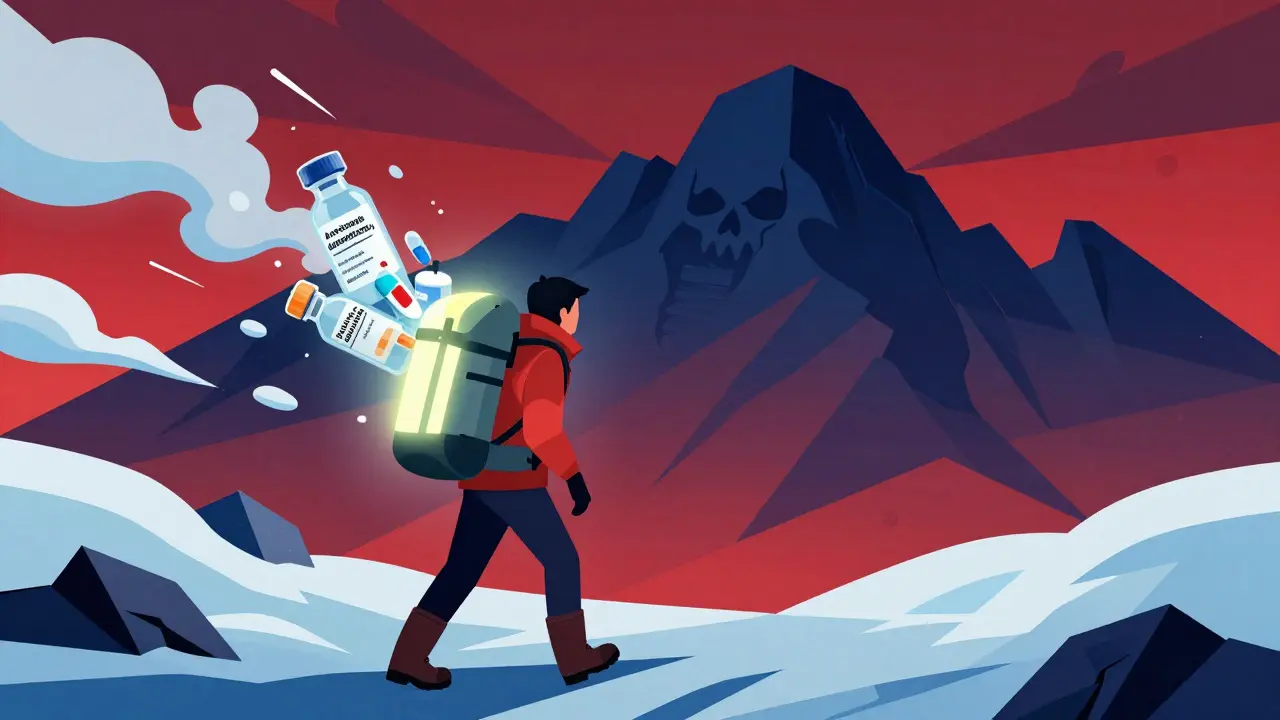
When you're heading up a mountain for a pilgrimage or a trek, your body doesn't just face long walks and cold weather-it faces a silent, dangerous opponent: low oxygen. At 14,000 feet, the air holds nearly 40% less oxygen than at sea level. That’s not just uncomfortable-it can kill. And if you’re relying on local pharmacies or health camps along the trail, you might be out of luck. Studies show that 89% of high-altitude health posts in Nepal didn’t have the basic meds needed to treat altitude sickness in 2013. You can’t afford to gamble with your health. This isn’t about packing extra socks. It’s about knowing exactly what medications to bring, how to store them, and when to use them-before you even leave home.
Know Your Risks Before You Go
Altitude sickness isn’t a one-size-fits-all problem. It comes in three main forms: Acute Mountain Sickness (AMS), High Altitude Pulmonary Edema (HAPE), and High Altitude Cerebral Edema (HACE). AMS feels like a bad hangover-headache, nausea, dizziness. HAPE fills your lungs with fluid; you’ll gasp for air even when resting. HACE swells your brain; confusion, loss of coordination, and vomiting are warning signs. At 17,500 feet-like at Everest Base Camp-nearly half of all trekkers get AMS. And if you’re diabetic, on blood pressure meds, or have asthma, your risk goes up even more.Most people think, “I’m fit, I’ll be fine.” But fitness doesn’t protect you from low oxygen. The real factor is how fast you climb. Going from sea level to 12,000 feet in one day-like flying into Lhasa-is a recipe for trouble. The body needs time to adjust. Even if you’re on a tight schedule, you can’t skip acclimatization. That’s why the Wilderness Medical Society says the best defense isn’t just medicine-it’s pacing. But when you can’t go slow, medicine becomes your safety net.
Essential Medications to Pack
You don’t need a pharmacy in your backpack, but you do need these four key drugs, backed by decades of research:- Acetazolamide (Diamox): This is the gold standard for preventing AMS. Take 125 mg twice a day, starting one day before you climb and continuing for three days after reaching high altitude. It helps your body breathe faster and adjust to lower oxygen. Side effects? More frequent urination and tingling fingers. That’s normal. But if you’re allergic to sulfa drugs (about 4% of people), skip this. Talk to your doctor first.
- Dexamethasone: Not for prevention. This is your emergency rescue drug for HACE. If someone starts stumbling, acting confused, or can’t walk a straight line, give 8 mg right away, then 4 mg every 6 hours. It doesn’t cure it-it buys you time to descend. Keep it in your daypack, not your main bag.
- Nifedipine (extended-release): For HAPE. Take 20 mg every 12 hours if you’re at high risk or if symptoms show up. It opens up the blood vessels in your lungs. Don’t wait until you’re gasping. If you have heart problems, ask your doctor if this is safe for you.
- Supplemental oxygen: Portable oxygen canisters aren’t luxury items anymore. They’re life-saving tools. Even a small 2-liter canister can give you hours of relief when symptoms hit. Some trekkers carry them as insurance, especially if they’re older or have a history of breathing issues.
Don’t forget the basics: ibuprofen for headaches and inflammation, azithromycin for traveler’s diarrhea (which affects 60% of trekkers), and diphenhydramine for allergic reactions or sleep aid. Antibiotics and painkillers should be in their original bottles with labels. No unlabeled pills.
Storage Is Just as Important as the Meds
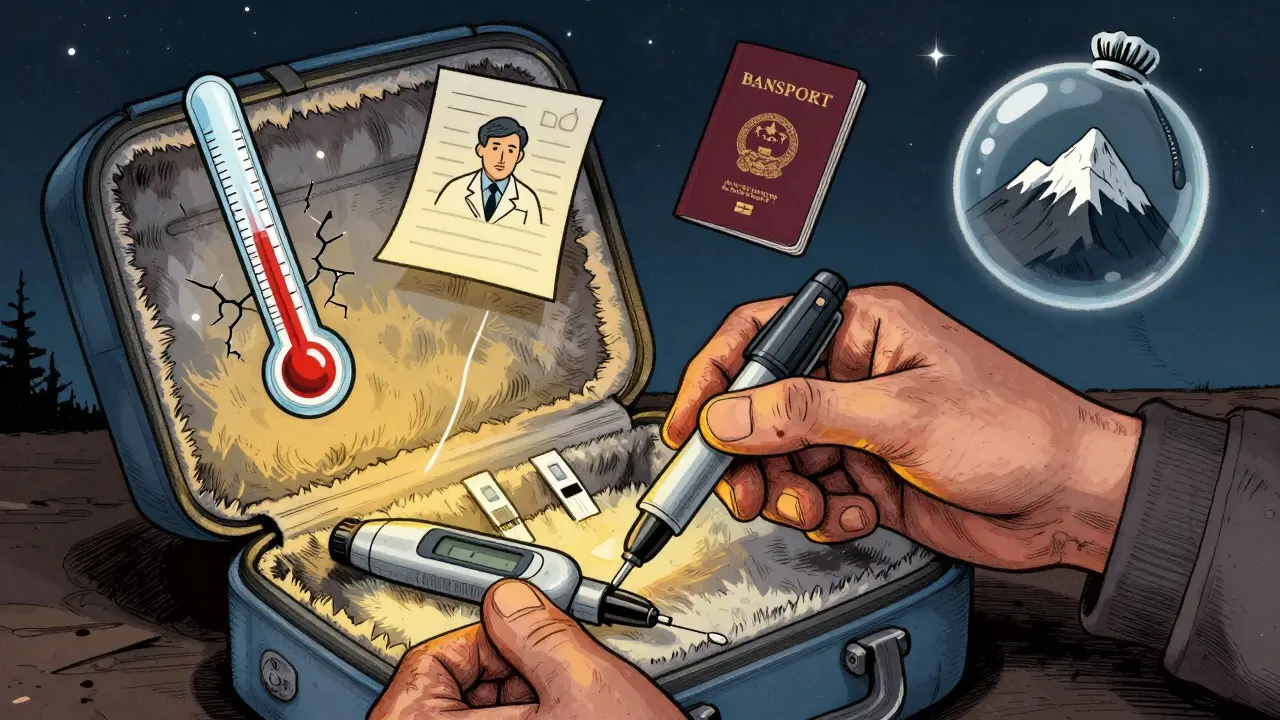
Medications don’t just vanish-they degrade. Insulin? It loses 25% of its strength in 24 hours if it gets colder than 32°F. Glucometers? They give wrong readings below freezing. One Reddit user lost control of their diabetes at 14,000 feet because their insulin froze. They needed a $4,200 evacuation.Here’s what to do:
- Use insulated, waterproof containers. Look for ones rated to keep meds between 59°F and 77°F.
- Keep insulin, epinephrine pens, and other temperature-sensitive drugs close to your body-like in an inner jacket pocket, not the bottom of your pack.
- For long treks, bring extra insulin and test strips. Store them in separate bags in case one gets wet or damaged.
- Never leave meds in your checked luggage. Airlines lose bags. High altitudes and temperature swings in cargo holds can ruin your meds before you even land.
The CDC says: Pack everything in original containers with pharmacy labels. If you’re carrying controlled substances like strong painkillers or ADHD meds, bring a letter from your doctor. Some countries require special permits. In 2021, 17% of trekking groups had to file paperwork just to bring their meds across borders.
Pre-Trip Medical Checkup Is Non-Negotiable
You wouldn’t drive a car without checking the oil. Why fly to Nepal and skip a doctor’s visit? The CDC says pre-travel consultation is the single most effective way to prevent travel-related illness. And it’s not just about altitude.Here’s what your doctor should check:
- Heart and lung function-especially if you’ve had pneumonia, asthma, or high blood pressure.
- Diabetes management-can your insulin handle the cold? Do you have enough supplies?
- Medication interactions-some drugs make altitude sickness worse. Beta-blockers, for example, can mask early symptoms of HAPE.
- Travel vaccines-typhoid, hepatitis A, and rabies are common risks in remote areas.
Get this done at least 4-6 weeks before you leave. That gives time to adjust prescriptions, get refills, or get special permits. The Himalayan Rescue Association says 83% of serious altitude complications could have been avoided with a simple pre-trip checkup.
What to Do If You or Someone Gets Sick
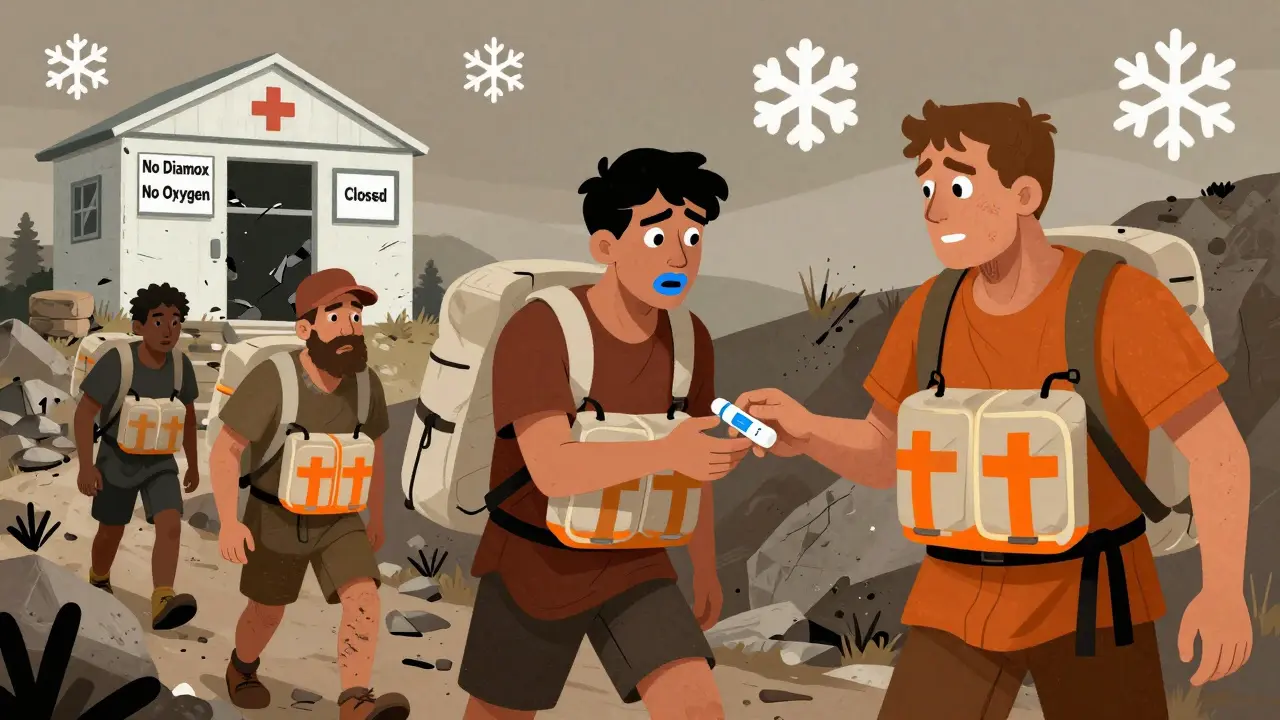
If someone starts showing signs of HACE or HAPE-confusion, blue lips, gasping for air-time is everything. The only real cure is descent. But if you’re stuck in a storm or at a remote camp, here’s your action plan:- Stop climbing immediately.
- Give dexamethasone (for HACE) or nifedipine (for HAPE) right away.
- Use supplemental oxygen if you have it.
- Call for help. If you’re with a group, send someone down to get assistance.
- Do NOT let the person sleep. Keep them awake and warm.
- Use a Gamow bag if you have one. These portable hyperbaric chambers simulate lower altitude. They’re rare on trails-but lifesavers when you find them.
And never, ever ignore symptoms because “it’s just fatigue.” I’ve heard too many stories of people who pushed through, only to end up in a helicopter or worse. The trail will still be there tomorrow. Your lungs and brain won’t.
Plan for the Unexpected
You can’t control the weather. You can’t control whether the local clinic has acetazolamide. But you can control your preparation.Here’s a quick checklist:
- Carry a full supply of all prescription meds for the entire trip-plus 3 extra days’ worth.
- Bring copies of prescriptions and doctor’s letters.
- Know the symptoms of AMS, HAPE, and HACE-and teach your travel partners.
- Use a waterproof, insulated case for all meds.
- Bring a small first aid kit with antiseptic, bandages, and painkillers.
- Buy a portable oxygen canister if you’re going above 15,000 feet.
- Don’t rely on local pharmacies. They may not have what you need.
Over 76% of trekkers now buy pre-packaged medical kits. They’re not perfect-but they’re a good start. If you’re going on a guided trek, ask if they carry emergency meds. If they don’t, bring your own.
It’s Not Just About You
Pilgrimages and treks aren’t solo journeys. You’re part of a group. If you’re prepared, you’re not just saving yourself-you’re helping others. If someone in your group gets sick, your extra dexamethasone or oxygen could be the difference between life and death. And if you’re part of a religious group making the pilgrimage together, talk to your leader. Push for basic meds to be carried by the group. Demand that guides know how to use them.There’s a growing movement in Nepal and India to train local health workers on altitude medicine. In 2021, Nepal distributed 15,000 medication kits along pilgrimage routes-and hospitalizations dropped by 22%. That’s proof that preparation works. You don’t have to wait for governments to act. Start with your own pack.
Final Thought: Don’t Let a Simple Mistake Ruin Your Journey
You’ve planned the route. You’ve bought the gear. You’ve saved for months. Don’t let one overlooked pill or a frozen insulin pen turn your pilgrimage into a nightmare. Medication preparation isn’t an afterthought. It’s the foundation of your safety. Treat it like your passport. Pack it. Protect it. Know how to use it.Can I buy altitude sickness meds in Nepal or India?
Yes, you can find acetazolamide and ibuprofen in major towns like Kathmandu or Delhi. But don’t rely on it. Pharmacies in remote areas often don’t stock critical meds like dexamethasone or nifedipine. A 2013 study found 89% of high-altitude health posts lacked these essential drugs. Bring your own supply from home, in original packaging with prescriptions.
Is Diamox safe for everyone?
No. If you have a sulfa allergy (about 3-6% of people), avoid acetazolamide. Symptoms include rash, swelling, or trouble breathing. If you’re unsure, get tested before your trip. Alternatives include dexamethasone for prevention (though it’s not ideal for long-term use) or focusing on slow ascent and hydration.
How much water should I drink at high altitude?
Drink 4 to 5 liters per day. Dehydration makes altitude sickness worse. Your body loses more water through breathing in thin air. Carry a water filter or purification tablets-contaminated water causes diarrhea in 60% of trekkers. Avoid alcohol and caffeine-they dehydrate you further.
Do I need a doctor’s note for my medications?
Yes, especially for controlled substances like strong painkillers, ADHD meds, or insulin pens. Customs officials and airlines may ask. A letter from your doctor listing your meds, dosages, and why you need them avoids delays or confiscation. Even for non-controlled meds, having prescriptions helps if you lose your bottles.
What if my glucometer stops working at high altitude?
Many glucometers give inaccurate readings below 32°F. At 14°F, error rates jump to 18%. Keep your device and test strips warm-store them in an inner pocket. Bring extra batteries and test strips. Consider carrying a backup glucose meter if possible. Always confirm readings with symptoms: dizziness, sweating, confusion mean low blood sugar, even if the meter seems off.
Can I take these meds if I’m pregnant?
Acetazolamide and dexamethasone are not recommended during pregnancy unless absolutely necessary. High-altitude travel itself carries risks for pregnant women. Consult your OB-GYN before planning any trek above 8,000 feet. Most experts advise against high-altitude pilgrimages during pregnancy due to potential fetal risks.
Comments
Alec Amiri January 23, 2026 at 06:53
Bro, I went to Everest Base Camp last year and didn’t bring a single pill. Just drank tea and prayed. Guess what? I lived. People overthink this stuff. Your body’s smarter than your pharmacy.
Lana Kabulova January 23, 2026 at 18:14
I’m not saying you’re wrong-but have you considered that altitude sickness isn’t just about meds? It’s about hydration, pacing, and mental state? I’ve seen people pop Diamox like candy and still collapse because they didn’t sleep right or drank too much whiskey at base camp. You can’t medicate your way out of bad decisions.
Mike P January 24, 2026 at 18:40
Look, I’m American, and I’ve hiked every mountain in Colorado. You don’t need all this fancy science. If you’re fit, you don’t need Dexamethasone. If you’re weak, you shouldn’t be up there in the first place. This article reads like a pharmaceutical ad. I’ve seen Nepali porters climb 20,000 feet with no meds and no problems. Why? Because they’re built for it. Stop treating altitude like a disease.
Sarvesh CK January 24, 2026 at 19:08
There is a profound truth in the idea that preparation is not merely logistical, but spiritual. In many Himalayan traditions, the journey itself is the purification. To carry medication is not a sign of weakness, but of responsibility-to oneself, and to one’s companions. The body may be frail, but the will, when aligned with awareness, becomes resilient. Perhaps the real medicine is not in the pill, but in the intention with which we undertake the climb.
Akriti Jain January 25, 2026 at 08:47
89% of clinics don’t have meds? 😏 Funny how that lines up with the WHO’s ‘global health equity’ reports… and also how Diamox is made by a US pharma giant. Coincidence? Or is this all just a clever way to sell you pills while pretending to save your life? 🤔💊 #BigAltitudePharma
Rob Sims January 27, 2026 at 01:24
Wow. Just… wow. You actually think people need to carry oxygen canisters like they’re going to Mars? I’ve seen tourists in Nepal with 5kg of meds and still cry because the stairs were steep. You’re not preparing for a trek-you’re preparing for a medical evacuation. Chill out.
arun mehta January 27, 2026 at 21:56
As someone who has guided pilgrims in the Himalayas for 18 years, I can say this: the most important thing is not what you carry, but who you travel with. A group that shares water, watches for signs, and stops when someone falters-that’s the real safety net. Medications are tools. Compassion is the medicine.
Keith Helm January 29, 2026 at 17:40
It is imperative that all individuals undertaking high-altitude expeditions adhere strictly to evidence-based protocols. Failure to do so constitutes a reckless disregard for personal and collective safety. The data is unequivocal. The risk is quantifiable. The consequences are irreversible.
Patrick Roth January 31, 2026 at 02:07
Actually, the 89% stat is from 2013. Things have changed. Nepal’s government now requires all trekking agencies to carry emergency kits. Also, Diamox is banned in Bhutan. So… your whole argument? Kinda outdated. Just saying.
Ryan Riesterer February 1, 2026 at 23:37
Insulin degradation at sub-zero temps follows first-order kinetics. The 25% loss figure is derived from Arrhenius modeling under controlled lab conditions. Real-world variability is ±12%. Also, glucometers exhibit altitude-induced electrochemical drift above 12,000 ft due to barometric pressure differentials. You need to calibrate in situ.
Kenji Gaerlan February 3, 2026 at 02:18
bro i just brought my insulin and forgot the test strips… and yeah i cried at 14k. dont be me
Lauren Wall February 4, 2026 at 16:58
Why do people think they need to bring oxygen? You’re not climbing K2. Just walk slower. And stop buying overpriced ‘trekking kits’ from Amazon. Your local pharmacy has all this.
Philip House February 5, 2026 at 13:25
It’s ironic. We’re told to prepare like our life depends on it-yet we’re also told to ‘trust the journey.’ But if your life depends on a pill, then the journey isn’t sacred-it’s a gamble. And if you’re gambling with your health, are you really on a pilgrimage? Or just a tourist with a checklist?
Chiraghuddin Qureshi February 6, 2026 at 03:08
As an Indian who’s done Kailash Mansarovar twice, I can say this: locals don’t use Diamox. They use ginger tea, garlic soup, and rest. Maybe the answer isn’t more meds-but reconnecting with traditional wisdom. 🙏🌿