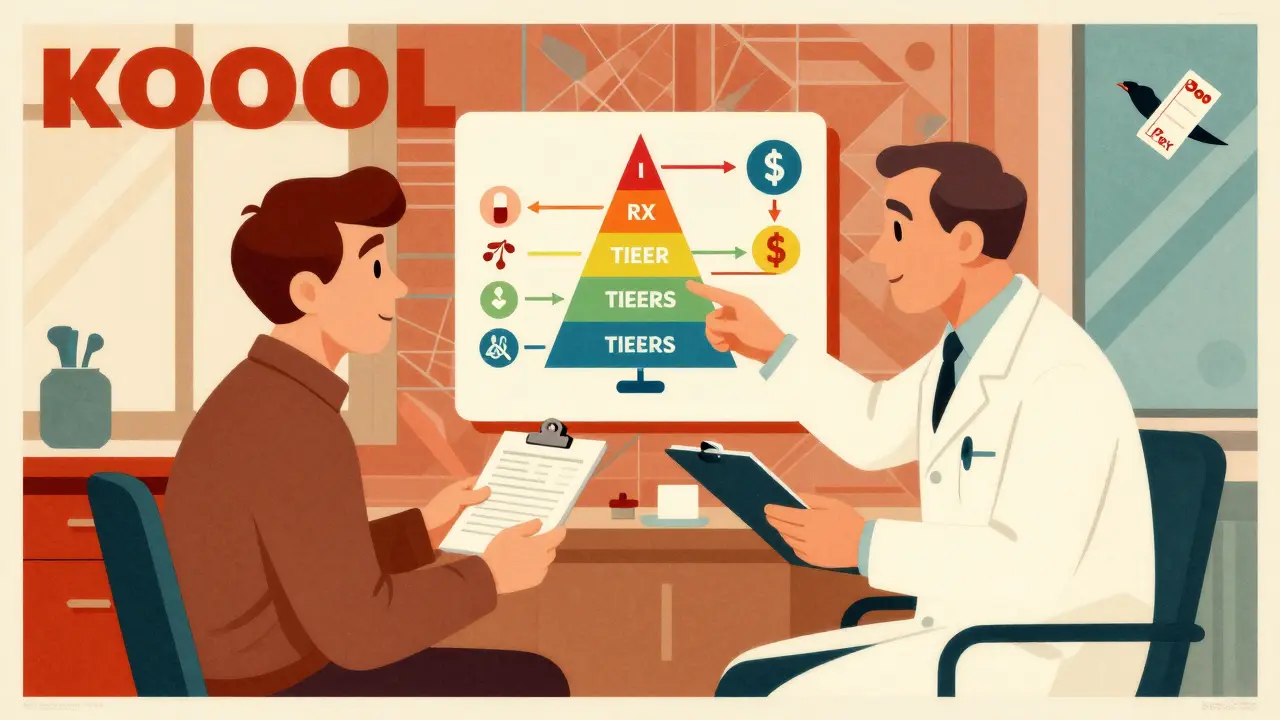
Getting a new prescription shouldn’t feel like a surprise bill waiting to happen. Yet, prescription cost is one of the most common reasons people skip doses, delay refills, or stop taking medication altogether. Around 22% of prescriptions are never picked up because the patient couldn’t afford the out-of-pocket price at the pharmacy. That’s not just inconvenient-it’s dangerous. The good news? You don’t have to wait until you’re standing at the counter to find out how much something costs. You can-and should-talk about it before your doctor even writes the script.
Why Cost Discussions Matter Before You Leave the Office
Most people assume their doctor knows what their insurance will cover. But the truth is, doctors aren’t always aware of the exact copay for your specific plan. Insurance formularies change constantly. A drug that was covered last month might now require prior authorization-or cost $150 instead of $30. According to a 2023 study in the Journal of General Internal Medicine, patients who talk about cost with their provider are 37% less likely to skip doses because of money. That’s not a small number. It’s life-changing. The Inflation Reduction Act of 2022 changed the game for Medicare beneficiaries. Starting in 2025, out-of-pocket costs for prescription drugs under Medicare Part D are capped at $2,000 a year. In 2026, that cap drops to $2,100. Insulin now costs no more than $35 per month for Medicare users. These rules don’t apply to private insurance, but they’ve raised the bar for what patients should expect. If you’re on Medicare, you have rights. If you’re on private insurance, you still have options.Know Your Insurance Before the Appointment
Before you even walk into the doctor’s office, take five minutes to check your plan’s formulary. Every insurance company has one. It’s a list of drugs they cover and what you’ll pay for each. You can usually find it online by logging into your insurer’s website or calling customer service. Look for your medication by its generic or brand name. Note the tier it’s on. Most plans use a tier system:- Tier 1: Generic drugs-usually $5 to $15
- Tier 2: Preferred brand-name drugs-$25 to $50
- Tier 3: Non-preferred brand-name drugs-$50 to $100
- Tier 4 or Specialty: High-cost drugs-often 25% to 33% coinsurance, sometimes over $200 per fill
Ask These Five Questions at Your Appointment
Don’t wait for your doctor to bring it up. Be direct. Here’s what to say:- “Is there a generic version of this drug?” Generics are chemically identical to brand names but cost up to 80% less.
- “Will this be covered under my plan?” Even if it’s on the formulary, some drugs need prior authorization. Ask if that’s required.
- “What’s my estimated out-of-pocket cost?” Don’t settle for “I think it’s affordable.” Ask for a number. If your doctor doesn’t know, ask if they can check using a tool like Surescripts’ Real-Time Prescription Benefit (RTPB), which shows live cost data inside most electronic health records.
- “Can I get a 90-day supply?” Many plans offer lower copays for mail-order or 90-day fills. You might save $50 or more per month.
- “Are there patient assistance programs or coupons?” Many drug manufacturers offer savings cards. GoodRx, SingleCare, and RxSaver also let you compare cash prices at local pharmacies-even if you have insurance.
Use Tools to Compare Prices Before You Leave
Your phone is your best friend here. Open GoodRx or SingleCare while you’re still in the waiting room. Type in your drug, your zip code, and your insurance. You might be shocked. In one case, a patient in Sydney found her blood pressure medication cost $140 at her local pharmacy with insurance-but only $27 using a GoodRx coupon. She showed the pharmacist the price, and they accepted it. That’s not a trick. It’s legal. Pharmacies often accept these coupons even if you’re insured. If you’re on Medicare, use the Medicare Plan Finder tool. It lets you compare costs across different Part D plans. You can only switch plans during the Annual Enrollment Period (October 15 to December 7), but if you’re already on a plan, you can see how much your current drugs will cost next year. That helps you decide if you need to change plans.What If Your Drug Isn’t Covered?
If your doctor prescribes a drug that’s not on your formulary, don’t panic. You have two paths:- Ask for a generic or alternative. Sometimes, switching to a similar drug in the same class works just fine. For example, if you’re on a brand-name statin, there are at least three generics that work equally well.
- Ask for a prior authorization. Your doctor can submit paperwork to your insurer asking them to make an exception. About 68% of specialty drugs require this, and it’s often approved if there’s medical justification. Don’t assume it’s denied-ask your doctor to try.
Timing Matters: Pay Attention to Your Deductible
If you’re on a high-deductible plan, the time of year affects your bill. Most people hit their deductible between January and March. That means even if your drug is covered, you might pay full price until your deductible is met. In 2023, the average individual deductible for marketplace plans was $480. If you fill a $200 prescription in February, you’re paying $200 out of pocket. Wait until July, and you might pay $30. Plan ahead. If you know you’ll need a new prescription in January, ask your doctor if they can write a 90-day supply to be filled in December. That way, you use your deductible before the new year starts.
Medicare’s New Payment Plan: Spread Out Your Costs
Starting in 2025, Medicare Part D beneficiaries can enroll in the Medicare Prescription Payment Plan. This lets you pay for your medications in monthly installments instead of one big bill at the pharmacy. It’s especially helpful if you’re on multiple high-cost drugs. You pay up to $2,100 total per year, but it’s spread out. The catch? You have to sign up early. If you enroll after September, there aren’t enough months left in the year to make the payments manageable.What If Your Doctor Doesn’t Want to Talk About Cost?
Some doctors still don’t bring up cost because they’re not trained to, or they assume you’ll figure it out. That’s changing. The American Medical Association has recommended cost discussions since 2018. If your doctor brushes you off, say this: “I want to make sure I can afford this. Can we find a more affordable option?” Most will respond. If they don’t, ask for a referral to a pharmacist or patient advocate. Pharmacists are now trained to step in. The American Pharmacists Association says pharmacists should initiate cost conversations if a patient’s out-of-pocket cost exceeds 2% of their monthly income. That’s about $80 for someone earning $4,000 a month. If you’re paying more than that, ask your pharmacist if there’s a cheaper way.Final Tip: Write It Down
After your appointment, write down:- The drug name (generic and brand)
- What your insurance says it will cost
- What GoodRx says it costs
- Whether prior authorization is needed
- Who to call if there’s a problem
Prescription costs aren’t going away. But you don’t have to be powerless against them. Talking about money before you get the script isn’t rude-it’s smart. It’s part of your right to care. And with the new rules in place, you have more power than ever to control what you pay.
Can I use GoodRx even if I have insurance?
Yes. GoodRx coupons often work even if you have insurance. Pharmacies accept them because they’re designed to compete with insurance pricing. Always ask the pharmacist to check both your insurance price and the GoodRx price-you might save hundreds.
What if my insurance doesn’t cover my medication at all?
Ask your doctor for a generic alternative or a similar drug in the same class. If that’s not possible, ask them to file a prior authorization request. You can also check for manufacturer assistance programs-many offer free or low-cost medication to those who qualify.
Why do some drugs cost more even though they’re the same?
Different brands or formulations can have different prices because of patent protections, marketing, or pharmacy contracts. Generic versions are chemically identical but often cost 80% less. Always ask if a generic is available.
Does the Medicare Prescription Payment Plan work for all drugs?
It works for most Part D-covered drugs, but you must enroll before September to get the full benefit. It’s designed to help with high-cost medications, especially those requiring monthly refills. It doesn’t cover non-covered drugs or over-the-counter items.
How do I know if my doctor uses real-time cost tools?
Ask directly: “Can you check my out-of-pocket cost for this drug right now using your system?” If your doctor’s office uses an electronic health record (EHR) like Epic or Cerner, there’s a good chance they have access to Surescripts’ Real-Time Prescription Benefit tool. About 72% of U.S. practices use this as of 2024.
Are there free programs to help pay for prescriptions?
Yes. Many drug manufacturers offer patient assistance programs (PAPs) for low-income patients. You can apply online through organizations like NeedyMeds or RxAssist. These programs often provide free or deeply discounted medications with little paperwork.
If you’re on Medicare, check the Medicare.gov website for updated plan details each October. If you’re on private insurance, call your plan’s customer service with the drug’s NDC number for the most accurate price. And always, always ask-before you leave the office.
Comments
Aurelie L. January 27, 2026 at 04:20
I once paid $200 for a pill that should've been $12. I cried in the pharmacy. No one asked. No one cared. Now I bring a printed list of prices before every appointment.
Joanna Domżalska January 28, 2026 at 15:12
This whole thing is just capitalism pretending to care. Doctors don't care about cost because they're paid to prescribe, not to save you money. The system is broken. You're not supposed to win.
Faisal Mohamed January 29, 2026 at 21:18
The real issue is the pharmacoeconomic dissonance in the U.S. healthcare industrial complex 🤔💊. We're optimizing for shareholder value, not patient outcomes. GoodRx is a band-aid on a hemorrhage. #PharmaCritique
Josh josh January 31, 2026 at 04:10
bro just use goodrx its free like why are we overcomplicating this i got my blood pressure med for 7 bucks last week and my doc didnt even know
bella nash February 2, 2026 at 03:59
It is imperative that patients engage in proactive dialogue with their healthcare providers regarding pharmaceutical expenditures. The absence of such communication may result in non-adherence, which is clinically detrimental.
Sally Dalton February 3, 2026 at 13:29
OMG YES THIS!! I had no idea my insulin was gonna be $400 until I asked and then my doc was like oh wait we can switch you to this other one for $15 😭 I feel so dumb for not asking sooner but now I ask EVERY TIME. Thank you for writing this!!
Shawn Raja February 5, 2026 at 08:52
Let me guess - you’re one of those people who thinks ‘just ask’ is a solution. Cool. Meanwhile, my grandma had to choose between her blood pressure med and her groceries last winter. You think a 78-year-old with arthritis is gonna Google GoodRx while her hands shake? This isn’t a productivity hack. It’s a moral failure.
Ryan W February 5, 2026 at 10:14
This is why America needs to stop being soft. If you can't afford your meds, you shouldn't be taking them. We're not a welfare state. Get a job. Or move to Canada. They handle this better.
Allie Lehto February 6, 2026 at 13:04
I used to be one of those people who just paid whatever they asked. Then I found out my anxiety med was $300 and I could've paid $12 with a coupon. I felt SO stupid. Like I let myself be exploited. Now I check every prescription like it's my job. And I tell everyone. Don't be like me.
Dan Nichols February 7, 2026 at 12:50
The fact that we need a guide like this proves the system is broken. Doctors should know this stuff. Pharmacies should be transparent. Patients shouldn't have to become financial analysts just to breathe. This isn't empowerment. It's damage control.
Renia Pyles February 9, 2026 at 01:30
I called my doctor’s office to ask about cost and they hung up on me. Then I called again and they said ‘we don’t discuss pricing.’ So I went to the pharmacy and paid $220 for a pill that cost $18 cash. Now I’m mad. And I’m not alone.
Rakesh Kakkad February 10, 2026 at 05:06
In my country, the government subsidizes essential medications. It is a fundamental right, not a privilege. The notion that one must negotiate with a physician for life-sustaining pharmaceuticals is both archaic and inhumane. I hope your system evolves.