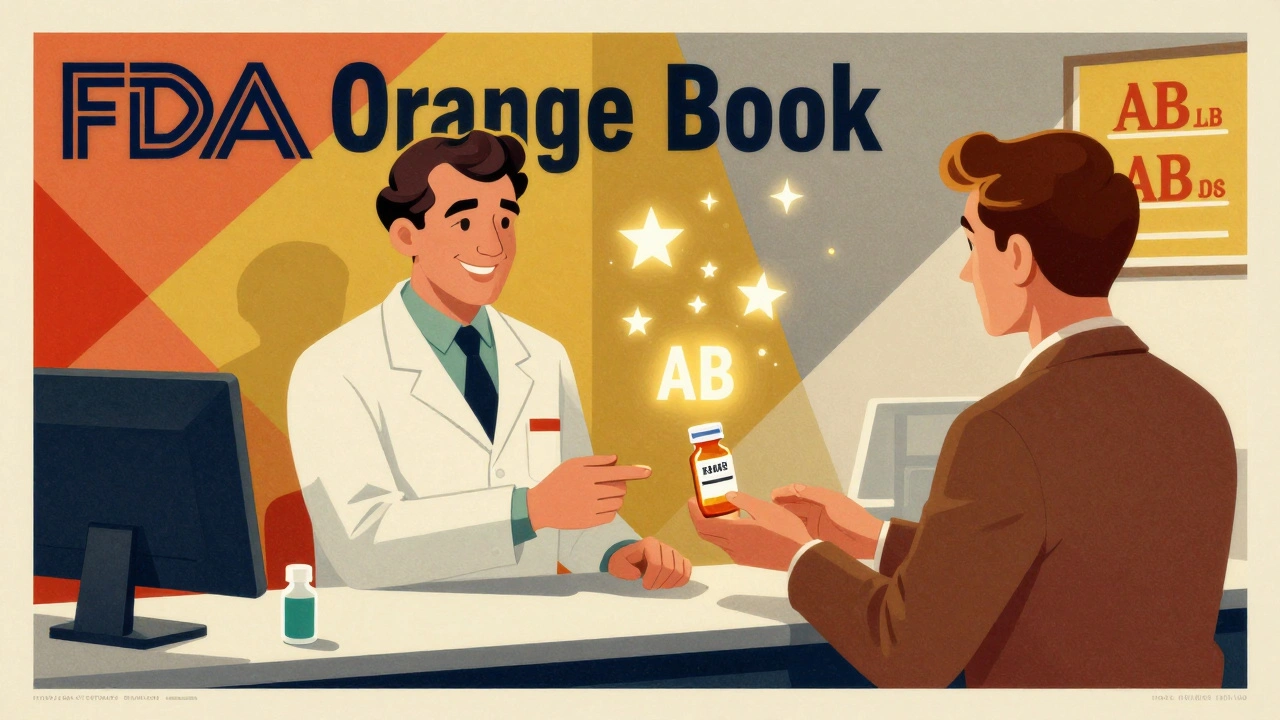
When your doctor writes a prescription, you might not realize you have a choice - and that choice could save you hundreds of dollars a year. Most brand-name drugs have cheaper, equally effective generic versions. But how do you know if one is available for your specific medication? It’s not always obvious. You might assume your pharmacist automatically swaps in a generic, but that’s not always the case. Sometimes, the switch doesn’t happen unless you ask. And sometimes, even when a generic exists, it’s not approved for your condition. This isn’t about cutting corners - it’s about making sure you get the right medicine at the right price.
What Makes a Generic Medication Official?
A generic drug isn’t just a copy. It’s a legally approved version of a brand-name drug that contains the same active ingredient, dose, and way of being taken - whether it’s a pill, injection, or cream. The U.S. Food and Drug Administration (FDA) requires generics to match the brand-name drug in strength, safety, and how quickly it’s absorbed into your body. This is called bioequivalence. The FDA tests these drugs using strict standards: the generic must deliver between 80% and 125% of the brand’s absorption rate. That’s not a wide gap - it’s tight enough to ensure your body responds the same way.
Not every drug has a generic. About 10% of medications still don’t, mostly because they’re protected by patents. These patents can last up to 17 years from the date they’re filed, though extensions and legal battles sometimes delay generics for longer. But for most common prescriptions - like high blood pressure pills, cholesterol meds, or antibiotics - a generic is likely already available.
The FDA’s Orange Book: Your Secret Weapon
The FDA publishes a document called the Orange Book - officially titled Approved Drug Products with Therapeutic Equivalence Evaluations. It’s not flashy, but it’s the most reliable source for knowing if a generic is approved as interchangeable with your brand-name drug. Each approved generic gets a two-letter code. The most important one is AB. If you see that, it means the generic is considered fully equivalent and can be substituted without concern.
Other codes like BX mean there are known issues - maybe the drug has a complex delivery system, like an inhaler or extended-release tablet, where switching could affect how it works. These aren’t unsafe, but they need more caution. If your doctor prescribed a drug with a BX rating, don’t assume the generic will work the same without checking with them first.
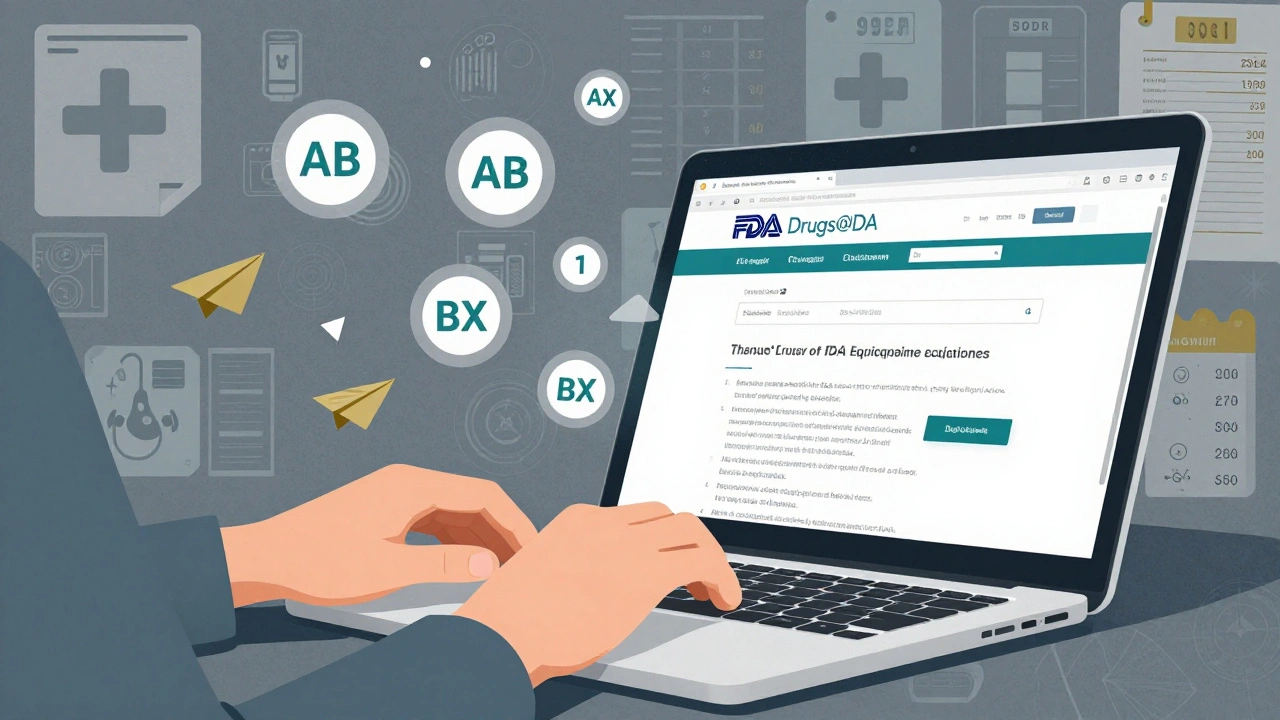
How do you find this? Go to the FDA’s Drugs@FDA website. Type in your brand-name drug. Look under the "Therapeutic Equivalence Code" column. If it says AB, you’re good to go. If it’s BX or not listed, you’ll need to dig deeper.
Ask Your Pharmacist - But Ask the Right Way
The fastest, most reliable way to check for a generic is to ask your pharmacist. They have real-time access to databases that track which generics are approved, covered by your insurance, and in stock. A 2022 study in JAMA Internal Medicine found pharmacists correctly identify generic alternatives 98.7% of the time.
But don’t just ask, “Do you have a generic?” That’s too vague. Instead, say: “Is there a therapeutically equivalent generic available for this prescription?” That’s the exact phrase the American Pharmacists Association recommends. It signals you know what you’re asking for - and it gets you the right answer.
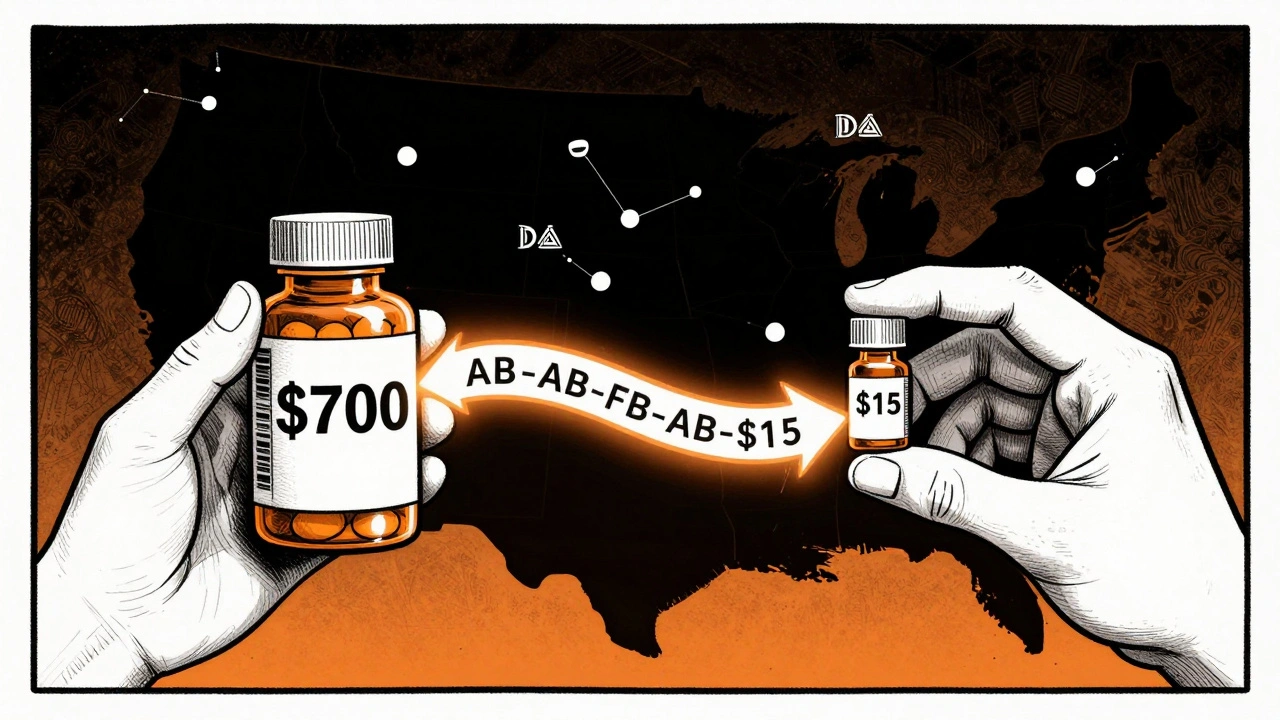
Most major pharmacy chains - CVS, Walgreens, Rite Aid - have systems that automatically suggest generics when they’re available. But if your prescription was filled without a suggestion, it’s worth asking. Many people don’t realize they’re paying $700 for a brand-name drug when a generic costs $15.
Use Tools Like GoodRx - But Don’t Rely on Them Alone
Apps like GoodRx are great for comparing prices. They show you how much a generic costs at nearby pharmacies and even offer coupons. Over 35 million Americans use GoodRx every month. But here’s the catch: GoodRx tells you what’s cheap - not always what’s therapeutically equivalent.
For example, you might see three different generic versions of a drug, all priced differently. One might be AB-rated. Another might be BX. GoodRx won’t always tell you which is which. That’s where the FDA’s Orange Book comes in. Use GoodRx to find the best price, then double-check the therapeutic code on Drugs@FDA. Don’t skip the second step.
Medicare and Insurance Plans: Watch for Automatic Substitutions
If you’re on Medicare Part D or have private insurance, your plan might automatically switch your brand-name drug to a generic without telling you. That’s legal - and often helpful. But it can also cause confusion. A 2023 study found 41% of Medicare beneficiaries didn’t know their medication had been changed.
Starting January 1, 2024, Medicare plans are required to show you real-time generic availability through the Medicare Plan Finder tool. Log in, search your drug, and look for the “Therapeutic Equivalence” note. If your plan doesn’t list a generic, it might be because it’s not covered - not because it doesn’t exist. Always check both the plan formulary and the FDA’s database.
When Generics Aren’t Safe to Swap
For most drugs, generics are perfectly safe. But for some, even small differences matter. These are called narrow therapeutic index (NTI) drugs. Examples include warfarin (a blood thinner), levothyroxine (for thyroid conditions), and certain seizure medications like phenytoin.
Studies show that in 5-8% of patients taking NTI drugs, switching between different generic versions can cause noticeable changes in blood levels - enough to affect how well the drug works or increase side effects. If you’re on one of these, your doctor may need to write “Dispense as Written” on the prescription. Even then, don’t assume all generics are the same. Stick with the same manufacturer if possible.
What If No Generic Is Available?
If you search and find no AB-rated generic, don’t assume you’re stuck paying full price. Sometimes, a generic exists but isn’t approved for your exact use. For example, a generic might be approved for high blood pressure but not for heart failure - even though it’s the same pill. Talk to your doctor. They can check if the generic is still appropriate for your condition.
Also, check the ASHP Drug Shortages database. Even if a generic exists, it might be out of stock. As of November 2023, over 280 drugs were in short supply, including some generics. If your usual generic isn’t available, your pharmacist might offer a different brand of the same generic - or suggest a temporary alternative.
Real Savings, Real Stories
One person on Reddit saved $1,200 a year just by asking for a generic version of their cholesterol medication. Another TikTok user, a nurse with 2.4 million followers, showed how she used the FDA’s Drugs@FDA tool to find a $12 generic for a $400 brand-name drug. These aren’t outliers. They’re common.
The average brand-name drug cost $765 in 2022. The average generic? $15.23. That’s not a 20% savings - it’s an 85% drop. And it’s legal, safe, and backed by decades of FDA oversight.
Next Steps: What to Do Today
- Look at your prescription. Write down the brand name.
- Go to Drugs@FDA and search for it.
- Find the Therapeutic Equivalence Code. If it’s AB, a generic is approved and safe to use.
- Ask your pharmacist: “Is there an AB-rated generic available for this?”
- If you’re on Medicare, check the Medicare Plan Finder for your plan’s coverage.
- If your drug is for a narrow therapeutic index condition (like thyroid or seizures), talk to your doctor before switching.
You don’t need to be a pharmacist to do this. You just need to ask. And if you’re paying full price for a drug that has a $15 generic version - you’re overpaying. Not because you’re being careless. Because no one told you it was an option.
Are generic medications as safe as brand-name drugs?
Yes. The FDA requires generic drugs to meet the same strict standards as brand-name drugs for quality, strength, purity, and how they work in the body. They use the same active ingredients and are made in the same type of facilities. The only differences are in inactive ingredients like color or filler - which don’t affect how the drug works.
Why do some generics cost more than others?
Price differences come from supply, competition, and manufacturing. When a new generic enters the market, prices drop fast. But if only one company makes a generic, or if there’s a shortage, prices can rise. Always compare prices at different pharmacies - even the same generic can cost $5 at one store and $20 at another.
Can my pharmacist switch my medication without telling me?
In most cases, yes - unless your doctor wrote “Dispense as Written” on the prescription. Pharmacists are allowed to substitute generics for brand-name drugs if they’re rated AB by the FDA. But they’re not required to notify you. That’s why it’s important to ask about substitutions when you pick up your prescription.
What if my insurance won’t cover the generic?
That’s unusual, but it can happen. Sometimes, your plan’s formulary lists only one version of a drug - even if a cheaper generic exists. Call your insurer and ask why. You can also ask your doctor to file an exception request. Most plans will approve the generic if you show it’s FDA-approved and medically appropriate.
Are all generics made in the same countries?
No. Generics are made in many countries, including the U.S., India, and China. The FDA inspects all manufacturing facilities - no matter where they’re located - before approving a generic. If a facility fails inspection, the drug can’t be sold. You don’t need to worry about the country of origin as long as the drug is FDA-approved.
How often do generic drugs fail to work?
Very rarely. The FDA requires generics to be bioequivalent, meaning they work the same way in the body. In rare cases, patients report differences - often because they switched between different generic brands. If you notice a change in how you feel after switching, tell your doctor. But for most people, generics work just as well as brand-name drugs.
Can I switch from a brand-name drug to a generic without my doctor’s approval?
For most medications, yes - if your doctor didn’t say “Dispense as Written.” Pharmacists can legally substitute an AB-rated generic. But for drugs with narrow therapeutic indexes - like warfarin or levothyroxine - your doctor should be involved. Always check with them if you’re unsure.
Comments
Kenny Leow December 1, 2025 at 15:28
Just wanted to say this post saved me $800 last year on my blood pressure med. I never knew the FDA had that Orange Book thing - thought pharmacists just picked whatever was cheapest. Turns out, I was paying $300 for a $12 pill. Mind blown. 🤯
Kelly Essenpreis December 3, 2025 at 02:41
Generic drugs are a socialist scam designed to make Big Pharma look bad. The FDA is just a puppet of China and India. My grandpa took brand-name Lipitor and lived to 98. Your generic probably has talc and glitter in it.
Alexander Williams December 3, 2025 at 12:25
While the bioequivalence parameters set forth by the FDA are statistically robust, the pharmacokinetic variance within the 80–125% AUC window can induce suboptimal therapeutic outcomes in pharmacogenetically sensitive subpopulations. The assumption of therapeutic equivalence is an oversimplification of complex pharmacodynamic interactions.
Suzanne Mollaneda Padin December 5, 2025 at 12:10
Great breakdown. I work in a clinic and see patients overpay all the time. The trick is to ask for the AB-rated generic by name - pharmacists appreciate when you know what you're asking for. Also, if your drug is NTI (like levothyroxine), stick with the same manufacturer. Switching brands even within generics can throw off your labs.
Erin Nemo December 7, 2025 at 09:58
I used GoodRx to find my generic for $4 and then checked Drugs@FDA - turned out it was AB-rated. I felt like a genius. Also, my pharmacist gave me a free sample of the generic so I could test it out first. Best $0 I ever spent.
ariel nicholas December 7, 2025 at 22:38
....You know... the FDA... is not... a god... it's a bureaucracy... and bureaucracies... are inherently... flawed... and yet... we place our lives... in their... sanitized... spreadsheets... and call it... medicine...? ...I'm not saying generics are bad... I'm saying... we've outsourced our trust... to a machine... that doesn't feel... pain... or fear... or the quiet dread... of a missed dose... ...
Rachel Stanton December 8, 2025 at 11:47
For anyone new to this - if you're on Medicare, go to Medicare.gov and use the Plan Finder. Search your drug, click "Therapeutic Equivalence," and it'll show you exactly what's covered and if there's a generic. I walked my mom through this last month - she was paying $400 for a $17 generic. She cried. We saved $4,000 a year. This info matters.
Amber-Lynn Quinata December 9, 2025 at 03:25
Why do people just accept this? Why don’t we demand ALL drugs be made in the USA? Why are we letting foreign countries control our medicine? 🇺🇸💔 And why do you trust a pill made in a factory with no names on the wall? I’d rather pay more and know my life isn’t in the hands of some anonymous worker in a country that doesn’t even speak English. 😔