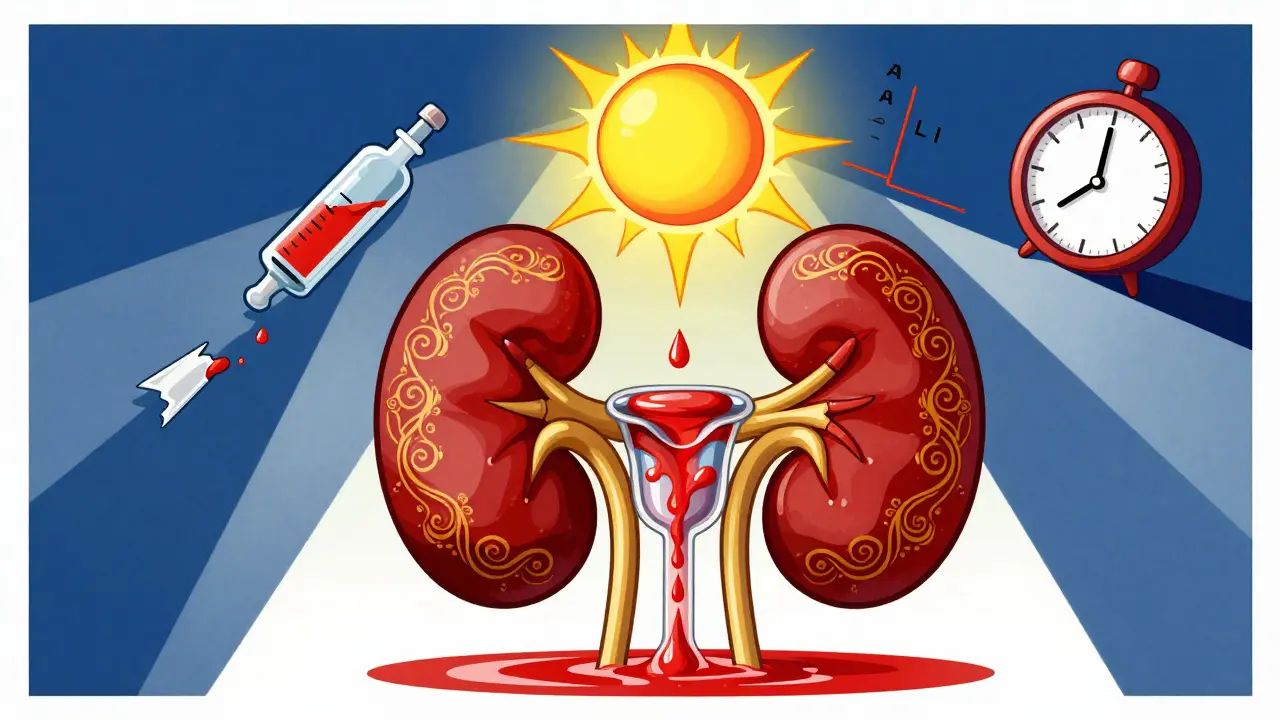
When your kidneys start leaking protein, it’s not just a lab result-it’s a warning sign your body is under siege. For people with diabetes, the earliest and most telling signal of kidney damage is albuminuria. It’s not something you feel. No pain. No swelling. Just a tiny amount of protein in your urine, quietly creeping up. But if you catch it early and act, you can stop diabetic kidney disease before it steals your kidney function-or your life.
What Is Albuminuria, Really?
Albumin is a protein your kidneys normally keep in your blood. When they’re healthy, they act like fine filters, holding onto albumin and letting waste pass out. But high blood sugar over time damages those filters. Once they’re leaky, albumin slips into your urine. That’s albuminuria. The old terms-microalbuminuria and macroalbuminuria-are gone. Since 2012, guidelines from KDIGO and the American Diabetes Association (ADA) now use three clear levels:- Normal: Less than 30 mg of albumin per gram of creatinine (UACR <30 mg/g)
- Moderately increased: 30 to 300 mg/g (what used to be called microalbuminuria)
- Severely increased: Over 300 mg/g (what used to be macroalbuminuria)
Here’s the critical part: any albumin above 30 mg/g means kidney damage is already happening. It’s not a "pre-disease"-it’s the first stage of diabetic kidney disease (DKD). And the higher the number, the faster things fall apart.
Studies tracking over 128,000 people with diabetes found that those with UACR over 300 mg/g had a 73% higher risk of dying from any cause and an 81% higher risk of dying from heart disease compared to those with normal levels. This isn’t just about kidneys-it’s about your whole body breaking down.
Why You Can’t Trust a Single Test
A single high UACR result doesn’t mean you have DKD. That’s because albumin in urine can spike temporarily. Exercise the day before? Infection? High blood sugar? Menstruation? Severe high blood pressure? All of these can cause a false alarm. That’s why guidelines require two out of three abnormal tests over a 3- to 6-month window to confirm diagnosis. If your first test shows 120 mg/g, don’t panic. Get it checked again in 3 months. And again. Only then can you be sure it’s real.Most clinics use a simple spot urine test-it’s fast, cheap, and accurate enough. Some labs still use 24-hour collections, but those are messy and rarely needed. The key is consistency: test once a year if you have diabetes. If albuminuria shows up, test every 3 months.
Tight Control Isn’t Just a Suggestion-It’s Survival
The best weapon against DKD isn’t a new drug. It’s control. Tight, consistent, long-term control. The landmark DCCT/EDIC study followed people with type 1 diabetes for over 30 years. Those who kept their HbA1c below 7% cut their risk of developing albuminuria by 39% and reduced progression to severe proteinuria by 54%. Even more powerful? The benefits lasted decades. That’s called "metabolic memory"-your body remembers good control, even after you slip up. For type 2 diabetes, the UKPDS showed something just as powerful: every 1% drop in HbA1c lowers your risk of kidney disease by 21%. That means going from 8.5% to 7.5% isn’t just a number-it’s a 21% lower chance of your kidneys failing.Today, ADA recommends HbA1c under 7% for most people with diabetes. But if you’re younger, have had diabetes for less than 10 years, and don’t have low blood sugar episodes, aiming for 6.5% can give you even stronger protection. For others, 7.5% might be safer. The goal isn’t perfection-it’s sustainable control.
Blood Pressure: The Hidden Killer
High blood pressure doesn’t just strain your heart-it crushes your kidneys. And in diabetes, the two are a deadly team. KDIGO recommends a target of less than 120/80 mmHg for people with DKD and UACR over 300 mg/g. But here’s the catch: the SPRINT trial showed that pushing systolic pressure below 120 reduced albuminuria by 39%, but also increased the risk of sudden kidney injury in 1 out of every 47 people. So the ADA and most doctors now recommend a target of less than 140/90 mmHg for most patients. That’s still tight enough to protect your kidneys without risking harm. The key is using the right drugs: ACE inhibitors or ARBs. These aren’t just blood pressure pills-they’re kidney protectors. They reduce albumin leakage even if your blood pressure is normal.And here’s the rule most patients miss: titrate to the highest tolerated dose. Don’t stop at 5 mg of lisinopril because your pressure is "fine." Go to 40 mg. Don’t settle for 25 mg of losartan. Go to 100 mg. The IRMA-2 trial proved that full-dose losartan cuts progression from moderate to severe albuminuria by 53%. That’s not a bonus-it’s the standard.
The New Game-Changers: SGLT2 Inhibitors and Finerenone
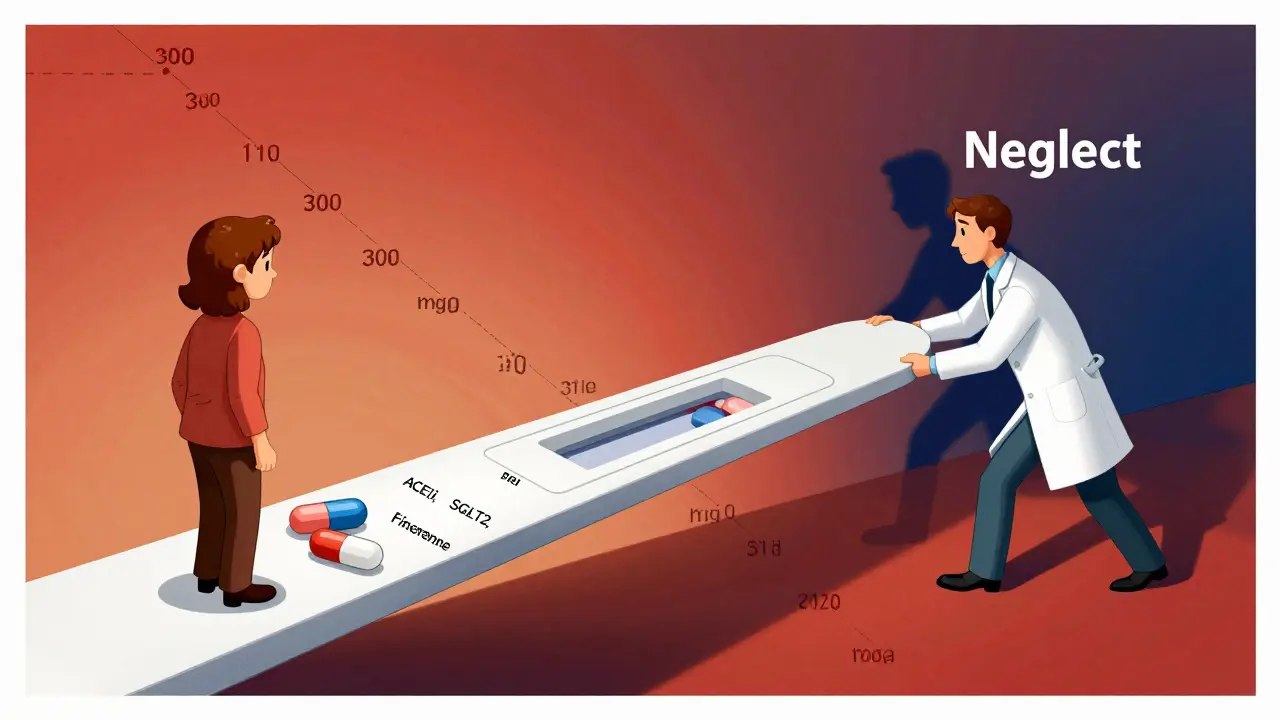
The old playbook-control sugar, control blood pressure, use ACEi/ARB-is still vital. But now, two new classes of drugs have changed everything. First, SGLT2 inhibitors: drugs like empagliflozin, dapagliflozin, and canagliflozin. Originally developed to lower blood sugar, they do something even more powerful: they protect the kidneys. The 2023 EMPA-KIDNEY trial showed that empagliflozin reduced the risk of kidney failure or death by 28% in patients with UACR over 200 mg/g-even if they were already on maximum ACEi/ARB therapy. Second, finerenone. This is a new type of mineralocorticoid receptor blocker. Unlike older drugs like spironolactone, it doesn’t cause dangerous potassium spikes. The FIDELIO-DKD trial showed that finerenone, when added to ACEi/ARB, reduced albuminuria by 32% in just 4 months and slowed kidney function decline by 23% over three years.Together, these drugs are revolutionizing care. But here’s the problem: only 28.7% of patients with DKD actually get both an SGLT2 inhibitor and a RAAS blocker. Why? Cost. Lack of awareness. Fear of side effects. And too often, doctors don’t know how to use them together.
Why Most People Don’t Get the Care They Need
The science is clear. The guidelines are strong. But reality is different. NHANES data from 2017-2018 found that only 12.2% of U.S. adults with diabetes hit all three targets: HbA1c under 7%, blood pressure under 140/90, and LDL cholesterol under 100. That means 88% of people are walking around with uncontrolled risk. Screening is even worse. Despite ADA’s highest-level recommendation for annual UACR testing, only 58-65% of clinics actually do it. Why? Electronic health records don’t remind doctors. Patients forget to bring urine samples. Providers don’t understand how critical albuminuria is as a predictor. A 2022 NKF survey found that 41% of primary care providers didn’t fully grasp that albuminuria itself is a disease marker-not just a risk factor. And 23% of patients fail to return for follow-up urine tests because the process is confusing or inconvenient.Successful clinics fix this. They embed UACR tracking into their EHRs with automatic alerts. They offer point-of-care urine tests in the exam room-no collection cup, no waiting. They use pharmacists to titrate meds. One study showed that with pharmacist-led care, 89% of patients reached maximum ACEi/ARB doses. That’s not luck-it’s system design.
What You Can Do Today
If you have diabetes, here’s your action plan:- Ask for your UACR number at your next visit. If you don’t know it, you’re flying blind.
- If your UACR is above 30 mg/g, don’t wait. Get two more tests within six months to confirm.
- If confirmed, ask your doctor: "Am I on the highest tolerated dose of an ACE inhibitor or ARB?" If not, push for it.
- Ask if you’re a candidate for an SGLT2 inhibitor or finerenone. These aren’t optional extras-they’re now standard of care.
- Keep your HbA1c under 7%. If you can safely go lower, do it.
- Check your blood pressure at home. Write it down. Bring it to every visit.
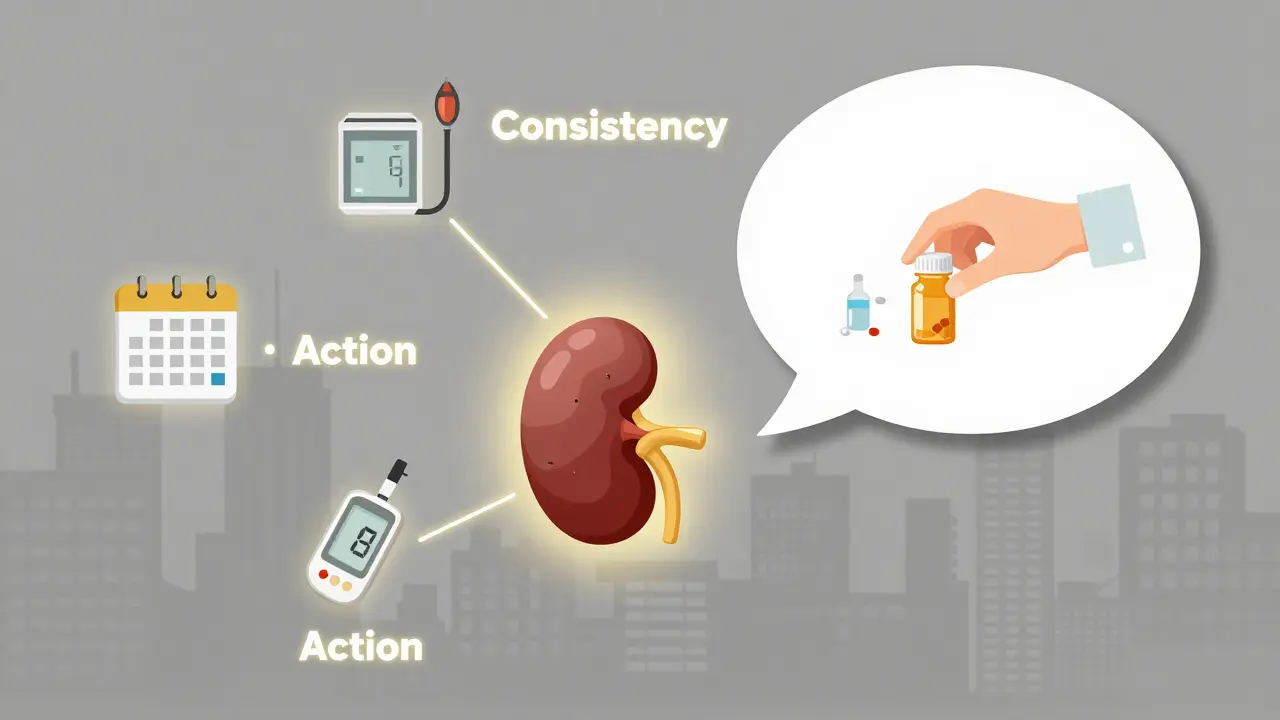
You don’t need to be perfect. But you do need to be consistent. One missed test. One skipped pill. One ignored number. That’s how kidneys fail.
Comments
Aubrey Mallory January 8, 2026 at 13:18
Albuminuria isn’t a footnote-it’s the alarm bell no one wants to hear until it’s too late. I’ve seen patients ignore it for years, convinced their sugar numbers were "good enough." But kidneys don’t care about HbA1c alone. They care about sustained damage. If your UACR is over 30, you’re already in the danger zone. No sugarcoating. No waiting. Act now or pay later-literally.
Evan Smith January 9, 2026 at 02:46
So let me get this straight-my doctor says my HbA1c is 7.2, BP is 138/88, and my urine test showed 45 mg/g… and I’m supposed to panic? I mean, I’m not even on any of those fancy new drugs yet. Are we sure this isn’t just another way to sell pills?
Joanna Brancewicz January 9, 2026 at 07:45
UACR >30 = DKD stage 1. ACEi/ARB at max tolerated dose. SGLT2i if eGFR permits. Finerenone if persistent albuminuria despite optimal RAAS blockade. That’s the algorithm. No ambiguity. No "maybe." This isn’t theoretical-it’s protocol. If your provider isn’t following this, ask why.
Manish Kumar January 10, 2026 at 06:40
You know, in India, we don’t even have access to half of this. My cousin with type 2 diabetes got his first UACR test at age 52-after he started swelling like a balloon. No one checks for albuminuria unless you’re on dialysis already. And the cost of dapagliflozin? More than his monthly salary. So we talk about metabolic memory and kidney protection like it’s some luxury philosophy, while real people are just trying to afford insulin. This article reads like a manual for the privileged. The science is brilliant, but the system? Broken. We need global access, not just global guidelines.
Molly Silvernale January 11, 2026 at 05:20
It’s terrifying, really-how quietly the body unravels. No screaming pain, no flashing lights… just a whisper in a urine sample. Like a ghost writing letters to your future self, saying: "You had time. You had options. You just didn’t listen." And the worst part? You don’t even know you’re dying until you’re already half-dead. We treat diabetes like a diet problem. But it’s not. It’s a slow-motion earthquake-and albuminuria is the first tremor. Stop ignoring the tremors.
Ken Porter January 12, 2026 at 21:05
UACR testing? 65% compliance? That’s pathetic. We’re in 2024. Electronic health records should auto-flag every diabetic patient for annual UACR. No excuses. No "forgot to order." If your clinic isn’t doing this, it’s malpractice by omission. Stop being nice. Start being systematic.
christy lianto January 14, 2026 at 04:37
I used to think "tight control" was just doctor talk. Then my dad lost his kidneys. He didn’t miss a single HbA1c test. He didn’t skip his BP meds. But he never got the ACEi pushed to 40mg because the doctor said "it’s fine." Fine. Fine. Fine. Until it wasn’t. Don’t let "fine" kill you. Push. Demand. Fight for the dose. The numbers don’t lie.
Prakash Sharma January 14, 2026 at 14:02
Western medicine thinks it’s the only truth. But in India, we’ve managed diabetes for centuries with diet, exercise, and herbs. Now you want us to swallow expensive pills because some trial says so? SGLT2 inhibitors? Finerenone? Who even are these companies? Big Pharma is selling fear, not solutions. If you want to save kidneys, fix the sugar industry. Fix the food. Stop pushing pills like candy.
Lois Li January 14, 2026 at 19:35
I got my UACR result yesterday-42 mg/g. I didn’t panic. I called my doctor. We’re starting lisinopril next week. And I’m asking for empagliflozin. No more waiting.