Medication Switch Decision Aid
Compare Your Medication Options
Why switching meds isn’t just a doctor’s call
Changing medications isn’t like switching your phone plan. One wrong move can mean more side effects, worse symptoms, or even hospital visits. And yet, nearly half of all patients stop their new meds within the first year-not because they don’t work, but because they didn’t fully understand what they were signing up for.
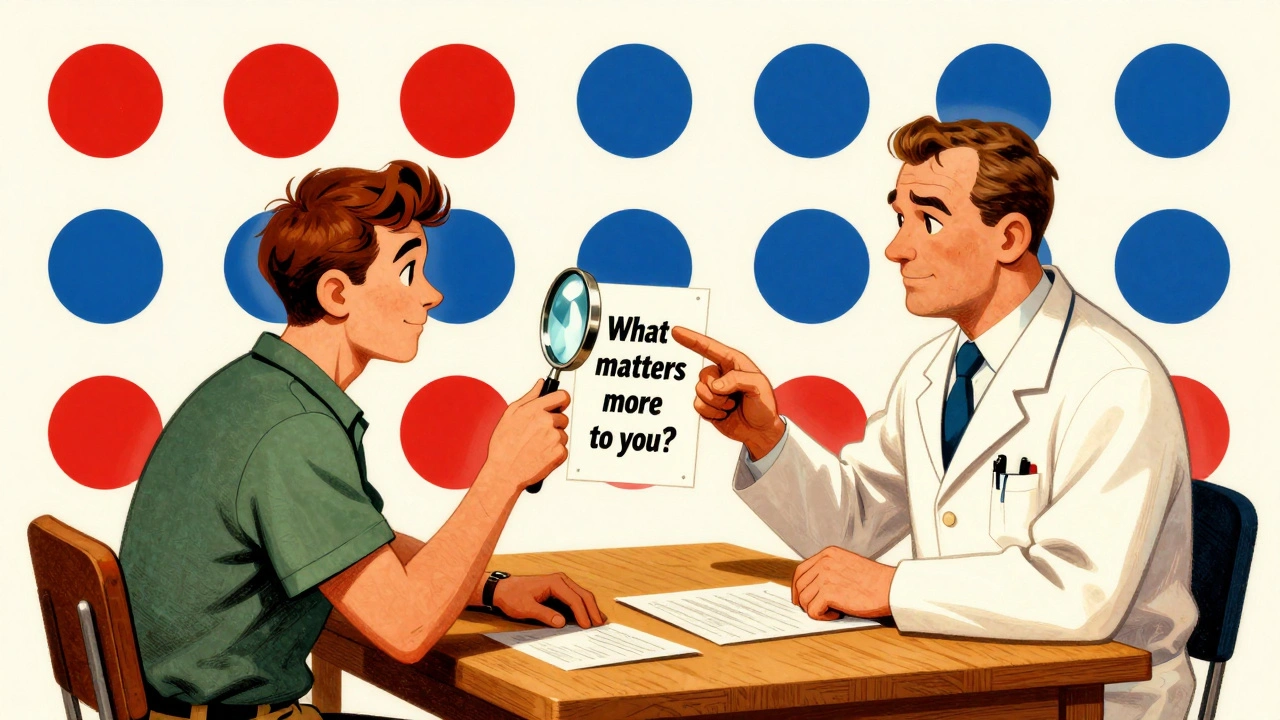
That’s where decision aids come in. These aren’t fancy apps or flashy brochures. They’re structured tools built to help you and your doctor talk through the real trade-offs: What’s the chance this new drug will help? What side effects might you actually feel? And which ones matter most to you?
What exactly is a decision aid?
A decision aid is a clear, evidence-based tool that lays out your options when switching medications. It doesn’t tell you what to do. It shows you what’s likely to happen-with numbers, pictures, and real-life examples.
For example, if you’re thinking about switching from warfarin to a DOAC (like apixaban or rivaroxaban), a good decision aid will show you:
- Out of 100 people like you, 10 will have a stroke in 5 years on warfarin. On the new drug, it drops to 7 or 8.
- But 8 out of 100 people on warfarin will have a serious bleed. On the new drug, it’s 3 or 4.
And it doesn’t just stop there. It asks you: Which matters more to you-avoiding a stroke or avoiding a bleed? Some people fear blood clots more. Others are terrified of internal bleeding. Your answer changes the best choice.
These tools use simple visuals-like icon arrays with colored dots-to make numbers feel real. One study found patients using these aids understood their risks 32% better than those who just got a pamphlet.
When do decision aids actually help?
They shine in situations where there’s no single “right” answer. That’s called a preference-sensitive decision.
Examples:
- Switching antidepressants because the first one caused weight gain or low libido
- Choosing between metformin, SGLT2 inhibitors, or GLP-1 agonists for type 2 diabetes
- Deciding whether to switch from a statin to a non-statin cholesterol drug because of muscle pain
In each case, multiple options are equally effective. The difference isn’t in the science-it’s in what you’re willing to tolerate.
One 2021 study found that when patients used decision aids for diabetes meds, 41% more ended up with a treatment that matched their personal values. That’s huge. It means fewer people quit because they felt blindsided.
But they don’t work for everything. If you’re having a heart attack and need a clot-buster right now, there’s no time for a decision aid. Same if you have severe memory problems-processing numbers and probabilities becomes too hard.

What’s in a good decision aid?
Not all tools are created equal. A strong one includes:
- Absolute risk numbers-not just “reduces risk by 25%.” It says: “Out of 100 people, 10 have a problem now. With this drug, it drops to 7.”
- Side effect comparisons-side-by-side tables showing how often each drug causes weight gain, fatigue, diarrhea, or sexual side effects.
- Value clarification-interactive questions like: “How important is taking one pill a day vs. two?” or “Would you accept a 1 in 50 chance of nausea if it meant no more dizziness?”
- Clear sources-they cite real studies, not vague claims.
Tools from the VA’s MIRECC program, the Ottawa Hospital Research Institute, and the Mayo Clinic are among the most trusted. Many are free and available online. Some even work in 12 languages and meet accessibility standards for vision or motor impairments.
Why don’t more doctors use them?
Because they take time.
Studies show adding a decision aid to a visit adds 7 to 12 minutes. In a 15-minute appointment, that’s a lot. Many doctors say they don’t have the time, or their EHR system doesn’t integrate with the tools.
A 2023 survey of 1,200 primary care doctors found 68% said workflow disruption was a major barrier. Some don’t know where to find good tools. Others worry patients will get overwhelmed.
But here’s the twist: when doctors do use them, patients are more likely to stick with the medication. Fewer calls to the pharmacy. Fewer complaints. Fewer returns.
One VA clinic tracked this over a year. After training staff to use decision aids for antidepressants, medication adherence jumped by 22%. That’s more than just convenience-it’s better outcomes.
Real stories: What patients actually say
On Reddit, a veteran named u/VetMedSurvivor wrote: “The icon array showing 100 people with 3 bleeding events on DOACs versus 8 on warfarin made it real for me.” He switched-and hasn’t looked back.
Another patient, after using a decision aid for diabetes meds, decided to stay on metformin even though her doctor suggested a newer drug. “The tool showed me I had a 1 in 10 chance of getting stomach cramps on the new one,” she said. “I’ve had enough of that already. I’d rather take two pills than feel sick all day.”
But not all stories are smooth. Some patients felt the tools made everything seem equally risky, even when one option had much stronger evidence. Others struggled with the tech-23% of negative reviews on Healthgrades mention difficulty accessing the tools online.
And then there’s the misinformation risk. One 2021 study found 22% of patients thought “reducing stroke risk by 30%” meant they’d never have a stroke. That’s dangerous. Good decision aids always clarify: This doesn’t mean zero risk. It means less.
How to ask for one
You don’t need to wait for your doctor to bring it up. You can ask.
Try saying:
- “I’ve heard there are tools to help compare meds. Could we use one to look at my options?”
- “I want to make sure I understand the real risks before switching. Is there a decision aid for this?”
- “Can I review this ahead of time so I’m ready to talk?”
Many tools can be accessed 24 to 72 hours before your appointment. That gives you time to think, write down questions, or even show it to a family member.
Start with these trusted sources:
- Ottawa Hospital Decision Aid Library (updated March 2024)
- VA MIRECC Decision Aids (last updated September 2023)
- Mayo Clinic Patient Education Tools
Search for “decision aid” + your condition (e.g., “decision aid for antidepressants” or “decision aid for cholesterol meds”).
The bottom line
Switching medications shouldn’t feel like a gamble. Decision aids turn guesswork into informed choice. They don’t replace your doctor-they help you and your doctor work as a team.
They’re especially powerful when side effects are the main reason you want to change. If you’re tired of dizziness, weight gain, or brain fog, a decision aid can show you whether the next drug will fix that-or just trade one problem for another.
And if you’re worried about being overwhelmed? That’s normal. Start small. Pick one medication you’re thinking about. Use one tool. Ask one question. That’s all it takes to take back control.
What’s next?
Decision aids are getting smarter. In early 2024, Intermountain Healthcare launched an AI tool that personalizes risk numbers based on your age, weight, and even how you learn best. The FDA is also pushing for new rules to make sure these tools don’t mislead.
By 2027, most value-based care systems will likely require them. But you don’t need to wait for the system to catch up. You can start today.
Ask for a decision aid. Read it. Talk about it. Make your next medication change one you truly understand.
Comments
Elizabeth Farrell December 2, 2025 at 07:23
I’ve used decision aids when switching my antidepressants, and honestly? It was the first time I felt like my doctor actually listened. The icon arrays made the risks feel real-not just numbers on a page. I stayed on my old med because I couldn’t handle the nausea, even though the new one had better stats. No regrets. I wish more docs just handed these out without us having to ask.
Sheryl Lynn December 3, 2025 at 22:13
Oh, how quaint-a ‘decision aid’ as if patients are capable of parsing absolute risk ratios without a PhD in biostatistics. The very notion that a layperson can meaningfully weigh ‘1 in 50 chance of nausea’ against ‘3% reduction in stroke incidence’ is a charming delusion of modern medicine’s performative empathy. We’ve outsourced cognitive labor to glossy PDFs while physicians become glorified clerks. Truly, the zenith of patient-centered care.
Fern Marder December 4, 2025 at 10:26
YESSSS this is what we need!! 🙌 I was so scared to switch from statins till I saw the side-by-side table showing muscle pain rates. I thought I was just ‘weak’-turns out, 18% of people get it. Not me. Not a failure. Just biology. 😭🙏
william tao December 5, 2025 at 08:33
There is no such thing as a "preference-sensitive decision" when the data is overwhelmingly in favor of one option. These tools are a distraction, designed to absolve physicians of responsibility while pandering to the emotionally immature. The science is clear. The evidence is robust. Stop letting patients make decisions they are unqualified to make.
Sandi Allen December 6, 2025 at 15:13
WHO is funding these "decision aids"??!! I bet it's Big Pharma!! They want you to switch to the $$$ drugs-DOACs cost 10x more than warfarin!! They don't care if you live or die-they care about your insurance premiums!! The "icon arrays"? A distraction!! They're manipulating you into thinking you have a choice when the real choice is: pay up or suffer!!
John Webber December 7, 2025 at 01:45
i tried one of these tools for my diabetes med and it just confused me more. i dont know what a glp-1 agonist is and why does it matter if its 1 in 10 or 1 in 5? i just wanna not feel sick. also the website crashed on my phone. so much for tech helping.
Shubham Pandey December 8, 2025 at 02:51
Useful in theory. But in India, doctors don’t have time. Patients don’t have internet. Tools like this are for rich countries. Simple advice: "Try this. If side effects, come back." Works fine.
Paul Santos December 9, 2025 at 00:04
Ah, the grand illusion of autonomy-how delightfully postmodern! We’ve replaced the paternalistic physician with the algorithmic oracle, yet the patient remains a passive consumer of probabilistic narratives. The decision aid, in its elegant neutrality, is merely the neoliberal state’s latest instrument of depoliticized compliance. One wonders: if one’s values are so malleable, are they truly one’s own? 🤔
Eddy Kimani December 9, 2025 at 00:44
Actually, the most fascinating part is how these tools reveal hidden heterogeneity in patient preferences. Two people with identical clinical profiles can make opposite choices based on tolerance for fatigue vs. weight gain-and that’s not random, that’s human. We’ve been treating medication adherence as a compliance issue when it’s really a values alignment problem. This isn’t just education-it’s personalized behavioral design.
Chelsea Moore December 9, 2025 at 03:07
MY DOCTOR REFUSED TO USE ONE!! I ASKED THREE TIMES!! HE SAID "I KNOW WHAT’S BEST" AND THEN WALKED OUT!! I WAS SO HURT I CRIED IN THE PARKING LOT!! THIS IS WHY PEOPLE DON’T TRUST DOCTORS!! THEY THINK THEY’RE GODS!! 😭💔 #PatientRights #DecisionAidNow
John Biesecker December 10, 2025 at 07:22
you know what’s wild? the fact that we even need these tools means our system is broken. we’re supposed to trust our doctors, but they’re rushed, underpaid, and stuck in click-heavy ehrs. so we get handed a 20-page pdf and told "think about it"-like we’re not already drowning in life. i used one for my cholesterol med. it didn’t change my mind, but it made me feel like i wasn’t crazy for wanting to know more. that’s the real win.