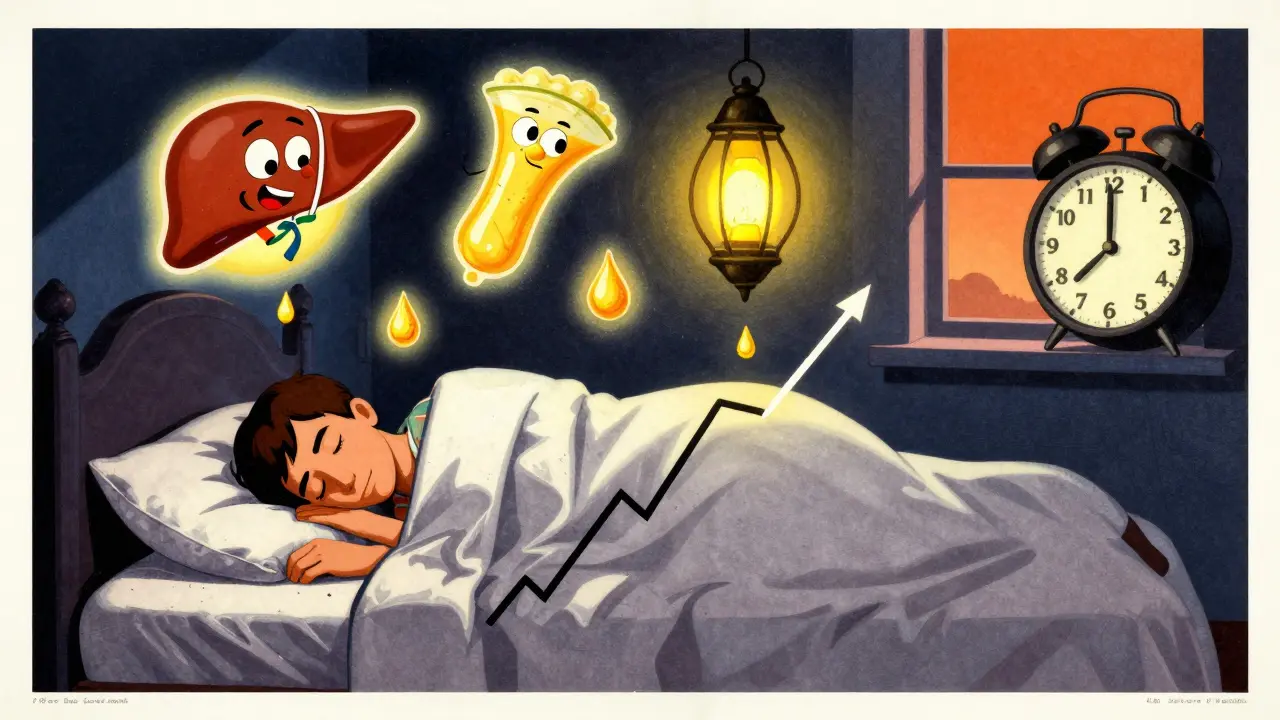
Waking up to a blood sugar reading of 180 mg/dL or higher-after eating well the night before and taking your meds-is frustrating. You didn’t overdo it on carbs, you didn’t skip insulin, yet your numbers are up. If this happens often, you’re likely dealing with the dawn phenomenon.
What Is the Dawn Phenomenon?
The dawn phenomenon is a natural rise in blood sugar that happens between 3:00 a.m. and 8:00 a.m. It’s not caused by eating, skipping insulin, or poor habits. It’s your body doing what it’s supposed to do-preparing for the day.
As morning approaches, your body releases hormones like cortisol, growth hormone, glucagon, and epinephrine. These signals tell your liver to pump out glucose so you have energy to wake up. In someone without diabetes, the pancreas responds by releasing just enough insulin to keep blood sugar in check. But if you have Type 1 or advanced Type 2 diabetes, your body can’t make or use insulin well enough to handle that extra glucose. That’s when your morning numbers climb-sometimes to 200 mg/dL or more.
This isn’t rare. Around half of all people with Type 1 diabetes and half of those with Type 2 diabetes experience it regularly. Studies show it affects children, adults, and seniors equally. It’s not a mistake. It’s biology.
Dawn Phenomenon vs. Somogyi Effect: Don’t Mix Them Up
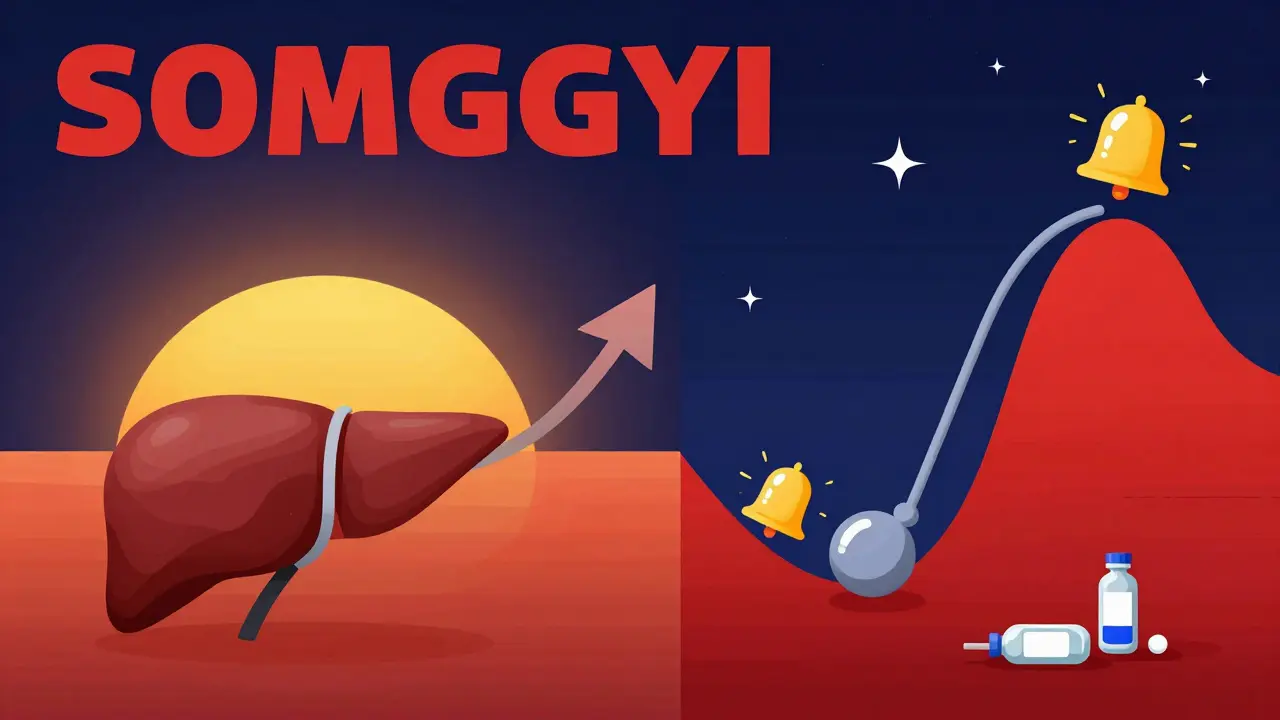
Many people confuse the dawn phenomenon with the Somogyi effect. They both cause high morning blood sugar, but they’re completely different.
The Somogyi effect happens when your blood sugar drops too low overnight (below 70 mg/dL). Your body panics, releases stress hormones, and overcorrects-leading to a rebound high. It’s like a pendulum swinging too far in the opposite direction.
The dawn phenomenon? No low at all. Your blood sugar just steadily climbs from 3:00 a.m. onward. No crash. No rebound. Just a slow, steady rise.
How do you tell them apart? Check your blood sugar at 3:00 a.m. for three nights in a row.
- If it’s below 70 mg/dL → Somogyi effect.
- If it’s above 100 mg/dL and rising → dawn phenomenon.
Continuous glucose monitors (CGMs) make this way easier. Look at your trend arrows. If they’re pointing steadily up from 3:00 a.m. to 7:00 a.m., that’s the dawn phenomenon. If they spike up after a low, that’s Somogyi.
Why It Matters: More Than Just a High Morning Number
That 180 mg/dL you see at 7:00 a.m. isn’t just annoying. It adds up.
Each 1% increase in your HbA1c raises your risk of diabetes complications by 21%. The dawn phenomenon can push your HbA1c up by 0.5 to 1.2 percentage points-even if your daytime numbers are perfect. That’s enough to move you from “well-controlled” to “at risk.”
Long-term, unmanaged morning highs increase your chance of nerve damage, kidney problems, vision loss, and heart disease. Severe cases can even trigger diabetic ketoacidosis (DKA), especially in Type 1 diabetes. One study found 3.2 episodes of DKA per 100 patient-years in people with uncontrolled dawn phenomenon.
And it’s not just physical. A 2022 survey found that 57% of people with diabetes said morning spikes seriously affected their quality of life. Anxiety, frustration, and burnout are real.
How to Manage the Dawn Phenomenon
You can’t stop your body from releasing morning hormones. But you can manage how your body responds to them.
1. Use a Continuous Glucose Monitor (CGM)
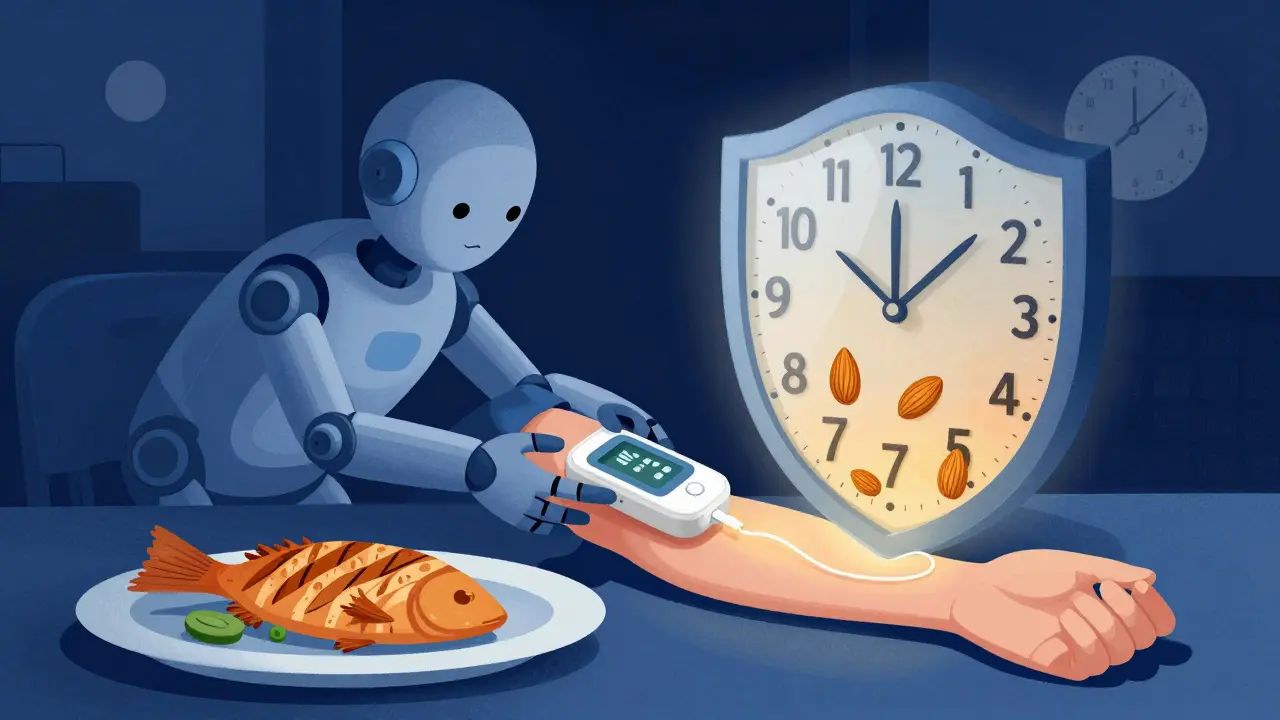
This isn’t optional anymore. If you’re struggling with morning highs, you need a CGM. Devices like the Dexcom G7, Abbott FreeStyle Libre 3, or Medtronic Guardian 4 show you exactly when your blood sugar starts rising and how fast.
85% of endocrinologists now say CGMs are essential for diagnosing and managing the dawn phenomenon. Without one, you’re guessing.
2. Adjust Your Insulin (Type 1 Diabetes)
If you use an insulin pump or multiple daily injections, you can tweak your basal rate.
- Most people need a 20-30% increase in basal insulin between 3:00 a.m. and 7:00 a.m.
- Automated insulin delivery systems (like Control-IQ) automatically do this for you. A 2022 trial showed they cut morning spikes by 58%.
- Newer pumps, like Tandem’s t:slim X2 with Control-IQ 3.0, start adjusting as early as 2:00 a.m. for better results.
Don’t guess the increase. Start with 10% and adjust based on 3 nights of 3:00 a.m. checks. Small changes matter.
3. Time Your Medications (Type 2 Diabetes)
If you take GLP-1 receptor agonists (like semaglutide or dulaglutide), taking them at night instead of in the morning can help. A 2021 study showed this shift lowered morning glucose by 18-22 mg/dL.
Metformin taken at bedtime may also help. It reduces liver glucose output overnight. Ask your doctor if this fits your regimen.
4. Watch What You Eat at Dinner
Evening carbs play a big role. A 2021 study from Joslin Diabetes Center found that limiting dinner carbs to under 45 grams reduced morning spikes by 27%.
Avoid sugary desserts, pasta, rice, or bread late at night. Instead, focus on protein and healthy fats:
- Grilled chicken or fish
- Leafy greens with olive oil
- Hard-boiled eggs
- A small handful of almonds
Some people benefit from a small bedtime snack-15g of protein and 5g of fat (like 1 oz of turkey or 2 tbsp of peanut butter). This stabilizes blood sugar without triggering a spike.
5. Sleep Matters More Than You Think
Poor sleep increases morning glucose by 15-20 mg/dL. It messes with cortisol rhythms and insulin sensitivity.
Shoot for 7-8 hours of quality sleep. Avoid screens an hour before bed. Keep your room cool. Stick to a consistent bedtime-even on weekends.
6. Don’t Overcorrect
Dr. John Buse from UNC warns that aggressively treating morning highs without confirming the dawn phenomenon can cause dangerous overnight lows.
One study found that 34% of people who adjusted insulin based only on morning readings ended up with more hypoglycemia. Always use 3:00 a.m. checks or CGM data before changing your dose.
What Doesn’t Work
Many people try to fix morning highs by:
- Skipping dinner
- Going to bed hungry
- Taking extra insulin before bed without knowing why
These don’t fix the root cause-and they can make things worse. Skipping meals or overmedicating can trigger the Somogyi effect. You end up with low blood sugar at 2:00 a.m. and a crash-and-bounce cycle.
Also, don’t blame yourself. The dawn phenomenon isn’t your fault. It’s not about willpower. It’s about biology.
What’s Next: The Future of Dawn Phenomenon Management
Research is moving fast. Novo Nordisk’s once-weekly insulin icodec shows 28% better morning control than daily insulins. New dual-hormone systems are testing micro-doses of pramlintide to block glucagon’s rise in the early morning.
And scientists at Oxford have found 7 genetic variants linked to stronger dawn phenomenon responses. In the next 5-7 years, we may be able to test for your personal risk and tailor treatment before it even becomes a problem.
For now, the best tools are still CGMs, smart insulin timing, and careful diet adjustments. The goal isn’t perfection-it’s control. Even lowering your morning number by 30-50 mg/dL can make a huge difference over time.
Key Takeaways
- The dawn phenomenon is a natural hormone surge that raises blood sugar in the early morning-it’s not your fault.
- It affects about 50% of people with Type 1 and Type 2 diabetes.
- It’s not the same as the Somogyi effect. Check your blood sugar at 3:00 a.m. to tell the difference.
- CGMs are the gold standard for diagnosis and management.
- Small changes in insulin timing, bedtime snacks, and dinner carbs can significantly reduce morning spikes.
- Never adjust insulin based on morning highs alone-use overnight data to avoid dangerous lows.
Comments
Harriot Rockey February 3, 2026 at 16:30
OMG YES THIS!! 😭 I used to wake up at 7am to 210 and thought I was doing everything wrong... then I got a CGM and saw it started creeping up at 3am like clockwork. No late snacks, no skipped insulin, just my body being a tiny rebellious teenager. I increased my basal by 25% from 2:30–6:30 and now I’m hovering around 110–130. Life-changing. You’re not broken, you’re just biologically scheduled. 🙌
Samuel Bradway February 3, 2026 at 23:05
Same. I thought I was failing at diabetes until I learned about this. My doc didn’t even mention it until I brought it up. So glad someone finally explained it like this. No judgment, just science. Thanks for writing this.
pradnya paramita February 5, 2026 at 03:34
From a clinical endocrinology standpoint, the dawn phenomenon is mediated by circadian-driven hepatic gluconeogenesis and glycogenolysis, primarily under the influence of cortisol and growth hormone surges. The counterregulatory response is amplified in insulinopenic states due to inadequate suppression of glucagon. The key diagnostic differentiator from the Somogyi effect is the absence of nocturnal hypoglycemia, which can be objectively verified via CGM-derived time-in-range (TIR) analysis between 02:00–04:00. Basal insulin titration should be guided by 15–30% incremental adjustments, validated over ≥72 hours of continuous glucose data.
Keith Harris February 6, 2026 at 14:17
Lol, you people are making this way too complicated. The REAL reason your sugar spikes in the morning? You’re eating carbs at night. Plain and simple. No magic hormones. No science. Just you sneaking pizza at midnight. Stop lying to yourself.
Kunal Kaushik February 6, 2026 at 23:42
Man, I used to stress about this so hard. Now I just check my CGM, see the little upward arrow at 3am, and go back to sleep. It’s just biology. I don’t fight it anymore. 🌅💤
Mandy Vodak-Marotta February 7, 2026 at 16:49
I had no idea this was a thing until last year when I started wearing my Libre and noticed the slow, steady climb every single morning like it was on a timer. I thought I was just bad at this, you know? Like maybe I was too lazy to track my food or I wasn’t disciplined enough. But no - it’s literally my liver waking up and yelling ‘TIME TO GO, HUMAN!’ and my pancreas just sitting there like ‘uhhh… I got nothing.’ So I started adjusting my basal at 2:30am and now I’m not starting my day at 190 anymore. Also, I swear by the turkey slice before bed. It’s weird, but it works. I’m basically a glucose wizard now. 🧙♀️✨
Caleb Sutton February 9, 2026 at 14:18
This is all government propaganda. The dawn phenomenon doesn’t exist. Your insulin is just weak. Big Pharma wants you dependent on CGMs and fancy pumps. Sleep deprivation causes high sugar. Stop buying the lie.
Katherine Urbahn February 10, 2026 at 17:45
While I appreciate the attempt at clarity, I must respectfully point out that the term "dawn phenomenon" is not formally recognized in the American Diabetes Association’s 2023 Standards of Medical Care in Diabetes. The phenomenon described is better classified under "nocturnal hepatic glucose overproduction." Furthermore, the recommendation to use CGMs as a "gold standard" is misleading, as their clinical utility remains contingent upon patient adherence and sensor accuracy, which varies significantly across populations. A more evidence-based approach would prioritize HbA1c trends over isolated nocturnal glucose fluctuations.
Joseph Cooksey February 11, 2026 at 07:04
You know what’s funny? Everyone’s out here fine-tuning their basal rates and tweaking bedtime snacks like they’re launching a rocket to Mars. Meanwhile, I’ve got a friend who just eats a handful of almonds at 10pm and never sees a number above 120. No CGM. No pump. Just almonds. And she’s been diabetic for 22 years. I’m not saying you’re wrong - I’m saying you’re overcomplicating it. Sometimes the simplest thing works. Also, if you’re waking up to 180, maybe you’re not as "well-controlled" as you think. Just saying.
Joy Johnston February 11, 2026 at 07:55
Thank you for this. I’ve been struggling with this for years and felt so alone. My endo just said "adjust your insulin" without explaining why. This breaks it down perfectly. I’ve started taking my GLP-1 at night and my fasting sugars dropped from 185 to 135 in two weeks. Small changes, huge impact. You’re not alone. We’ve got this.
Shelby Price February 12, 2026 at 06:28
So… if I have a 3am reading of 105 and it climbs to 170 by 7am, that’s dawn phenomenon, right? Not a rebound? I’ve been doing the 3am check for a week and it’s always above 100. Just wanna make sure I’m not overthinking it 😅
Jesse Naidoo February 13, 2026 at 23:59
Wait, so if I skip dinner, will that fix it? I’m just asking. I’ve been doing it for three weeks and my sugar’s still high. Maybe I’m doing it wrong?
Daz Leonheart February 14, 2026 at 19:16
Hey, I saw your comment about skipping dinner. Don’t do that. I tried it. Ended up with a 58 at 2am and then a 220 at 7am. That’s the Somogyi effect. It’s not helping. Stick with the protein snack. It’s not about being perfect - it’s about being steady. You got this. 💪
Zachary French February 15, 2026 at 02:12
lol this whole thing is just a scam. dawn phenomenon? more like dawn scam. insulin companies paid these doctors to make you feel guilty so you buy more pumps. i checked my sugar at 3am once. it was 90. then i woke up at 7am and it was 120. so… i dunno. maybe my body just likes to chill? maybe i dont need all this tech? maybe you’re all overthinking it? 🤷♂️
Amit Jain February 15, 2026 at 04:02
From India, I can say this: many people here don’t even have access to CGMs. But simple things help - eat dinner before 8pm, avoid white rice at night, walk for 15 minutes after dinner. Also, try metformin at bedtime. Works for many. No need for fancy tech. Biology is biology, no matter where you live.