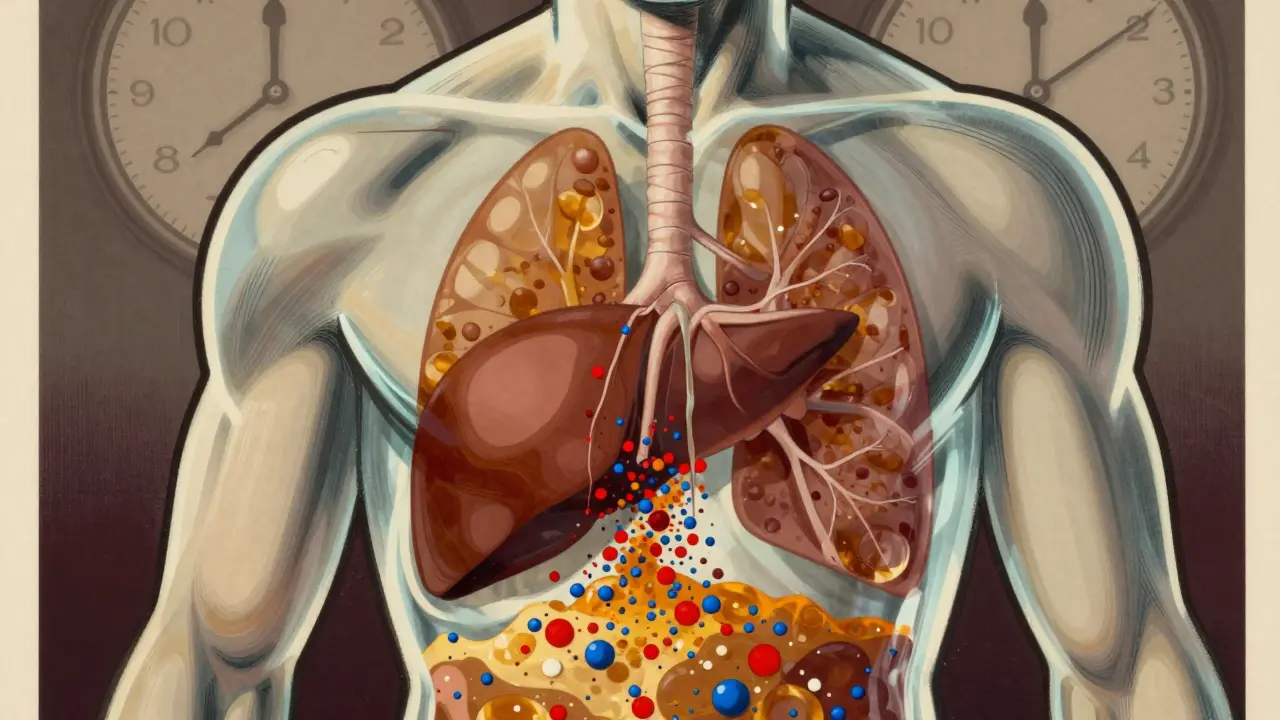
Most people assume that if a medication is safe for a few weeks, it’s safe for years. But that’s not always true. Some drugs don’t hurt you right away-they quietly build up in your body until, one day, you wake up with a new symptom you can’t explain. A cough that won’t go away. A weird heartbeat. Fatigue that won’t lift. These aren’t random bad luck. They’re cumulative drug toxicity.
What Exactly Is Cumulative Drug Toxicity?
Cumulative drug toxicity happens when your body takes in more of a drug than it can get rid of. Over time, the leftover pieces pile up like dirty dishes in a sink you never clean. Eventually, the overflow starts causing damage. This isn’t the same as an overdose. You’re not taking too much at once. You’re taking the right dose, day after day, month after month, until your system can’t keep up.It’s most common with drugs that stick around in your body for a long time. Think of medications with half-lives longer than 24 hours. That means it takes more than a day for your body to clear half the dose. If you take it daily, you’re adding more before the last bit is gone. The result? Levels creep upward. And when they cross a threshold, your organs start reacting.
Some drugs store themselves in fat or bone. Vitamins A, D, E, and K do this. So do heavy metals like lead or mercury. Even some antibiotics and heart meds. Once they’re tucked away, they come out slowly-sometimes over months or even years. That’s why side effects can show up years after you started the drug.
Who’s at Risk?
It’s not just older people, though they’re the most vulnerable. About 68% of adverse drug reactions in seniors come from this slow buildup, according to the Journal of the National Cancer Institute. Why? Because as we age, our livers and kidneys don’t work as well. They can’t filter drugs out as fast. A 70-year-old might clear a drug 30-50% slower than a 30-year-old. That means the same dose becomes a much heavier burden.People with chronic conditions are also at higher risk. If you have liver disease, kidney failure, or heart failure, your body’s ability to process drugs drops. Even if you’re on a normal dose, your system can’t handle it the way it used to.
And then there’s the long-term meds. These are the ones you take for years-maybe for life:
- Amiodarone (for irregular heartbeat): Can cause lung scarring after a cumulative dose over 600 grams.
- Digoxin (for heart failure): Builds up in muscle tissue. Too much causes nausea, confusion, and dangerous heart rhythms.
- Lithium (for bipolar disorder): Narrow therapeutic window. Small increases in blood levels can lead to tremors, memory loss, or kidney damage.
- Anthracyclines (cancer chemo): Can permanently damage the heart. Lifetime dose limits are set at 450 mg/m² because beyond that, heart failure risk spikes.
- Methotrexate (for rheumatoid arthritis): Can harm the liver and lungs over time if not monitored.
These aren’t rare cases. The FDA’s adverse event database recorded over 12,000 reports of cumulative toxicity between 2018 and 2022. Nearly half involved blood thinners or heart meds.
Why Don’t Doctors Catch It Sooner?
It’s not that they’re not looking. It’s that the signs are sneaky. A patient takes their pill every day. Their blood test last month looked fine. Their doctor sees no red flags. But here’s the problem: standard blood tests don’t measure the total amount of drug in your body over time. They measure what’s in your blood right now. If you’ve been taking the same dose for five years, your blood level might look normal-even though your liver has been storing the excess for years.One oncologist on Reddit shared a case: a patient on amiodarone had normal blood levels every checkup. But after taking it for six years, they developed severe lung scarring. The cumulative dose had hit 700 grams. The blood test never warned them. The damage was already done.
Another issue? Patients don’t connect the dots. A nurse on AllNurses wrote about a patient who said, “I’ve been on this medicine for 10 years. Why am I tired now?” The side effect wasn’t sudden. It was slow. Like rust forming on a pipe. You don’t notice until it leaks.

How Do You Know If You’re at Risk?
Ask yourself these questions:- Have I been taking this medication for more than a year?
- Do I have kidney or liver problems?
- Am I over 65?
- Have I started noticing new symptoms-fatigue, dizziness, shortness of breath, changes in vision or hearing?
- Is this drug known to build up? (Check the label or ask your pharmacist.)
If you answered yes to any of these, you’re in the risk zone. That doesn’t mean you need to stop your meds. But it does mean you need to talk to your doctor about monitoring.
What Can Be Done?
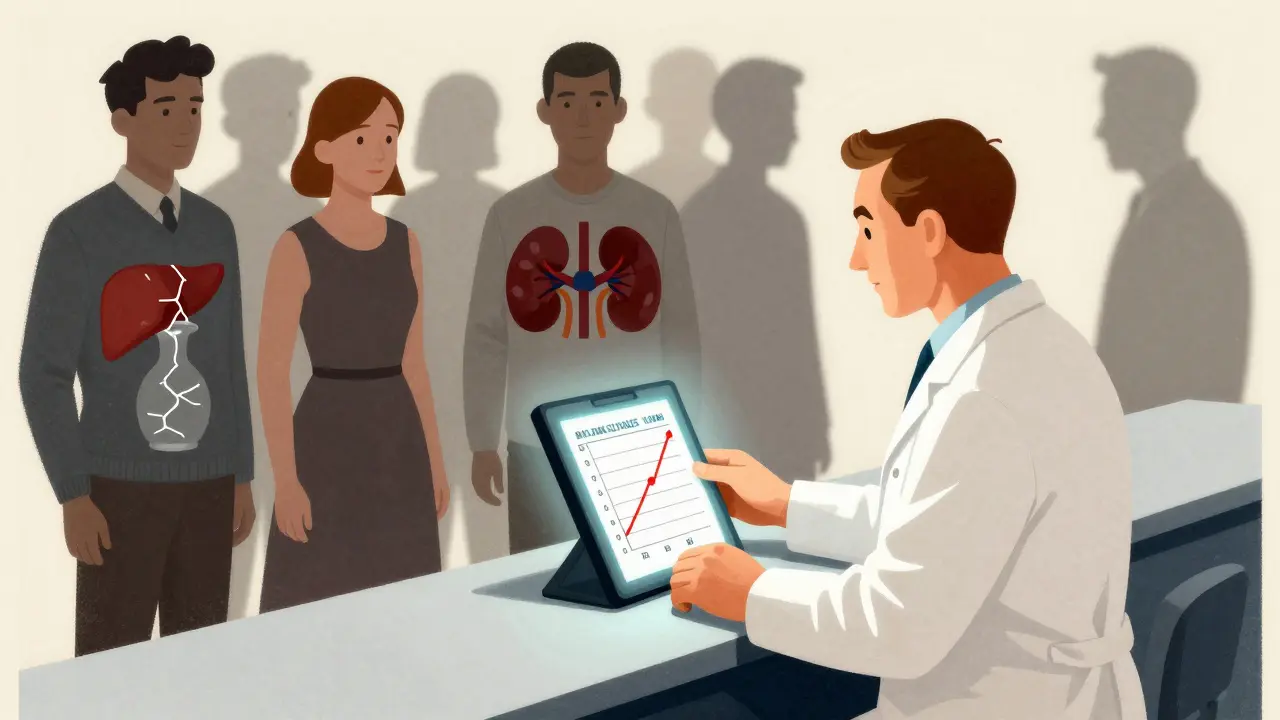
The good news? We know how to prevent most of this.Therapeutic drug monitoring is the gold standard. It’s not just checking blood levels once a year. It’s tracking your total cumulative dose over time. Some hospitals and clinics use digital systems that automatically add up your doses from pharmacy records and flag when you’re approaching danger zones. One study showed that using these systems cut methotrexate-related hospital visits by 37%.
For certain drugs, there are hard limits:
- Anthracyclines: Don’t exceed 450 mg/m² total.
- Amiodarone: Consider switching after 600g cumulative dose.
- Lithium: Keep blood levels between 0.6-0.8 mmol/L. Anything above 1.0 is risky.
Pharmacists are key players here. The American Pharmacists Association found that pharmacist-led monitoring reduced hospital admissions for drug toxicity by 29% across 45 health systems. That’s not magic. It’s just someone paying attention to the full picture.
For older adults, the American Geriatrics Society’s Beers Criteria lists 34 medications with high cumulative risk. If you’re over 65 and on any of these, ask if there’s a safer alternative.
What’s Changing in the Industry?
The tide is turning. In 2022, 78% of new cancer drugs had cumulative dose warnings on their labels. That’s up from 52% in 2017. The European Medicines Agency now requires cumulative toxicity assessments for any drug meant for long-term use-starting in January 2024.AI is stepping in too. Researchers at Memorial Sloan Kettering are testing models that predict your personal risk by analyzing 27 factors: your age, liver enzymes, kidney function, genetics, even your diet. Early results show 82% accuracy. That’s not science fiction-it’s coming to clinics soon.
But here’s the gap: only 38% of U.S. electronic health records can automatically track cumulative doses. That means most doctors are still doing math by hand-or worse, guessing.
What You Can Do Today
You don’t need to wait for AI or new guidelines. Here’s what you can do right now:- Make a list of every medication you’ve taken for more than a year-including vitamins and supplements.
- Ask your pharmacist: “Is this one known to build up in the body?” They can tell you the half-life and if there’s a cumulative limit.
- Ask your doctor: “Should I be getting regular tests to check for buildup?” For some drugs, it’s as simple as a blood test every 6 months.
- Track your symptoms. Write down new ones-even small ones. A dry cough. Trouble sleeping. Unexplained weight loss. Bring it to your next appointment.
- Don’t skip checkups. If your doctor says “come back in 6 months,” don’t cancel it because you feel fine. That’s when the damage is quietly growing.
Cumulative toxicity isn’t a scare tactic. It’s a real, measurable, and preventable problem. The medications that keep you alive can also harm you-if no one’s watching the long game. You don’t need to fear your pills. You just need to understand them. And that starts with a conversation.
When to Worry
Not every side effect means toxicity. But if you notice any of these after being on a drug for over a year:- Unexplained fatigue that doesn’t improve
- New or worsening shortness of breath
- Irregular heartbeat or palpitations
- Yellowing of skin or eyes (jaundice)
- Changes in urine output or swelling in legs
- Memory lapses or confusion
- Unusual bruising or bleeding
Don’t assume it’s aging. Don’t assume it’s stress. Ask: “Could this be from my medication?”
Can you reverse cumulative drug toxicity?
Sometimes, yes-but not always. If caught early, stopping the drug and supporting your liver and kidneys can let your body clear the buildup. For example, stopping amiodarone early can halt lung damage. But if the damage is already done-like heart scarring from anthracyclines or kidney failure from long-term lithium-it’s often permanent. The goal is prevention, not reversal.
Do over-the-counter drugs cause cumulative toxicity?
Yes. Even common OTC meds can build up. Long-term use of NSAIDs like ibuprofen or naproxen can harm your kidneys and stomach lining. Herbal supplements like kava or comfrey can cause liver damage over time. And vitamin A supplements? Too much over years can lead to bone loss and liver toxicity. Just because it’s sold without a prescription doesn’t mean it’s safe forever.
Is cumulative toxicity the same as addiction?
No. Addiction is about dependence and craving. Cumulative toxicity is about physical buildup and organ damage. You can have toxicity without being addicted (like with digoxin or methotrexate). And you can be addicted to a drug without it causing cumulative toxicity (like alcohol or opioids, which are metabolized quickly). They’re two different problems.
Why don’t drug labels always warn about cumulative effects?
Many older drugs were approved decades ago, before we fully understood long-term effects. Newer drugs are required to include cumulative data, but older ones often still carry outdated labels. Also, if the risk is rare or only appears after 5+ years, it’s harder to prove in clinical trials-which typically last 1-3 years. That’s why patient reports and real-world data are so important.
Can I just stop taking the drug if I’m worried?
Never stop a prescribed medication without talking to your doctor. Some drugs, like blood thinners or seizure meds, can cause dangerous withdrawal effects. Stopping suddenly could be more harmful than the buildup. Instead, ask your doctor about testing, alternatives, or a gradual taper.
Comments
Paul Barnes January 20, 2026 at 08:39
Cumulative toxicity is real, but let’s not turn every side effect into a pharmaceutical conspiracy. I’ve been on lisinopril for 8 years. My labs are pristine. My kidneys are fine. Doctors don’t ignore this-they monitor it. The real issue is patients who Google symptoms and panic. Not every fatigue is amiodarone.
pragya mishra January 21, 2026 at 00:35
This is why I stopped trusting Western medicine. My aunt took lithium for 12 years and developed kidney failure. No one told her. No one warned her. In India, we use Ayurveda for bipolar-natural, no buildup. Why are you letting Big Pharma poison your elders? This isn’t science, it’s profit.
Manoj Kumar Billigunta January 22, 2026 at 20:50
Good breakdown. I work in a clinic and see this all the time. Older patients on 5+ meds, no one tracking cumulative doses. The biggest win? Pharmacist-led reviews. One woman on methotrexate had liver enzymes creeping up. We caught it at 2x normal-switched her to a biologic. No hospitalization. Just someone paying attention. You don’t need AI to start asking: ‘How long have you been on this?’
And yes, OTC matters too. I had a patient on daily ibuprofen for 15 years. Thought it was ‘just for arthritis.’ Turned out he had silent GI bleeds. Simple fix: stop it. But you have to ask.
sagar sanadi January 24, 2026 at 17:17
Of course drugs build up. The government knows. The FDA knows. But they won’t tell you because they need you hooked. Look at statins-designed to keep you on them forever. Amiodarone? They knew about lung scarring in the 80s. They just didn’t want to admit it. The real toxicity? The system that lets this happen. You’re not sick-you’re being exploited.
kumar kc January 25, 2026 at 21:56
If you’re over 65 and on meds, you’re asking for trouble. Stop being lazy. Take responsibility.
Carolyn Rose Meszaros January 27, 2026 at 06:49
YES. This is so important. 🙌 I’m 72 and on digoxin. My pharmacist flagged my cumulative dose last year-said I was hitting the 600g mark. We switched me to a newer drug. No more palpitations. I didn’t even realize I’d been feeling off for two years. Thank you for writing this. Everyone needs to read it.
Greg Robertson January 28, 2026 at 00:50
Really appreciate this post. My dad’s on lithium and we’ve been tracking his levels every 3 months since he turned 70. It’s a pain, but worth it. I didn’t know about the Beers Criteria until I read this-now I’ve printed it out and brought it to his next appointment. Small steps, but they matter.
Crystal August January 29, 2026 at 15:03
Wow. So now we’re supposed to be paranoid about every pill we’ve ever taken? Next you’ll tell me my multivitamin is slowly turning my bones to dust. This feels like fearmongering dressed up as ‘awareness.’ If you’re worried, talk to your doctor. Don’t turn a medical article into a guilt trip.
thomas wall January 31, 2026 at 13:21
It is lamentable, indeed, that the modern pharmacopeia has become a labyrinth of unintended consequences. The notion that a therapeutic agent may, over time, accumulate within the organism with deleterious effect, is not novel-yet institutional inertia persists. The failure to mandate cumulative dosing algorithms within EHR systems constitutes, in my estimation, a dereliction of professional duty. One must ask: if we can track our Netflix habits, why not our cardiac medications?
Shane McGriff February 1, 2026 at 19:22
Man, this hit home. My sister’s on methotrexate for RA and just had her first liver biopsy last month. She thought she was fine because her bloodwork looked ‘normal.’ Turns out, the damage was silent. The doctor said they only caught it because she mentioned her new fatigue and occasional nausea. That’s the thing-people don’t connect the dots. Symptoms creep in so slowly, you think it’s just aging. But it’s not. It’s the meds. Thank you for saying this out loud.
Jacob Cathro February 2, 2026 at 18:46
so like… amiodarone = lung cancer? lol. and digoxin = heart attack? bro. you’re telling me my grandma’s 10-year-old heart med is gonna kill her? and no one told her? this is why i dont trust doctors. they’re just selling pills. also, why is the FDA so slow? 2024? bro, we’re in 2025. where’s my flying car?
also i took 20 ibuprofen once for a headache. i’m fine. so your ‘cumulative’ thing is just fear porn.
Andy Thompson February 4, 2026 at 17:25
They’re hiding this because the government wants you dependent. Big Pharma owns the FDA. The military knows about this stuff-remember Agent Orange? Same playbook. They test drugs for 2 years, then release them. You’re the lab rat. Your kidneys? Your liver? Sacrificed for profit. Wake up. This isn’t medicine. It’s control.
Thomas Varner February 6, 2026 at 08:15
Interesting. But I’d add one thing: what about drug interactions? I’ve been on warfarin, metformin, and amlodipine for 7 years. No one checks how they interact cumulatively. Just the individual drugs. That’s the real blind spot. A single drug might be fine. But together? The liver doesn’t care about labels. It just sees a chemical soup. And it’s tired.