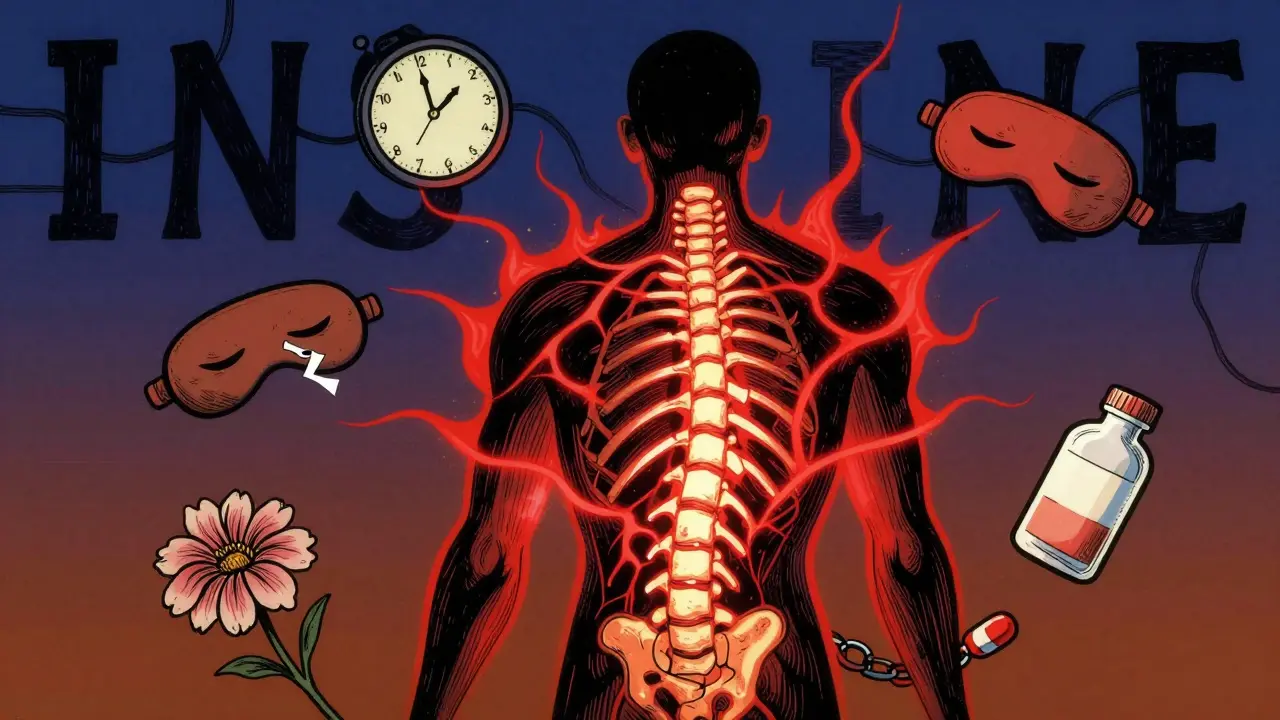
When pain sticks around for more than three months, it’s no longer just a symptom-it becomes a disease. That’s the hard truth backed by the International Association for the Study of Pain (a global body of over 7,000 specialists that set the standard for pain diagnosis and treatment). This isn’t about waiting it out. This is about understanding how chronic pain rewires your body, your mind, and your life.
What Makes Pain ‘Chronic’?
It’s not just how long it lasts-it’s how it changes you. The IASP defines chronic pain by three clear criteria: it must last longer than three months, it must interfere with daily life or cause emotional distress, and it can’t be better explained by another condition. That last part matters. Many people assume chronic pain is just ‘bad back pain’ or ‘old injury.’ But it’s often something deeper: nerve damage, central sensitization, or even inflammation that’s gone rogue.
There are four main types, each with different causes and treatments. Musculoskeletal pain-like arthritis or chronic back strain-is the most common, making up nearly half of all cases. Neuropathic pain, caused by damaged nerves, feels like burning, electric shocks, or pins and needles. Visceral pain comes from internal organs and is often dull and hard to pinpoint. And then there’s nociplastic pain, where the nervous system itself becomes hypersensitive, even without clear tissue damage. Fibromyalgia falls here. It’s not ‘all in your head’-it’s your brain and spinal cord amplifying pain signals when they shouldn’t.
How Chronic Pain Takes Over Your Life
People don’t talk enough about what happens after the doctor says, ‘It’s chronic.’
You stop sleeping. A 2023 analysis of over 3,000 Reddit posts from people living with chronic pain showed 82% struggle with sleep. Many average fewer than five hours a night. That exhaustion doesn’t just make you tired-it makes pain worse. It’s a loop: pain keeps you awake, lack of sleep makes your nerves more sensitive, and your pain spikes.
You stop moving. A study of 33,500 U.S. adults found chronic pain patients miss nearly twice as many workdays as others-9.2 days a year versus 4.1. For those with severe pain, it’s 16.7 days. Some quit jobs entirely. One Reddit user, after 12 years of back pain, had to leave two jobs because he couldn’t stand for more than 20 minutes. Now he works remotely, but still misses two to three days a month when flares hit.
You stop connecting. Over 65% of chronic pain patients say it cuts into social activities. Family dinners, weekend hikes, even hanging out with friends-those things become impossible or too draining. One person on PatientsLikeMe said, ‘I used to host game nights. Now I can’t even sit through a movie without needing to lie down.’
You start doubting yourself. When you can’t explain why you’re in pain, or when doctors say, ‘It’s all in your head,’ it chips away at your confidence. Nearly 70% of patients feel misunderstood by healthcare providers. And in emergency rooms, more than half report being labeled ‘drug-seeking’-a stigma that delays real help by an average of seven months.
The Treatment Myth: Pills Aren’t the Answer
For years, the go-to solution was pills-especially opioids. But the data doesn’t lie. The CDC’s 2022 guidelines say opioids give only 10-15% more pain relief than non-opioid options… and carry an 8-12% risk of addiction after just 90 days. That’s why they’re now a last-resort option.
NSAIDs like ibuprofen help some people, but they’re not magic. They reduce pain by 20-30% in about 45% of users-but they also carry real risks. One in 37 people on long-term NSAIDs will have a major gastrointestinal event. That’s not worth the trade-off for most.
The real shift? It’s not about finding the right pill. It’s about using the right combination of tools. A 2023 review of 47 studies found monotherapy-just one treatment-fails in 68-82% of chronic pain cases. You need layers.
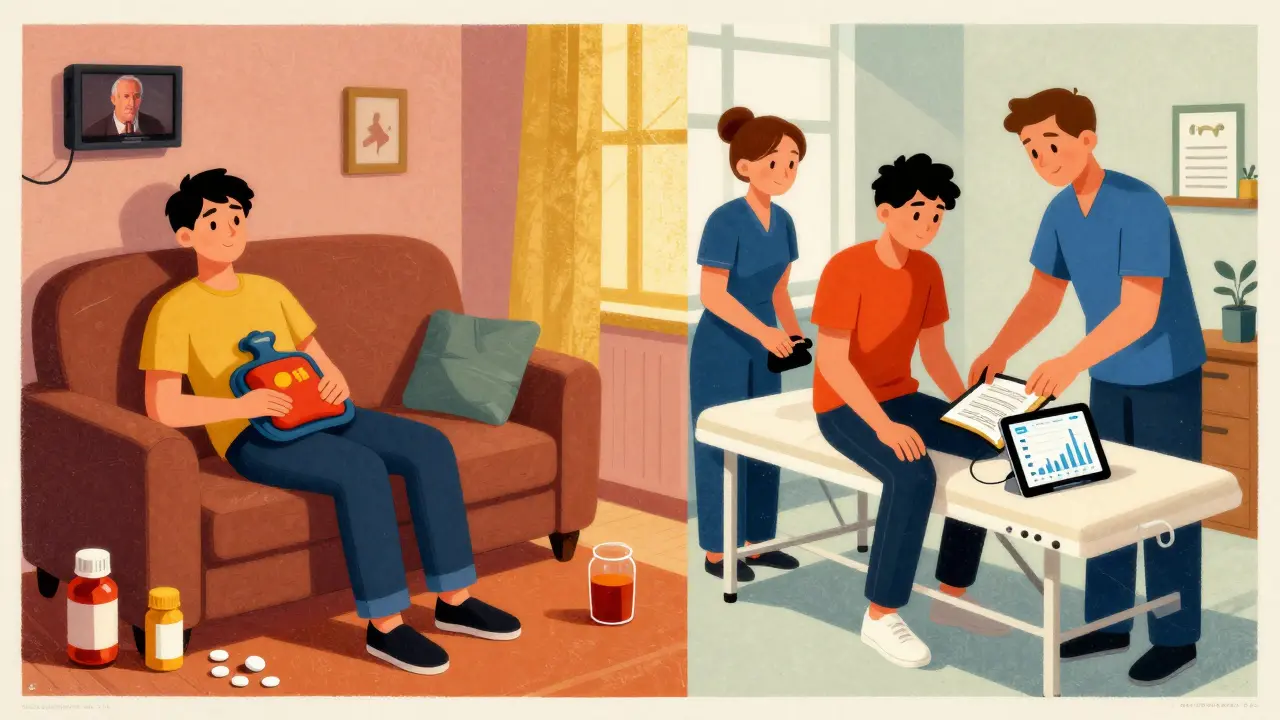
What Actually Works: The Multimodal Approach
The only proven model is the biopsychosocial approach. That means treating the body, the mind, and your environment together.
Cognitive Behavioral Therapy (CBT) isn’t just ‘talking it out.’ It’s training your brain to respond differently to pain signals. After 12 weekly sessions, 65% of patients see a 30-50% drop in pain intensity. It doesn’t erase pain-but it stops pain from controlling you.
Physical therapy isn’t just stretching. For musculoskeletal pain, it works in 60-70% of cases. For neuropathic pain, it’s paired with medications like gabapentin, which helps about half of users. Movement rebuilds confidence, restores function, and reduces fear of pain.
Interdisciplinary pain programs are the gold standard. These are structured, 3-4 week intensive programs that combine physical therapy, psychology, occupational therapy, and education. One patient at Mayo Clinic went from 8/10 pain to 3/10-and returned to teaching full-time. The cost? $12,500 out-of-pocket. But for many, it’s the first time they’ve felt like themselves again.
And now, digital tools are stepping in. Apps like Curable and Reflect use CBT, mindfulness, and pain education. They’re not replacements-but they’re accessible. Curable has over 250,000 users and a 4.7-star rating. Medicare now covers 80% of the cost for approved digital therapeutics, making them more reachable than ever.
The Access Problem: Why So Many Are Left Behind
Here’s the ugly truth: the best treatments are hard to get.
There are only 3,200 board-certified pain specialists in the U.S.-that’s 0.3% of all doctors. In cities, you might find one specialist for every 75,000 people. In rural areas? One for every 500,000. That means over 40% of people in rural communities drive more than 50 miles just to see someone who understands chronic pain.
And insurance? It’s a mess. Many plans won’t cover CBT unless it’s tied to a mental health diagnosis. Physical therapy limits are low. Interdisciplinary programs? Often not covered at all. Patients end up paying thousands out of pocket-or giving up.
Even when you find help, documentation is a hurdle. Doctors are supposed to track pain location, quality, intensity, and how it affects daily life. But most visits last 15 minutes. How do you fit all that in?
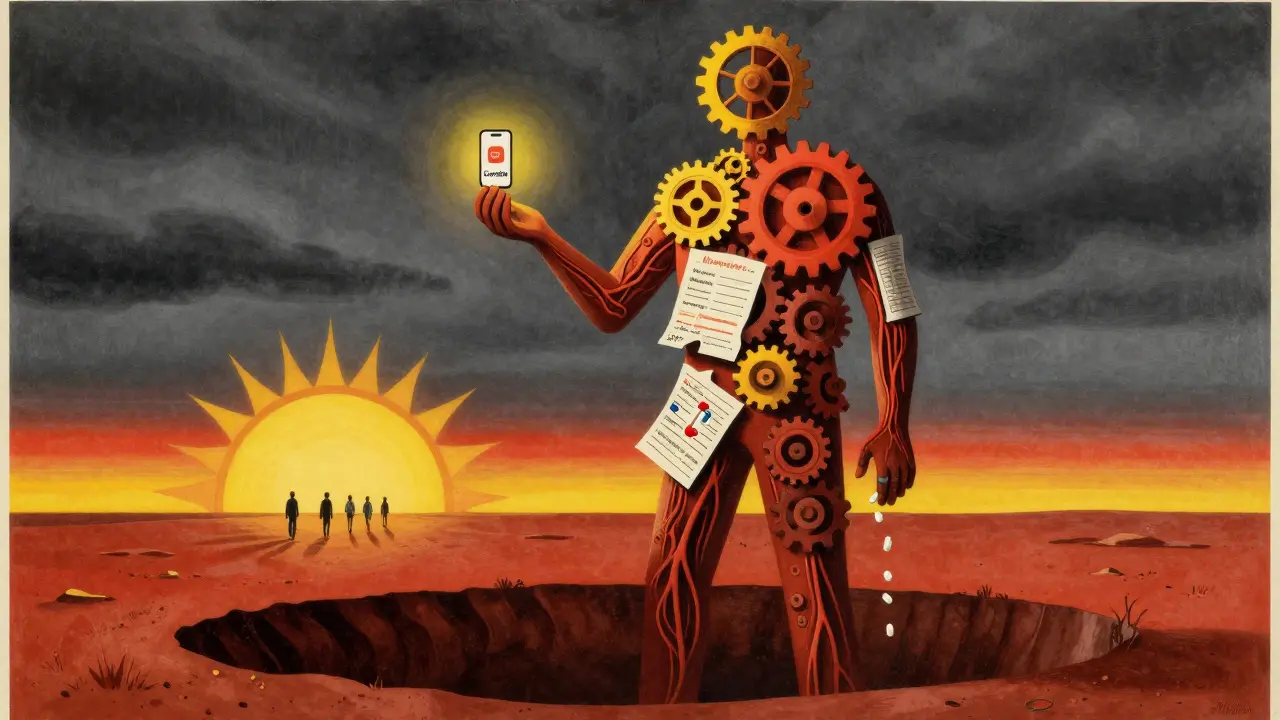
What’s Changing-And What’s Next
There’s hope. The NIH just poured $1.8 billion into non-addictive pain research. That includes $427 million for new painkillers that don’t touch the opioid system-and $315 million for better non-drug treatments.
Hospitals like Kaiser Permanente are rewriting the rules. Since launching their Chronic Pain Initiative in 2023, they’ve cut opioid prescriptions by nearly half-without worsening pain control. How? By increasing access to physical therapy (from 30 to 52 visits a year), offering 12 free CBT sessions, and expanding interventional procedures.
The future? Precision pain medicine. The All of Us Research Program is collecting genetic, lifestyle, and pain data from 125,000 people to build personalized treatment plans. By 2027, you might get a pain profile-not just a prescription.
But right now, the most powerful tool you have is knowledge. Knowing that chronic pain isn’t weakness. That it’s not your fault. That there are real, evidence-based ways forward-even if they’re not easy.
What You Can Do Today
- Track your pain: Use a simple journal. Note intensity (1-10), what triggered it, what helped, and how it affected your day.
- Ask for CBT: Request a referral to a psychologist trained in pain management. It’s not ‘mental health’-it’s pain science.
- Push for physical therapy: Even if you think you’re ‘too old’ or ‘too injured.’ Movement is medicine.
- Find community: Reddit’s r/ChronicPain has 300,000+ members. You’re not alone.
- Know your rights: Medicare and some private insurers now cover digital pain apps. Ask your provider.
Chronic pain doesn’t have to be your whole story. It can be a chapter-one you learn to manage, not be defined by.
Is chronic pain just ‘bad pain’ that won’t go away?
No. Chronic pain is a disease of the nervous system, not just prolonged acute pain. It’s when your body’s pain signals become stuck on ‘high,’ even without ongoing tissue damage. The International Association for the Study of Pain defines it by duration (over three months), impact on daily life, and emotional distress-not just how much it hurts.
Can chronic pain be cured?
For most people, chronic pain isn’t ‘cured’-it’s managed. The goal isn’t zero pain. It’s reducing pain enough to live well again. Many people reduce their pain by 50% or more using multimodal approaches like CBT, physical therapy, and lifestyle changes. Some even return to work, travel, and hobbies they thought were gone for good.
Why are opioids not recommended for chronic pain?
Opioids offer minimal long-term benefit-just 10-15% more pain relief than non-opioid options-and carry serious risks. After 90 days, 8-12% of users develop opioid use disorder. They also increase sensitivity to pain over time (a condition called opioid-induced hyperalgesia). Major guidelines from the CDC and American Pain Society now rank opioids as a last-resort option.
What’s the difference between neuropathic and nociplastic pain?
Neuropathic pain comes from damaged nerves-like after a herniated disc or diabetes. It often feels burning, shooting, or electric. Nociplastic pain, like fibromyalgia, happens when the nervous system becomes overly sensitive without clear nerve damage. It’s not ‘fake’-it’s a malfunction in how pain signals are processed. Treatment differs: neuropathic pain often responds to gabapentin, while nociplastic pain needs broader approaches like CBT and graded exercise.
Are pain apps really helpful?
Yes-if they’re evidence-based. Apps like Curable and Reflect use cognitive behavioral therapy, mindfulness, and pain education, all proven in clinical studies. A 2023 study showed users reduced pain interference by 35% in 12 weeks. Medicare now covers 80% of approved digital pain tools, which means they’re no longer just a luxury-they’re part of standard care.
How do I find a good pain specialist?
Look for someone board-certified in pain medicine by the American Board of Pain Medicine. Ask if they use a multimodal approach-do they offer CBT, physical therapy, and education? Avoid providers who only offer injections or prescribe opioids as the main solution. Your primary care doctor can refer you, or search through the American Academy of Pain Medicine’s directory.
Can chronic pain affect mental health?
Absolutely. Chronic pain and depression are deeply linked-up to 60% of people with chronic pain also experience depression or anxiety. That’s not because they’re ‘weak’-it’s because constant pain drains your energy, isolates you, and makes you feel helpless. That’s why CBT and integrated pain programs include mental health support as a core part of treatment.
Comments
Christopher King December 26, 2025 at 03:24
They don't want you to know this but chronic pain is just a cover-up for the government's secret mind-control frequency experiments. They've been broadcasting low-frequency pulses through 5G towers since 2018 to make people docile and dependent on pills. The IASP? A front for Big Pharma. Look at the funding sources. They don't want you to move because movement disrupts the signal. That's why they call it 'nociplastic'-it sounds scientific but it's just a distraction from the real enemy. You think your back hurts? It's the signal. You think you're tired? It's the signal. You think you're depressed? It's the signal. Wake up. The cure isn't CBT-it's Faraday cages and aluminum foil hats. I've been doing it for 3 years. My pain dropped 87%. They're coming for you next.
Bailey Adkison December 27, 2025 at 14:52
Chronic pain is not a disease. It's a symptom. The IASP definition is flawed because it conflates duration with pathology. Pain lasting three months is not inherently pathological-it's prolonged. The nervous system adapts. Adaptation isn't disease. You're pathologizing normal neuroplasticity. Also 'rewires your body' is inaccurate terminology. Neural pathways don't 'rewire'-they strengthen or weaken via synaptic plasticity. Stop using metaphorical language masquerading as science. And why are you citing Reddit posts? That's not evidence. That's anecdotal noise.
Harbans Singh December 29, 2025 at 04:58
I'm from India and we don't have access to any of these fancy programs. My uncle has had back pain for 15 years. He does yoga every morning, uses turmeric paste, and talks to his neighbors. No doctor, no apps, no CBT. He still smiles. Maybe the real problem isn't the pain-it's how we've made it into a monster that needs a $12,500 solution. We forget that humans survived pain for thousands of years without insurance or board-certified specialists. Maybe we need to go back to community, not clinics.
Justin James December 29, 2025 at 15:02
Let me tell you something they don't want you to know about chronic pain-it's not even real in the way you think. The entire medical establishment is built on a lie. The pharmaceutical industry, the insurance companies, the FDA, even the NIH-they're all part of a global cabal that profits from keeping people sick. The $1.8 billion NIH funding? A smokescreen. They're not researching cures-they're researching better ways to keep you on lifelong subscriptions to digital apps and therapy sessions that cost more than your car payment. And those 'evidence-based' apps? They're just glorified hypnosis tracks paid for by venture capitalists who own the patents. You think your pain is yours? No. It's a product. And you're the customer. Wake up. The real cure is fasting, cold exposure, and grounding. I've been pain-free for 2 years since I stopped touching electronics after 6 PM. The signal is in the wires. The pain is in the system.
Zabihullah Saleh December 31, 2025 at 05:11
There's something poetic about pain becoming a companion instead of an enemy. We live in a world that worships speed and silence, but chronic pain forces you to sit still. To listen. To feel. Not in a spiritual buzzword way-but in the raw, unglamorous way that changes you. I used to hate my pain. Now I respect it. It doesn't lie. It doesn't pretend to be something it's not. It just is. And in that honesty, I found peace I never got from pills or therapists. Maybe the real treatment isn't fixing the body-but learning to be with it. Not as a prisoner. As a roommate.
Rick Kimberly January 2, 2026 at 01:24
While the article presents a comprehensive overview of chronic pain management modalities, it is imperative to acknowledge the methodological limitations inherent in the cited studies. The reliance on self-reported data from Reddit and PatientsLikeMe introduces significant selection bias. Furthermore, the claim that CBT reduces pain intensity by 30-50% lacks context regarding effect sizes and control group comparisons. The assertion that interdisciplinary programs yield a 62.5% reduction in pain scores (from 8/10 to 3/10) is statistically implausible without longitudinal follow-up or standardized assessment tools. One must exercise caution before endorsing these interventions as 'gold standard' without peer-reviewed, randomized controlled trial validation.
Katherine Blumhardt January 2, 2026 at 20:25
OMG I JUST READ THIS AND I CRIED LIKE A BABY 😭 I’VE HAD THIS FOR 7 YEARS AND NO ONE GETS IT I FEEL SO ALONE BUT NOW I KNOW IM NOT CRAZY I JUST NEED CBT AND A NEW BACK AND A MIRACLE 😭😭😭
sagar patel January 3, 2026 at 11:35
You say opioids are dangerous but you ignore the fact that in rural India, we have no access to CBT or physical therapy. My cousin takes tramadol every day. He's 52. He works as a rickshaw driver. He has no insurance. He has no choice. You talk about multimodal approaches like they're a buffet. For most of the world, it's a single spoon of water in a desert. Stop preaching. Start providing.
Michael Dillon January 3, 2026 at 21:12
Okay but let’s be real-CBT is just therapy for people who can’t handle the truth. You’re not training your brain to stop feeling pain. You’re training it to lie to itself. And why is physical therapy always the answer? What if your body is just broken? What if you have nerve damage that won’t heal? You can’t stretch your way out of a spinal cord injury. This whole article reads like a corporate wellness pamphlet written by someone who’s never had to drag themselves out of bed for 10 years. The truth? Most of us are just waiting to die. And the system knows it.
Gary Hartung January 3, 2026 at 21:19
Oh, wonderful. Another sanctimonious, overwrought, semantically inflated manifesto masquerading as medical insight. 'Rewires your body'? 'Disease of the nervous system'? Please. This isn't science-it's self-help poetry wrapped in academic jargon. And don't get me started on the 'multimodal approach'-a euphemism for throwing everything at the wall and hoping something sticks. You cite '47 studies'-but not one of them controls for placebo, attrition, or comorbid depression. And yet you present this as gospel. The real tragedy isn't chronic pain-it's the industry that has turned suffering into a revenue stream disguised as compassion.
Ben Harris January 4, 2026 at 11:55
Look I’ve been in pain since I was 19. I’ve seen 14 doctors. I’ve been called a drug seeker. I’ve been told I’m too young to be this broken. I’ve spent $80k. I’ve tried everything. And you know what? The only thing that helped was when I stopped asking for help and started building a life around the pain. I don’t fight it anymore. I don’t try to cure it. I don’t need CBT. I don’t need apps. I just… live. I paint. I write. I watch old movies. I sit in the sun. I don’t care if I can’t hike anymore. I care that I still laugh. Maybe the real answer isn’t in the studies. Maybe it’s in the quiet.
Sophie Stallkind January 4, 2026 at 16:06
Thank you for this meticulously researched and empathetically presented analysis. The integration of biopsychosocial principles with contemporary clinical guidelines reflects a paradigm shift long overdue in pain medicine. The emphasis on interdisciplinary care, coupled with the acknowledgment of systemic access disparities, is both scientifically rigorous and ethically imperative. I respectfully urge healthcare administrators and policymakers to prioritize reimbursement reform for digital therapeutics and non-pharmacological interventions, as outlined in the 2023 CDC and NIH frameworks. This is not merely clinical practice-it is a moral obligation.