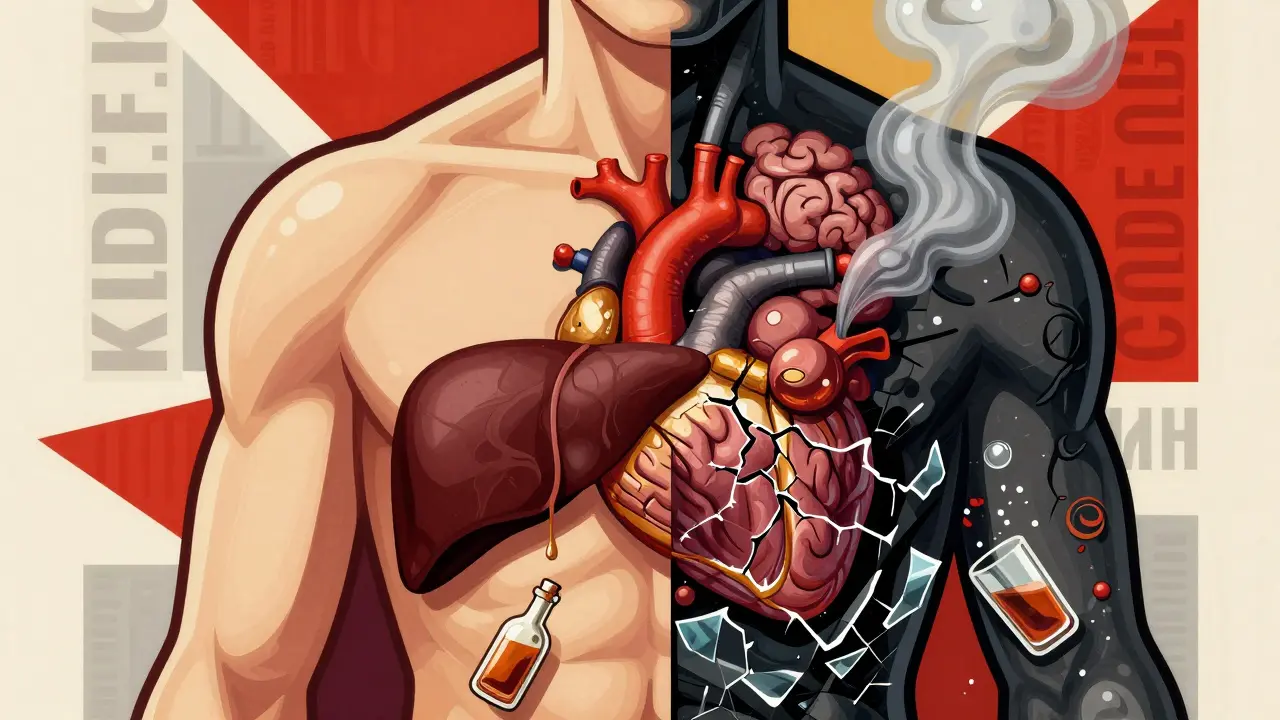
Chronic Alcohol Use Disorder isn’t just about drinking too much. It’s a medical condition where your brain and body get stuck in a cycle of compulsive drinking-even when it’s destroying your health, relationships, or job. This isn’t weakness. It’s a brain disease. And like any chronic illness, it needs real treatment, not judgment.
What Happens to Your Body When You Drink Too Much for Too Long
Your liver takes the first hit. After years of heavy drinking, nearly everyone develops fatty liver. It’s reversible-if you stop. But if you keep going, inflammation sets in. That’s alcoholic hepatitis. Cells die. Scar tissue builds up. Eventually, you reach cirrhosis. At this stage, the liver can’t filter toxins, make proteins, or store energy. The damage may be permanent.
Alcohol doesn’t just hurt your liver. It wrecks your heart. Heavy drinkers have a 40% higher chance of atrial fibrillation-a dangerous irregular heartbeat. Stroke risk jumps 34%. Blood pressure spikes. One in six cases of high blood pressure in the U.S. is linked to alcohol.
Your brain changes, too. Alcohol depresses your central nervous system. At first, you might feel relaxed. Then comes the crash: drowsiness, poor coordination, slurred speech. Over time, memory fades. Thinking gets foggy. Some people develop Wernicke’s encephalopathy-a brain disorder from thiamine (vitamin B1) deficiency. Symptoms include confusion, eye movement problems, and trouble walking. Left untreated, it can lead to permanent dementia.
Alcohol weakens your immune system. People with AUD are nearly three times more likely to get pneumonia. It also raises your cancer risk. Heavy drinkers face a fivefold increase in mouth and throat cancer. Breast cancer risk goes up 12% with every daily drink. Liver cancer, bowel cancer-those risks climb, too.
And then there’s the face. Redness. Puffiness. Broken capillaries. It’s not just from dehydration. It’s from chronic inflammation and damaged blood vessels. Your body is screaming for help.
Withdrawal Isn’t Just Uncomfortable-It’s Dangerous
If you’ve been drinking heavily for months or years, quitting cold turkey can kill you. Your nervous system has adapted to alcohol’s presence. When it’s gone, your brain goes into overdrive. Symptoms start within hours: shaking, sweating, nausea, anxiety. Within 24 to 72 hours, seizures can happen. Delirium tremens-confusion, hallucinations, rapid heartbeat-can follow. It’s life-threatening.
That’s why detox isn’t something to do at home. Medical supervision is non-negotiable. Doctors use medications like benzodiazepines to calm the nervous system and prevent seizures. They monitor vital signs. They replace lost vitamins, especially B1. Without this, you’re playing Russian roulette with your life.
Medications That Actually Work
There are three FDA-approved drugs for Alcohol Use Disorder-and they’re not just for "addicts." They’re for anyone trying to break the cycle.
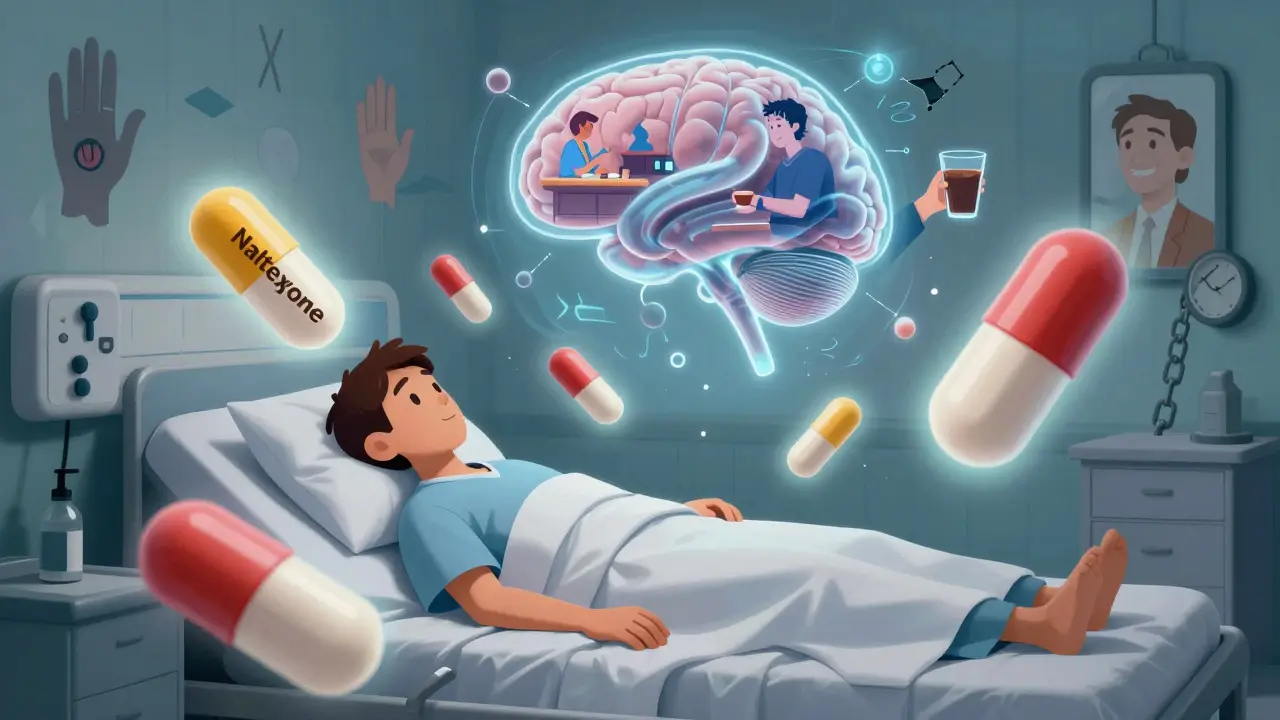
- Naltrexone (ReVia, Vivitrol): Blocks the pleasurable effects of alcohol. You still drink, but it doesn’t feel as good. This reduces cravings and helps people cut back or stop. It’s given as a daily pill or monthly injection.
- Acamprosate (Campral): Helps stabilize brain chemistry after you stop drinking. It doesn’t stop cravings, but it reduces the discomfort of being sober-less anxiety, fewer sleep problems. Best for people who’ve already quit.
- Disulfiram (Antabuse): Makes drinking unpleasant. If you drink while taking it, you get nausea, vomiting, headaches, and a racing heart. It’s a deterrent. Works only if you take it daily.
Studies show that combining medication with therapy boosts success rates by 24% compared to therapy alone. These aren’t magic pills. But they’re tools. And tools matter.
Therapy Changes the Way You Think
Medication helps your body. Therapy helps your mind.
Cognitive Behavioral Therapy (CBT) is the most studied. It teaches you to spot triggers-stress, parties, boredom-and replace drinking with healthier responses. In clinical trials, CBT reduced heavy drinking days by 60%.
Motivational Enhancement Therapy (MET) is different. It’s not about telling you what to do. It’s about helping you find your own reason to change. If you’re stuck between "I want to quit" and "I just can’t," MET helps you resolve that conflict.
Some people find group support works best. Alcoholics Anonymous (AA) has been around since 1935. It’s free, everywhere, and built on peer support. Their own data shows about 27% of members stay abstinent after one year. Critics say the numbers aren’t perfect-but for someone with no other options, it’s a lifeline.
New Frontiers in Treatment
Science is catching up. In 2022, a study in JAMA Psychiatry showed that transcranial magnetic stimulation (TMS)-a non-invasive brain stimulation technique-led to 50% abstinence rates after 12 weeks. It targets areas of the brain linked to cravings.
There’s also reSET, an FDA-approved app that acts like a digital therapist. It gives daily lessons, tracks triggers, and sends reminders. In trials, users were more than twice as likely to stay sober compared to those without it.
These aren’t gimmicks. They’re evidence-based. And they’re expanding access. Not everyone can afford weekly therapy. But an app? A phone call? That’s doable.
Recovery Is Possible-But It’s Not Linear
Relapse is common. It doesn’t mean failure. It means the treatment needs adjusting. Like diabetes or high blood pressure, AUD often needs long-term management. Some people stay sober for life. Others need to cycle through treatment more than once.
The good news? Liver damage can reverse-if you stop early. Early-stage cirrhosis? Stopping alcohol can improve function. The brain can heal. Memory improves. Mood lifts. Skin clears. You regain control.
But you can’t do it alone. And you don’t have to.
Why So Few People Get Help
Only 19.2% of Americans with AUD get treatment. Why? Shame. Fear. Cost. Lack of access.
Many still see AUD as a moral flaw-not a medical condition. Insurance doesn’t always cover it. Therapists are hard to find. Medications are underprescribed.
But change is coming. More doctors are screening for AUD. More clinics offer medication-assisted treatment. Telehealth makes therapy reachable-even in rural areas.
If you’re reading this and thinking, "It’s too late," it’s not. If you’re thinking, "I’ve tried before," you’re not alone. Recovery isn’t about perfection. It’s about showing up-again and again.
Can you recover from alcohol use disorder without professional help?
Some people do stop drinking on their own, especially if their use is mild. But for moderate to severe cases, professional help dramatically increases success. Medical detox prevents life-threatening withdrawal. Therapy addresses the root causes. Medications reduce cravings. Trying alone increases the risk of relapse-and dangerous complications.
How long does alcohol withdrawal last?
Symptoms usually start within 6 to 12 hours after the last drink. Peak intensity happens between 24 and 72 hours. Most physical symptoms fade within a week. But some, like anxiety, insomnia, or cravings, can last weeks or months. This is called post-acute withdrawal syndrome. Medical supervision makes this phase safer and more manageable.
Are AUD medications just replacing one addiction with another?
No. Medications like naltrexone and acamprosate don’t cause euphoria or dependence. They don’t get you high. They help restore brain function and reduce cravings-just like blood pressure meds help regulate your heart. Disulfiram creates an aversive reaction to alcohol, which discourages use. These are tools for recovery, not substitutes.
Can alcohol damage be reversed?
Yes-up to a point. Fatty liver reverses within weeks of stopping. Alcoholic hepatitis improves significantly with abstinence. Even early cirrhosis can stabilize or improve. But advanced cirrhosis with liver failure may require a transplant. Brain function, memory, and mood often improve within months. The sooner you stop, the better your chances.
What’s the difference between binge drinking and alcohol use disorder?
Binge drinking is a pattern-five or more drinks in two hours for men, four or more for women. It’s dangerous, but not everyone who binges has AUD. Alcohol Use Disorder is a medical diagnosis based on 11 criteria: cravings, loss of control, tolerance, withdrawal, neglecting responsibilities, continuing despite harm, and more. You can have AUD without binge drinking. You can binge drink without AUD. But repeated binges raise your risk of developing it.
Is it safe to quit drinking cold turkey?
If you’ve been drinking heavily for more than a few weeks, quitting cold turkey is dangerous. Seizures, delirium tremens, and heart complications can occur. Medical detox is the only safe way. Even if you think you’re "not that bad," it’s better to be safe. Call a doctor or local addiction service before stopping.
Can family members help someone with AUD?
Yes-but not by enabling. Support means encouraging treatment, not covering up consequences. Attend family therapy. Learn about AUD. Set boundaries. Avoid arguments when they’re drinking. Offer help finding resources. Your calm, consistent support makes a bigger difference than you think.
How do I know if I have AUD?
Ask yourself: Have you tried to cut down and couldn’t? Do you spend a lot of time drinking or recovering? Have you neglected responsibilities because of alcohol? Do you keep drinking even though it’s hurting your health or relationships? If you answer yes to two or more of the DSM-5 criteria, you likely have AUD. Talk to a doctor. Screening takes five minutes.
What Comes Next?
If you’re ready to stop, start here: call your doctor. Ask about AUD screening. Ask about medications. Ask about therapy. You don’t need to have hit rock bottom. You don’t need to be "ready" in the way society says. You just need to want something different.
Recovery isn’t about becoming someone else. It’s about getting back to yourself. The person who laughed easily. Who slept well. Who didn’t dread the morning after.
It’s not easy. But it’s possible. And you’re not alone.
Comments
Bridget Molokomme February 3, 2026 at 02:13
So let me get this straight - we’re now treating alcoholism like it’s a broken wifi signal? Just reboot with a pill and boom, you’re back to normal? 😒
My uncle drank for 30 years, quit cold turkey at 62, and now he hikes every weekend. No meds. No apps. Just grit and a really good therapist who didn’t judge him for crying in session.
Also - why is every treatment option a pill? What about yoga? What about getting a dog? Or just… learning to sit with your thoughts for once?
Vatsal Srivastava February 4, 2026 at 17:04
Medication for alcoholism? How quaint. In India we just call it a lifestyle choice. No need for FDA-approved nonsense when you’ve got chai, family, and a strong sense of detachment.
Also, TMS? That’s just electroshock therapy with a fancy name. And apps? Please. If you need an app to not drink, you were never serious to begin with.
Brittany Marioni February 4, 2026 at 17:18
Thank you for writing this. Seriously. So many people still think addiction is a moral failure - and this breaks it down so clearly.
Let me just say: if you’re reading this and you’re scared to reach out? You’re not alone. I was there. I cried in my car before calling my doctor. I thought I’d be judged. I thought I’d be labeled. But the truth? The people who care about you? They just want you alive.
Medication isn’t weakness. Therapy isn’t giving up. Detox isn’t failure. It’s all part of the comeback. And you? You’re worth the comeback.
Also - if you’re a doctor reading this? Please, please, please screen for AUD like you do for cholesterol. Five minutes could save a life.
Monica Slypig February 5, 2026 at 23:27
USA thinks it can fix everything with a pill and a smartphone app. Meanwhile, real countries like mine just tell people to stop drinking and get back to work.
Also - AA? That’s a cult. And TMS? Sounds like sci-fi. If you can’t control your drinking, maybe you shouldn’t be allowed to own a car, let alone a phone.
Stop coddling people. Discipline. That’s what we need. Not apps.
Becky M. February 6, 2026 at 14:17
Just wanted to say - I’m 5 years sober now. I didn’t use any of these meds. I didn’t go to AA. I just… stopped. One day, I looked in the mirror and didn’t recognize the person staring back.
It wasn’t magic. It was messy. I lost friends. I cried a lot. I slept for three days straight.
But the skin cleared. My hands stopped shaking. I remembered my mom’s voice.
If you’re reading this and you’re tired? You’re not broken. You’re just exhausted. And that’s okay.
You don’t need to be ready. You just need to want to breathe again.
jay patel February 8, 2026 at 09:42
Man, I’ve seen this too many times - friends who thought they could just ‘cut back’ and ended up in the ER with seizures. I’m from India, and here, we don’t talk about this stuff, but I’ve had cousins who drank themselves into liver failure and nobody said a word because ‘it’s just how he is’.
But here’s the thing - the science is right. It’s not about willpower. It’s about chemistry. Your brain literally rewires. And no, you can’t just ‘think positive’ and heal a damaged hippocampus.
Also - disulfiram? Yeah, it’s harsh. But imagine your grandma drinking a glass of wine and throwing up for three hours. That’s the deterrent. Sometimes, you need that kind of slap in the face to wake up.
And apps? I use reSET. It’s dumb. But it reminds me to drink water. And sometimes, that’s enough to keep me from reaching for the bottle.
Ansley Mayson February 10, 2026 at 05:34
Overstated. All this medical jargon to make people feel better about being weak.
People drink too much because they’re lazy. Not because their brain is broken.
Also - ‘liver damage can reverse’? Sure. If you’re 25 and stopped at stage one. Most of these people are 45 and have cirrhosis. Too late.
Why waste money on TMS when you could just tell them to get a job?
phara don February 10, 2026 at 16:48
Wait - so if I take naltrexone, I can still drink, but it won’t feel good? So it’s like… alcohol becomes a chore?
That’s actually kind of brilliant.
And the app? Is it like a fitness tracker but for sobriety? I’d use that.
Also - does anyone know if these meds interact with antidepressants? Asking for a friend. 😅
Hannah Gliane February 11, 2026 at 18:57
Oh wow. Another ‘addiction is a disease’ sermon. 🙄
My cousin got sober in 3 months by drinking kombucha and doing yoga. She didn’t need a $1000/month injection or an app that pings her every 2 hours.
Stop infantilizing people. If you can’t control your drinking, maybe you’re just not strong enough.
Also - why is everyone acting like alcohol is cocaine? It’s just a drink. People used to drink and work. Now we need a therapist to tell us it’s okay to have a glass of wine with dinner?
Pathetic.
Murarikar Satishwar February 13, 2026 at 06:24
Thank you for this. As someone from India who’s seen friends die from liver failure because no one talked about it, I’m so glad this exists.
Here, we say ‘beta, thoda kam piyo’ - drink less - like it’s a snack problem. But it’s not. It’s a brain problem. And we need to treat it like one.
I’ve worked with rehab centers in Delhi. The ones that combine meds with family counseling? They have the highest success rates.
Also - AA isn’t perfect. But it’s free. And in a country where therapy costs more than rent? That matters.
Don’t let shame silence you. You’re not weak. You’re human. And healing? It’s not linear. It’s messy. But it’s possible. I’m living proof.