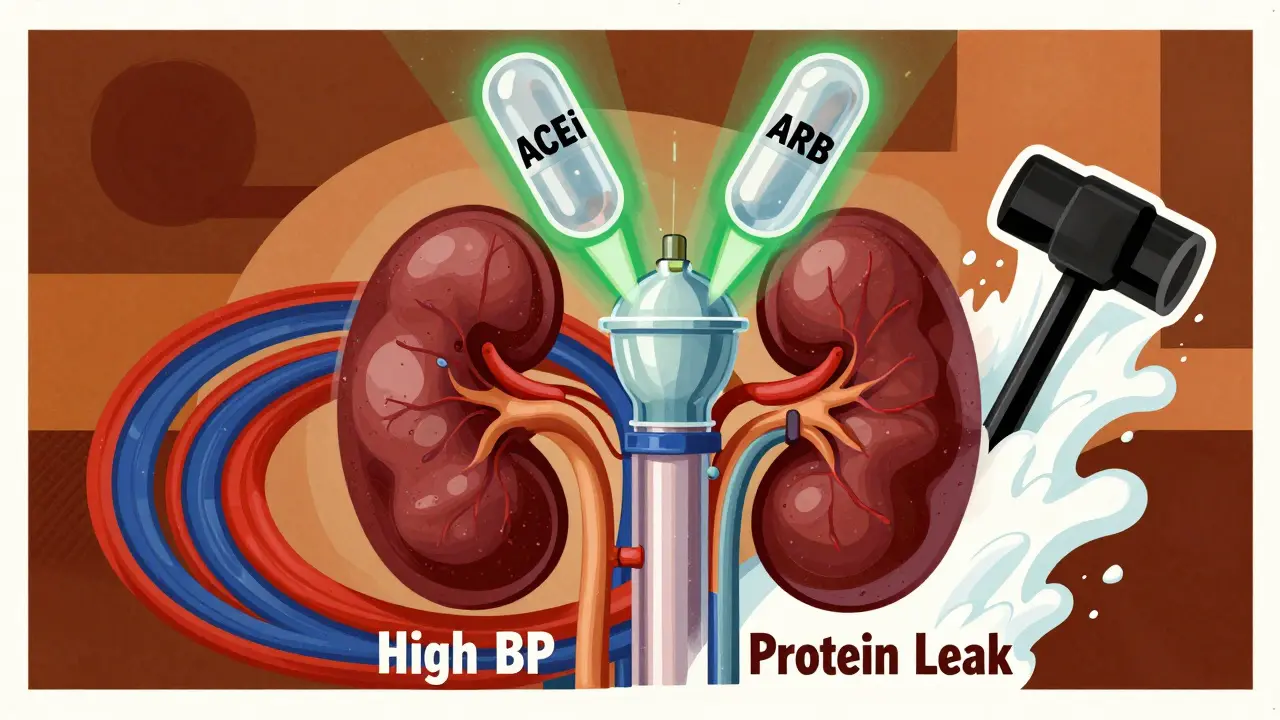
When your kidneys are damaged, high blood pressure doesn’t just make things worse-it speeds up the damage. That’s why controlling blood pressure isn’t just about preventing heart attacks or strokes. For people with chronic kidney disease (CKD), it’s about keeping the kidneys working as long as possible. And two classes of blood pressure medications-ACE inhibitors and ARBs-have become the gold standard for doing exactly that.
Why Blood Pressure Matters So Much in Kidney Disease
Your kidneys don’t just filter waste. They also regulate fluid balance and blood pressure. When kidney function drops, the body often responds by holding onto more salt and water. That raises blood pressure. But high pressure inside the tiny filtering units of the kidney-called glomeruli-damages them further. It’s a vicious cycle: damaged kidneys raise blood pressure, and high blood pressure damages more kidneys.
Protein leaking into the urine (proteinuria) is one of the clearest signs this damage is happening. The more protein in the urine, the faster kidney function tends to decline. That’s why doctors don’t just look at blood pressure numbers-they check urine tests too. A urine albumin-to-creatinine ratio (UACR) over 200 mg/g is a red flag that the kidneys are under serious stress.
How ACE Inhibitors and ARBs Work
Both ACE inhibitors and ARBs target the same system: the renin-angiotensin-aldosterone system, or RAAS. This is the body’s natural blood pressure control mechanism, but in kidney disease, it goes into overdrive.
ACE inhibitors (like lisinopril, enalapril, benazepril) block the enzyme that turns angiotensin I into angiotensin II. Angiotensin II is a powerful chemical that narrows blood vessels and increases pressure. By reducing its production, ACE inhibitors lower blood pressure and reduce pressure inside the kidney’s filtering units.
ARBs (like losartan, valsartan, irbesartan) do something similar but differently. Instead of stopping the production of angiotensin II, they block its receptors. Even if angiotensin II is still around, it can’t do its damage because the receptors it needs to bind to are shut down.
The result? Both types of drugs lower systolic blood pressure by 10-15 mmHg on average. More importantly, they reduce proteinuria by 30-50%. That drop in protein loss is one of the strongest predictors that kidney damage is slowing down.
What the Evidence Shows
Over the last 20 years, dozens of large studies have confirmed what early trials suggested: these drugs don’t just lower blood pressure-they protect the kidneys.
A landmark analysis published in the Journal of the American Medical Association found that patients with proteinuric kidney disease who took ACE inhibitors or ARBs had a 25% lower risk of reaching end-stage kidney disease compared to those on other blood pressure meds. That’s not a small benefit. For someone with stage 3 or 4 CKD, it could mean delaying dialysis by years.
A 2024 study of 1,237 patients with advanced CKD (eGFR under 20 mL/min) followed for nearly three years showed something remarkable: starting an ACE inhibitor or ARB cut the risk of needing kidney replacement therapy (dialysis or transplant) by 34%. Even in patients with very low kidney function, these drugs made a measurable difference.
And it’s not just about dialysis. A UK trial comparing patients who kept taking these drugs versus those who stopped in stage IV or V CKD found that those who continued had better-preserved kidney function over three years. No harm. Just benefit.
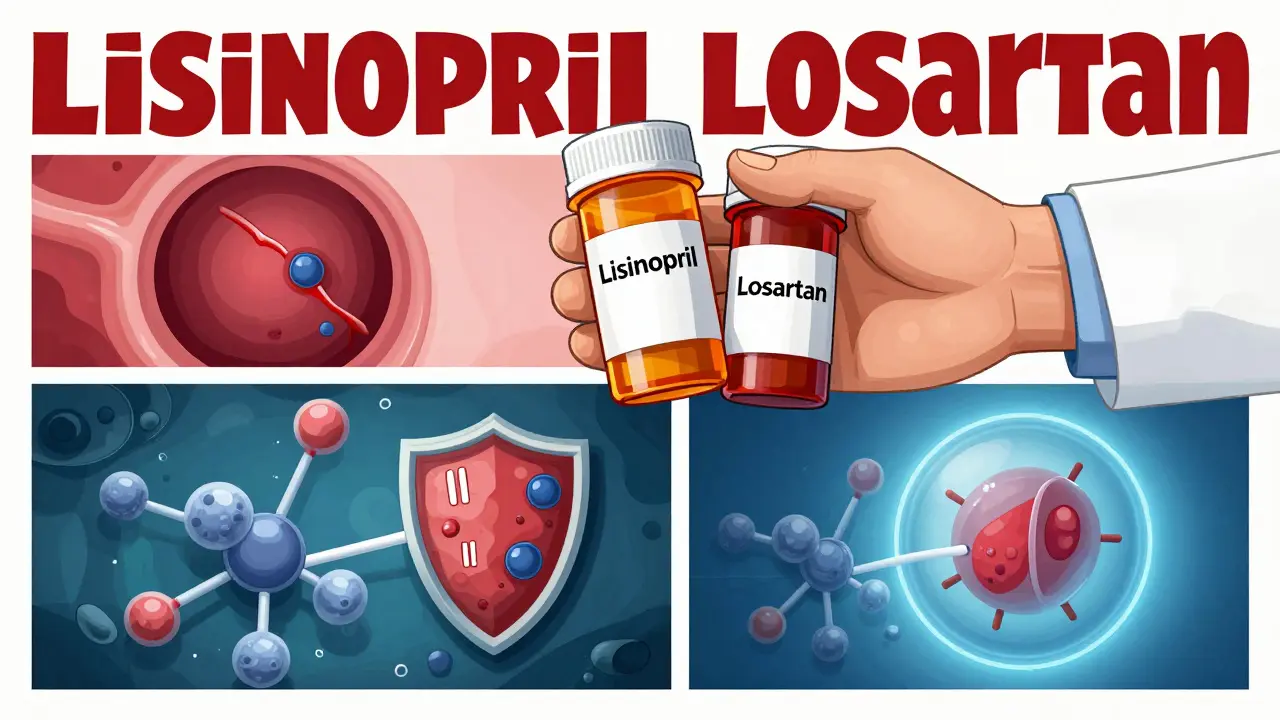
ACE Inhibitors vs. ARBs: What’s the Difference?
Both work similarly to protect the kidneys. But they differ in side effects.
ACE inhibitors are more likely to cause a dry, persistent cough-something that affects 5-20% of users. For some, it’s mild. For others, it’s unbearable. That’s why many switch to ARBs. They also carry a very small risk (0.1-0.2%) of angioedema-a rare but serious swelling of the face, lips, or throat.
ARBs rarely cause cough or angioedema. That makes them the go-to choice for people who can’t tolerate ACE inhibitors. Their kidney-protecting power is just as strong.
Here’s a quick comparison:
| Feature | ACE Inhibitors | ARBs |
|---|---|---|
| Examples | Lisinopril, Enalapril, Benazepril | Losartan, Valsartan, Irbesartan |
| Reduces proteinuria | 30-50% | 30-50% |
| Reduces systolic BP | 10-15 mmHg | 10-15 mmHg |
| Cough side effect | 5-20% | 1-2% |
| Angioedema risk | 0.1-0.2% | Very rare |
| Used as first-line in CKD | Yes | Yes |
Are These Drugs Safe in Advanced Kidney Disease?
This is where confusion sets in. Many doctors used to believe that if your kidneys were already failing, you shouldn’t use ACE inhibitors or ARBs. The fear? That they’d cause dangerously high potassium (hyperkalemia) or make kidney function crash.
Here’s the truth: those risks are real-but manageable. And avoiding these drugs because of fear often does more harm than good.
A 2024 study found that patients with eGFR below 20 mL/min who started an ACE inhibitor or ARB had a 34% lower risk of needing dialysis. The same study showed that acute kidney injury (a sudden drop in eGFR) happened in about 5-10% of patients, but it was usually temporary. Most of those patients recovered kidney function after stopping the drug briefly and restarting at a lower dose.
Hyperkalemia (potassium over 5.0 mmol/L) occurred in 10-15% of patients. But again, this was often fixable with diet changes, diuretics, or potassium binders. The key? Monitoring.
Current guidelines from KDIGO (Kidney Disease: Improving Global Outcomes) say clearly: keep using ACE inhibitors or ARBs in CKD stages 4 and 5-as long as potassium stays below 5.0 mmol/L and eGFR doesn’t drop more than 30% from baseline. That’s not a reason to stop. It’s a reason to check bloodwork more often.
What About Combining ACE Inhibitors and ARBs?
It sounds logical: if one is good, two must be better. But studies show otherwise.
The Veterans Affairs Nephropathy Trial found that combining an ACE inhibitor with an ARB lowered proteinuria by an extra 15-20%. But it also doubled the risk of acute kidney injury and increased hyperkalemia by 50%. No improvement in long-term kidney outcomes. No reduction in death or dialysis.
Today, guidelines strongly advise against dual RAAS blockade. It’s not worth the risk.
How to Use These Drugs Safely
Starting an ACE inhibitor or ARB isn’t a one-and-done decision. It needs careful setup.
- Check baseline kidney function and potassium. Get an eGFR and serum potassium test before starting.
- Start low, go slow. Begin with a low dose. Most patients need to build up over weeks.
- Monitor after 1-2 weeks. Recheck potassium and eGFR. A drop in eGFR of more than 30%? Hold the drug and reassess. A potassium level over 5.5? Stop and treat.
- Keep going if it’s safe. If potassium stays under 5.0 and eGFR doesn’t crash, keep increasing the dose until you reach the maximum tolerated dose. That’s when you get the best kidney protection.
- Monitor monthly at first. Once stable, check every 3-6 months. More often if you’re on other kidney-affecting drugs or have diabetes.
Many patients worry about side effects. But here’s what real users say: 65% of survey respondents with CKD reported stable kidney function on these drugs. Only 28% stopped because of cough, and 12% because of potassium issues. Most stayed on because they felt better and their labs improved.
What’s Next? The Future of Kidney Protection
Researchers are already looking beyond ACE inhibitors and ARBs. New drugs like sacubitril/valsartan (an angiotensin receptor-neprilysin inhibitor, or ARNI) are showing promise. In the 2024 PARADIGM-HF trial extension, this drug reduced kidney function decline by 22% compared to enalapril in heart failure patients with CKD.
It’s early, but it suggests that next-generation RAAS modulators might offer even better protection with fewer side effects. For now, though, ACE inhibitors and ARBs remain the most proven, most widely used, and most cost-effective tools we have.
Bottom Line
If you have kidney disease and high blood pressure, ACE inhibitors and ARBs aren’t just another pill. They’re one of the few treatments that can actually slow the progression of kidney damage. They lower blood pressure. They reduce protein in your urine. They keep you off dialysis longer.
The risks? Real-but manageable with smart monitoring. The benefits? Proven over decades of research. Too many patients still don’t get these drugs because doctors fear side effects. But the data is clear: the danger of not using them is greater than the risk of using them correctly.
Work with your doctor. Get your numbers checked. Don’t stop because you’re scared. And don’t assume these drugs are only for early-stage disease. They work-even when your kidneys are already damaged.
Comments
Chris Crosson March 26, 2026 at 03:00
I've been on lisinopril for 5 years with stage 3 CKD. My UACR dropped from 320 to 89. Not magic, just science. Doctors who say 'avoid these in advanced CKD' are living in 2010. The data is clear: if your K+ is under 5.0 and you're monitored, these drugs buy you time. Period.
Also, the cough? Real. Switched to valsartan. Zero issues. No drama.
James Moreau March 28, 2026 at 00:21
This is one of the clearest breakdowns I've seen on this topic. Really appreciate how you laid out the evidence without oversimplifying. I work in nephrology and even I learned a few things about the 2024 advanced CKD study. Thanks for the thoughtful post.
J. Murphy March 28, 2026 at 08:57
ace inhihbitors r overhyped fr
Jesse Hall March 29, 2026 at 11:25
I was scared to start my meds after reading horror stories online. But after 18 months? My kidneys are stable, my BP is better, and I feel more alive. 💪 Don’t let fear stop you. Talk to your doc. You got this. 🙌
Donna Fogelsong March 30, 2026 at 13:11
Big Pharma’s RAAS manipulation scheme. They don’t want you to know that potassium binders are just a cover for their profit margins. The real solution? Low-sodium diets, ancestral fasting, and avoiding processed foods. These drugs are just a Band-Aid on a bullet wound.
Sean Bechtelheimer March 31, 2026 at 10:18
they’re all just trying to sell you something. 😈 my cousin’s neighbor’s dentist said the same drugs cause kidney failure. and he’s got a PhD in ‘natural healing’ so… yeah.
Seth Eugenne March 31, 2026 at 18:26
This is why I love this community. No fluff. Just real, actionable info. If you’re reading this and on the fence - start low, monitor, and give it time. Your future self will thank you. 🙏
Alex Arcilla April 1, 2026 at 00:47
so like… we’re all just lab rats for Big Pharma’s ‘renin-angiotensin-aldosterone’ circus? 🤡
also, i love how they say ‘monitor potassium’ like it’s a chill weekend activity. bro, i’m supposed to get bloodwork every 2 weeks? that’s not monitoring. that’s a subscription.
Brandon Shatley April 1, 2026 at 15:33
i read this whole thing. i think the drugs help. but i also think we need to talk more about diet. like, no one mentions how much salt is in canned soup. or how many people don’t even know what 'proteinuria' means. maybe we need simpler messages.
Kevin Y. April 2, 2026 at 03:13
It is imperative to underscore the empirical rigor underpinning the therapeutic efficacy of ACE inhibitors and ARBs in the context of chronic kidney disease. The longitudinal outcomes data, particularly the JAMA meta-analysis and the 2024 multicenter cohort study, provide unequivocal support for their continued utilization in stages III through V CKD, provided vigilant electrolyte and renal function surveillance is maintained.
Raphael Schwartz April 2, 2026 at 05:41
USA healthcare is a scam. these drugs cost 300 bucks a month. i pay 50. they're just here to make you dependent. if you're not rich, you're screwed.
winnipeg whitegloves April 4, 2026 at 00:44
Winnipeg winters make my BP spike. Started on losartan last year. My nephrologist said, 'Don't stop, even if your creatinine climbs a bit.' Guess what? My proteinuria dropped like a rock. These drugs aren't perfect, but they're the best damn tool we've got. Even in -30°C.
Marissa Staples April 4, 2026 at 08:07
I wonder… if the body’s RAAS system is just trying to survive kidney damage, are we really 'protecting' the kidneys… or just delaying the inevitable? Maybe we’re treating the symptom of a deeper systemic failure. Food for thought.
Grace Kusta Nasralla April 5, 2026 at 12:24
I’ve been on these drugs for 7 years. My kidneys are worse. My potassium is always high. I’m tired. I don’t feel 'protected.' I feel like a statistic in a study. The system says 'keep going.' But no one asks how I feel.
Stephen Alabi April 6, 2026 at 17:59
The notion that ACE inhibitors and ARBs are 'gold standard' is a fallacy perpetuated by guideline committees with financial ties to pharmaceutical manufacturers. The 25% risk reduction cited is statistically significant but clinically marginal. Moreover, the exclusion criteria in these trials-patients with advanced CKD, diabetes, or prior hyperkalemia-are systematically omitted. A true risk-benefit analysis demands transparency.