It’s easy to confuse asthma and COPD. Both make you gasp for air. Both can leave you wheezing and coughing. But they’re not the same condition - and treating them like they are can be dangerous.
What’s Really Going On in Your Lungs?
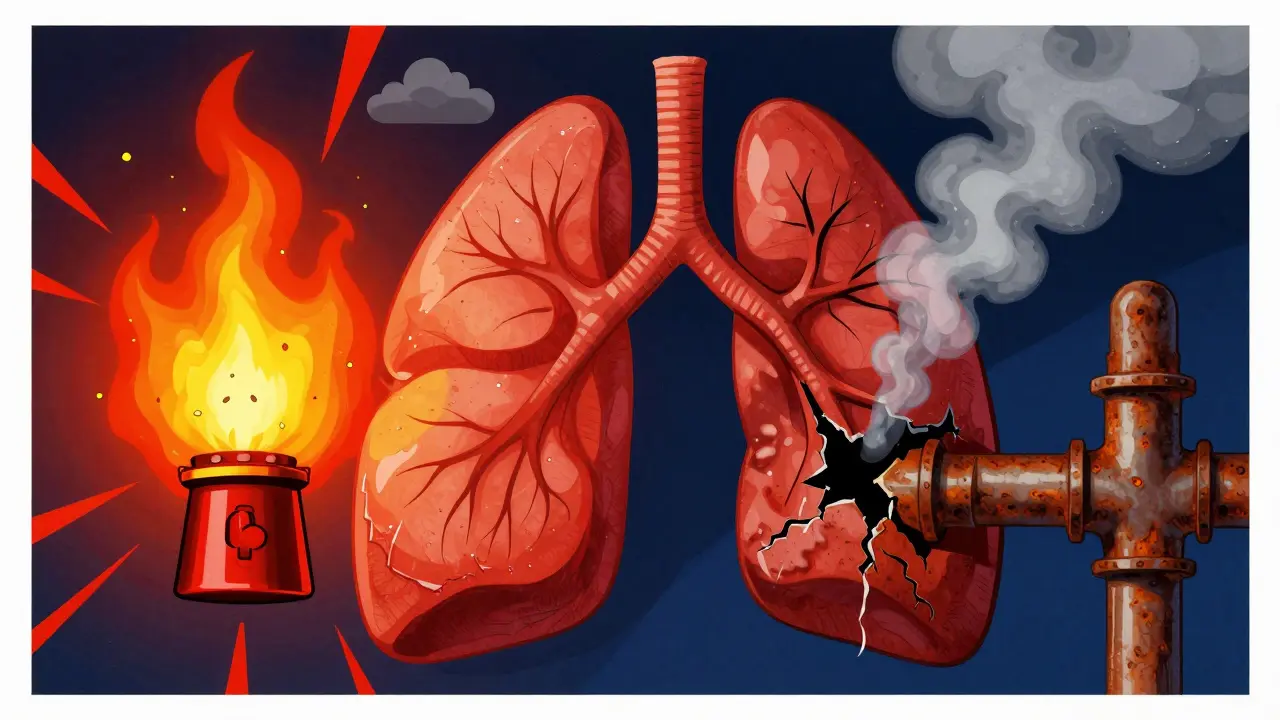
Asthma is like a fire alarm that goes off too often. Your airways get inflamed and tighten up when triggered - by pollen, cold air, exercise, or stress. But between attacks, most people breathe normally. The airway narrowing is temporary and usually reverses with medication.
COPD is more like rust inside a pipe. It’s a group of diseases - mostly emphysema and chronic bronchitis - that slowly destroy lung tissue. The damage is permanent. Even with treatment, airflow doesn’t bounce back the way it does in asthma. This isn’t about triggers. It’s about constant, worsening damage.
Symptoms: When It’s Asthma, When It’s COPD
If you’re wheezing, does that mean asthma? Not always. Here’s how to tell the difference:
- Asthma: Symptoms come and go. You might feel fine in the morning, then struggle to breathe after running or being around cats. Nighttime coughing is common. The cough is often dry. You might have allergies - hay fever or eczema - which are linked to asthma in 65% of cases.
- COPD: Symptoms are always there. You wake up coughing up phlegm - a lot of it. Breathing gets harder over years, not days. You might notice your lips or fingernails turning blue when you’re out of breath. This is cyanosis, a sign your body isn’t getting enough oxygen. It’s rare in asthma.
One study found that 68% of asthma patients have symptom-free periods between flare-ups. Only 12% of COPD patients say they ever feel truly normal.
Who Gets It and When?
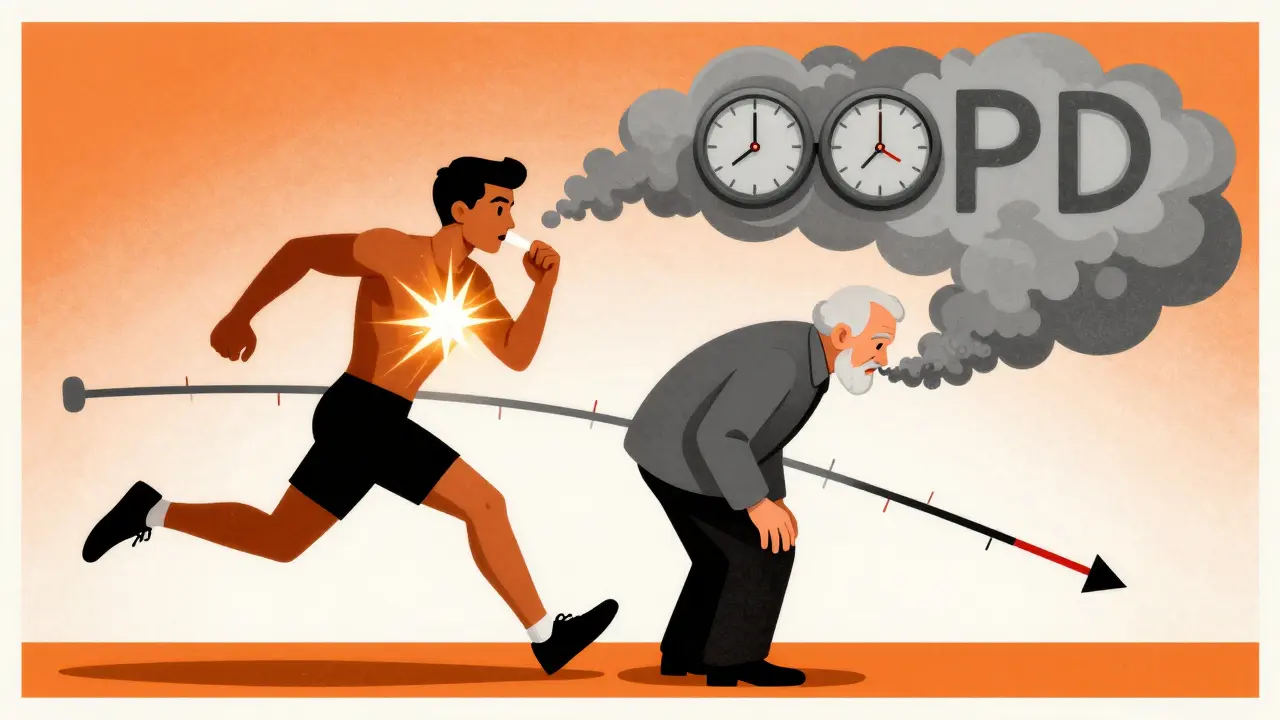
Asthma often starts in childhood. Half of all cases are diagnosed before age 10. Eighty percent are diagnosed by age 30. It can run in families - twin studies show a strong genetic link.
COPD? Almost never shows up before 40. Ninety-two percent of cases are in people over 45. The biggest risk factor? Smoking. About 90% of COPD cases are tied to cigarettes. Even secondhand smoke over years can do damage. Asthma? Only about 20% of cases are linked to smoking.
How Doctors Tell Them Apart
There’s no single test, but doctors use a few key tools:
- Spirometry: This test measures how much air you can blow out and how fast. In asthma, lung function improves by 12% or more after using a rescue inhaler. In COPD, that improvement is usually less than 12%. About 95% of asthma patients show strong reversibility. Only 15% of COPD patients do.
- FeNO test: This measures nitric oxide in your breath. High levels (above 50 ppb) mean eosinophilic inflammation - common in asthma. COPD patients usually have levels below 25 ppb.
- Blood eosinophils: A count above 300 cells/μL suggests asthma or overlap syndrome. Below 100 points to COPD.
- CT scan: Shows emphysema - damaged air sacs - in 75% of COPD patients. Only 5% of asthma patients show this.
These tools have cut misdiagnosis rates from 40% in 2010 to 25% today. But confusion still happens - especially in people over 40 with breathing problems.
Treatment: One Size Does Not Fit Both
Asthma treatment is about control. You start with a rescue inhaler - like albuterol - for quick relief. If you’re having symptoms more than twice a week, you’ll likely move to an inhaled corticosteroid to calm the inflammation. For severe asthma with high eosinophils, biologic injections (like omalizumab or mepolizumab) can cut attacks by half.
COPD treatment is about slowing decline. Bronchodilators - long-acting ones - are the foundation. These open the airways without fighting inflammation. Inhaled steroids are added only if you’re having frequent flare-ups. Why? Because the inflammation in COPD isn’t the same as in asthma. Steroids don’t help much and can raise your risk of pneumonia.
Here’s the hard truth: 89% of asthma patients can get their symptoms under control. Only 52% of COPD patients say they feel like they’re managing well. The lung damage doesn’t heal.
Pulmonary Rehab: What Works?
Exercise programs help both, but differently. COPD patients who do pulmonary rehab can walk 54 meters farther in six minutes - a real boost in daily life. Asthma patients? They might only gain 12 meters. Why? Because between attacks, their lungs are usually fine. They don’t need to rebuild endurance - they need to avoid triggers.
The Gray Zone: Asthma-COPD Overlap Syndrome (ACOS)
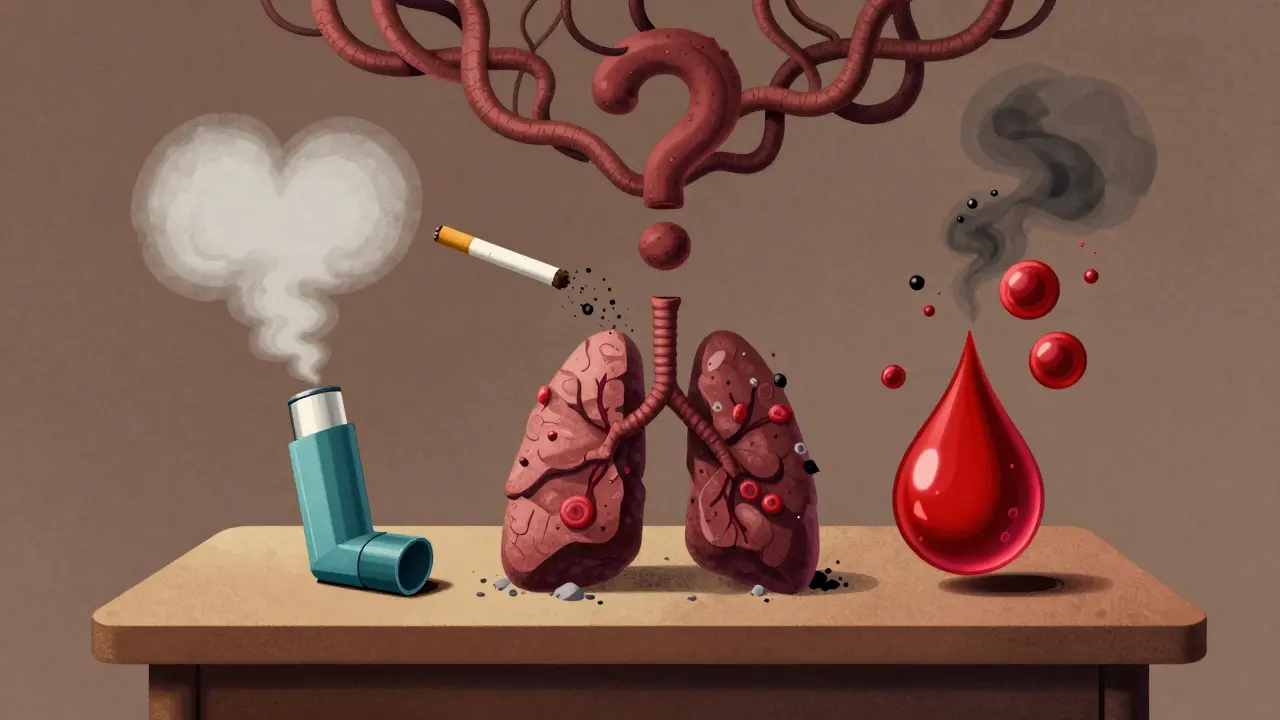
Up to 25% of people with obstructive lung disease have ACOS. These patients have features of both: they wheeze like asthmatics, but their airflow doesn’t fully reverse like it should. They often have high eosinophils (like asthma) but fixed airway narrowing (like COPD).
They’re the toughest to treat. They get sick more often - 1.8 emergency visits per year, compared to 0.7 for asthma alone. Many doctors give them triple therapy: two long-acting bronchodilators plus an inhaled steroid. But evidence for this combo is still weak. It’s a stopgap, not a solution.
Prognosis: What’s the Long-Term Picture?
Asthma has a much better outlook. The 10-year survival rate for moderate asthma is 92%. For moderate COPD? It’s 78%. Quitting smoking cuts COPD’s progression by half. It doesn’t stop asthma from flaring - unless you’ve got ACOS.
Here’s something surprising: if you’ve had asthma for more than 20 years, you might develop fixed airflow limitation. That’s when your airways become stiff and scarred. Now you’re closer to COPD. This blurs the lines - but it’s rare.
What You Can Do Right Now
If you’re struggling to breathe:
- Track your symptoms. When do they happen? After exercise? At night? With cold air? Or are they constant?
- Do you cough up mucus every morning? That’s a red flag for COPD.
- Have you smoked for 10+ years? Even if you quit, that matters.
- Do you have allergies? That leans toward asthma.
Don’t assume your inhaler is enough. If you’re using your rescue inhaler more than twice a week, see a doctor. Get a spirometry test. Ask about FeNO or blood eosinophils. Don’t let a misdiagnosis cost you years of lung health.
And if you smoke - stop. It’s the single biggest thing you can do to slow lung damage, whether you have asthma, COPD, or both.
Can asthma turn into COPD?
Not exactly. Asthma doesn’t become COPD. But long-term, poorly controlled asthma can cause permanent airway changes - called fixed airflow limitation - which looks like COPD on tests. This happens in about 15-20% of people with asthma lasting over 20 years. Smoking greatly increases this risk.
Is COPD curable?
No. COPD is progressive and irreversible. But it’s manageable. Quitting smoking, using bronchodilators, doing pulmonary rehab, and avoiding infections can slow decline and improve quality of life. The goal isn’t a cure - it’s staying as active and independent as possible for as long as possible.
Why do some people with asthma need steroids, but others don’t?
Asthma isn’t one disease. It’s a group of types. People with eosinophilic asthma - where inflammation is driven by certain white blood cells - respond well to inhaled corticosteroids. Others may have non-eosinophilic asthma, where steroids don’t help much. That’s why doctors now use FeNO tests and blood eosinophil counts to tailor treatment. One size doesn’t fit all.
Can you have both asthma and COPD at the same time?
Yes. It’s called Asthma-COPD Overlap Syndrome (ACOS). It’s more common than people think - affecting up to 25% of people with obstructive lung disease. These patients often have a history of asthma and smoking. They experience more flare-ups and hospital visits than people with just one condition. Treatment usually combines asthma and COPD medications, but research is still catching up.
Does using an inhaler too often mean I have COPD?
No. Using a rescue inhaler (like albuterol) more than twice a week means your asthma isn’t well controlled - not that you have COPD. But if you’re over 40, smoke, and need your inhaler often, you should get tested. It’s possible you have both conditions or that your asthma has caused airway remodeling. Don’t self-diagnose. See a doctor for spirometry.
What’s the biggest mistake people make with asthma or COPD?
Assuming they’re the same. Many people with COPD use asthma inhalers and think they’re fine. Others with asthma avoid steroids because they fear side effects - and end up with permanent damage. The biggest mistake? Delaying diagnosis. If you’re over 40 and have breathing problems, don’t write it off as ‘just getting older.’ Get tested. Early action makes all the difference.
Comments
Dorine Anthony December 21, 2025 at 11:42
My grandma had COPD and smoked till she was 82. She never used an inhaler, just sat by the window breathing slow. Doctors said she was lucky. Turns out, her lungs were just tougher than most.
Still, I get why people panic when they can’t catch their breath.
Chris Clark December 22, 2025 at 05:18
biggest thing no one talks about? asthma meds are way cheaper than copd meds. i had to pay $400 for my dad’s triple therapy inhaler last month. my asthma inhaler? $12 at walmart.
insurance is a joke. if you’re over 40 and breathing weird, get tested before you go broke.
Nina Stacey December 23, 2025 at 00:31
my mom had asthma since she was 5 and now shes 67 and shes got that fixed airflow thing they mentioned
she never smoked but she was around secondhand smoke for 20 years growing up and her lungs just kinda gave up
she says she feels like her airways are made of concrete now
they tried biologics but they didnt help much
she cries sometimes when she cant walk to the mailbox without stopping
its not just about meds its about dignity
and no one talks about that part
Guillaume VanderEst December 24, 2025 at 15:13
why do people think asthma is just "kids stuff"? my cousin had severe asthma as a teen and now hes 34 and he cant run up stairs without wheezing
he stopped playing soccer because he was embarrassed
he’s never smoked
but now he’s on three inhalers and a nebulizer twice a day
they call it ACOS now
but back then? doctors just told him to "get over it"
Aboobakar Muhammedali December 24, 2025 at 21:05
i read this whole thing and i just want to hug every person who’s ever had to choose between buying food or their inhaler
no one talks about how expensive this is
or how lonely it feels to sit alone on the couch trying not to cough
you dont need a degree to know this hurts
thank you for writing this
really
Dominic Suyo December 26, 2025 at 05:11
so let me get this straight - we’re spending billions on biologics for asthma while COPD patients are left with bronchodilators and prayers?
and the system calls this "evidence-based medicine"?
the real diagnosis here is capitalism
if your lungs are broken but you’re young and allergic - you get gold-plated care
if you’re 60 and smoked for 30 years - you get a pamphlet and a pat on the back
call it what it is: medical classism
anthony funes gomez December 26, 2025 at 14:19
the pathophysiological divergence between eosinophilic inflammation and proteolytic elastin degradation is fundamental - yet clinical practice still conflates them due to overlapping phenotypes and insufficient biomarker integration
spirometry alone is insufficient - we need FeNO, blood eosinophil thresholds, and CT-based emphysema quantification as standardized triage tools
the current diagnostic paradigm is reactive not proactive
and the lack of longitudinal phenotyping in primary care is a systemic failure
we’re treating symptoms not mechanisms
and that’s why mortality disparities persist
Hussien SLeiman December 26, 2025 at 17:11
you people are missing the point entirely. asthma is a lifestyle disease caused by over-sanitized childhoods and too much screen time. kids today don’t play outside, they don’t get dirty, their immune systems don’t learn - so they turn allergic. and now we’re medicating them into adulthood like it’s normal.
and as for COPD? people smoke because they’re lazy and emotionally broken. they don’t want to quit because they’d rather die than face their problems.
stop pretending this is medical. it’s moral. and if you can’t control your breathing, maybe you should’ve controlled your choices.
also, biologics are a scam. big pharma made them up to sell more drugs. you think your body needs a $30,000 injection to breathe? get a dog. walk. breathe fresh air. problem solved.
Nicole Rutherford December 27, 2025 at 19:56
my husband was misdiagnosed with asthma for 12 years. he was on steroids. he gained 60 pounds. his bones got weak. his mood crashed. then a pulmonologist did a CT scan and found emphysema.
he’s never smoked. never even liked it.
turns out he had alpha-1 antitrypsin deficiency.
they didn’t test for it because he was "too young".
now he’s on replacement therapy. it’s life changing.
but it took 12 years and two hospitalizations.
why don’t they test for this in everyone with "asthma" after 30?
it’s not complicated. it’s $100 blood test.
why is it so hard?
James Stearns December 29, 2025 at 04:03
It is imperative to underscore that the conflation of asthma and chronic obstructive pulmonary disease constitutes a profound clinical error, one which may precipitate deleterious therapeutic outcomes, including but not limited to iatrogenic pneumonia, glucocorticoid-induced osteoporosis, and inappropriate escalation of pharmacological regimens.
Furthermore, the proliferation of lay diagnostic assumptions - particularly in digital forums - undermines the integrity of evidence-based pulmonary medicine.
One must not presume that dyspnea is synonymous with asthma.
It is incumbent upon the medical community to enforce diagnostic rigor, not patient convenience.
Respect the science.
Adrienne Dagg December 29, 2025 at 13:35
my sister has ACOS and she uses 4 different inhalers and a nebulizer and a pill and a shot and i just wanna cry every time i see her
she’s 41 and she looks 60
she used to dance
now she walks slow
she says she misses her lungs
😭
please get tested if you’re over 35 and breathing weird
you don’t wanna be her
Chris Davidson December 30, 2025 at 20:28
if you're over 40 and you're still using albuterol more than twice a week you're not managing asthma you're ignoring a slow death
the lungs don't lie
get spirometry
get tested
stop pretending it's just a bad cold
your body is screaming
Glen Arreglo December 30, 2025 at 23:28
my uncle had COPD and he quit smoking at 58. didn’t cure it. but he stopped getting pneumonia every winter. started walking every day. joined a pulmonary rehab group. now he plays with his grandkids without stopping.
it’s not about being perfect.
it’s about being consistent.
you don’t need a miracle.
you need to show up.
and if you’re scared? go with someone.
you’re not alone.
anthony funes gomez January 1, 2026 at 23:04
the concept of "fixed airflow limitation" in long-term asthma is not a transition to COPD - it is airway remodeling, a structural change driven by chronic inflammation and epithelial-mesenchymal transition - distinct from the parenchymal destruction seen in emphysema.
the term "asthma turning into COPD" is a misnomer - it’s a phenotypic evolution, not a disease transformation.
the literature is clear on this.
but clinicians keep using sloppy language.
and it confuses patients.
and it leads to inappropriate treatment.
we need better terminology.
and better education.
and less marketing.
and more science.