Anticoagulation Dosing Calculator
Patient Assessment
Key Considerations
Results & Recommendations
Enter patient information to see dosing recommendations
Managing blood thinners in patients with both kidney and liver disease isn’t just complicated-it’s risky. Every dose decision carries the weight of potential stroke or life-threatening bleeding. And yet, most guidelines don’t give clear answers. Why? Because the people who need these drugs most-those with advanced kidney or liver failure-were left out of the big clinical trials that approved today’s popular blood thinners. So doctors are left guessing, relying on fragments of data, real-world experience, and a lot of caution.
Why Standard Blood Thinners Don’t Work the Same Here
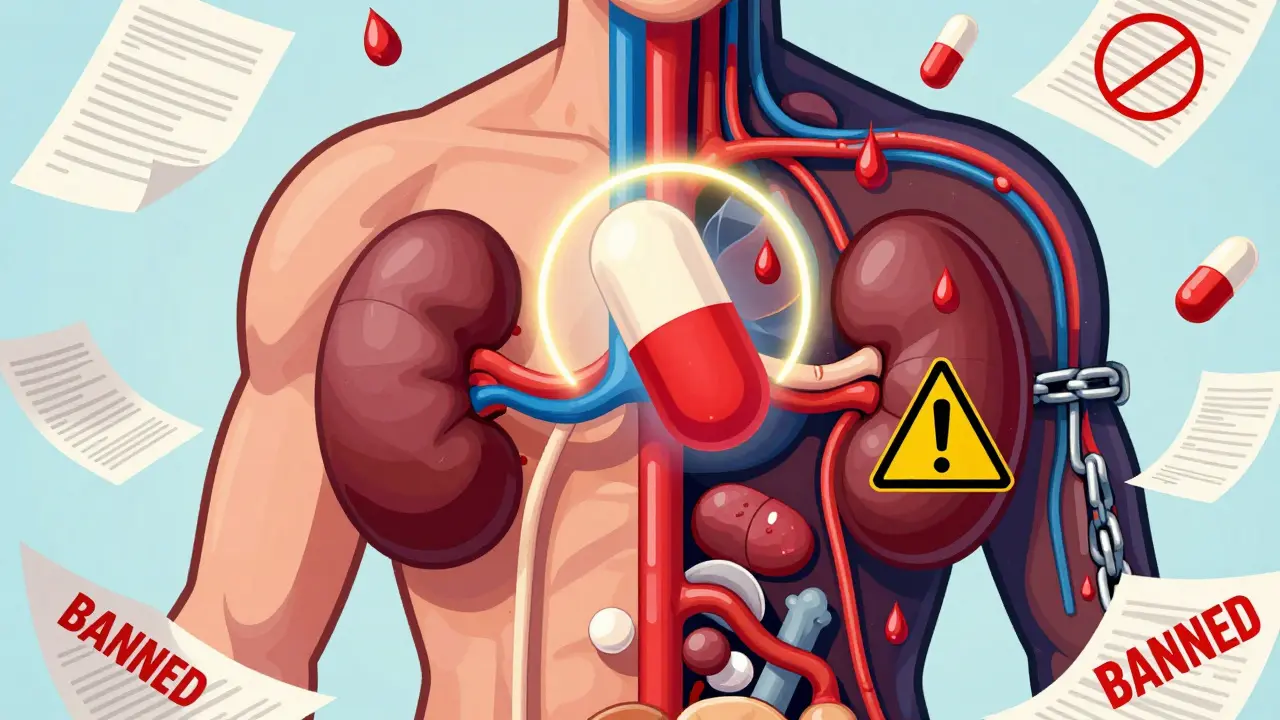
Most direct oral anticoagulants (DOACs)-like apixaban, rivaroxaban, and dabigatran-were tested in healthy, middle-aged patients with atrial fibrillation. Their kidneys and livers worked fine. But in someone with end-stage kidney disease or cirrhosis, the body handles these drugs differently. The liver makes clotting factors. The kidneys clear them. When either organ fails, the balance tips. Take dabigatran. About 80% of it leaves the body through the kidneys. In someone with an eGFR under 30, it builds up like a clogged drain. That’s why it’s banned in advanced kidney disease. Rivaroxaban? About a third is cleared by the kidneys, but it’s also processed by the liver. In cirrhosis, that’s a double problem. Apixaban, on the other hand, is only 27% cleared by the kidneys and relies more on liver metabolism. That’s why it’s often the go-to choice-even in dialysis patients-when other DOACs are off the table.Kidney Disease: The Dose Is Everything
For kidney disease, it’s not just about the eGFR number. It’s about how you got there. A 70-year-old with diabetes and eGFR 25 isn’t the same as a 45-year-old with polycystic kidney disease and the same number. But guidelines treat them the same. Here’s what works in practice:- eGFR 45 or higher: All DOACs are fine at standard doses.
- eGFR 30-44: Apixaban stays at 5 mg twice daily. Rivaroxaban drops to 15 mg daily. Edoxaban drops to 30 mg daily. Dabigatran is off-limits.
- eGFR under 30: Rivaroxaban is contraindicated in Europe. In the U.S., apixaban 2.5 mg twice daily is allowed based on post-hoc data showing it cuts bleeding risk by 70% compared to warfarin in this group. But it’s not approved for dialysis patients by the FDA-yet.
- On dialysis: Apixaban 2.5 mg twice daily is used off-label in many centers. Studies show it achieves about half the blood concentration of someone with normal kidneys. That’s often enough to prevent clots without causing bleeds. Warfarin is still common here, but it’s messy. INR targets drop to 1.8-2.5 because these patients bleed more easily.
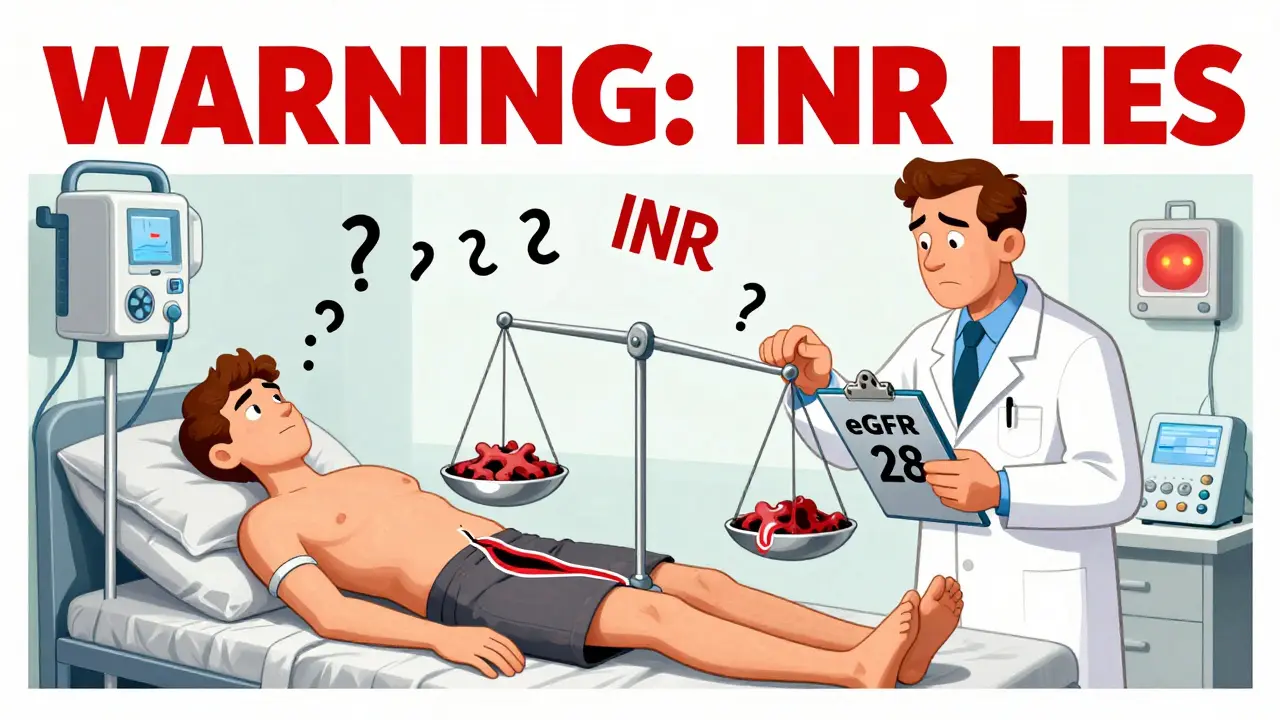
And don’t forget: creatinine-based eGFR formulas are wildly inaccurate in advanced kidney disease. A number like 28 might be wrong by 10 points either way. That’s why many nephrologists look at trends-how fast the number is falling-more than the single value.
Liver Disease: The INR Lies
The liver doesn’t just make clotting factors-it makes anticoagulants too. In cirrhosis, the body loses both sides of the balance. That’s why an INR of 1.8 might look normal, but the patient is actually at high risk for bleeding. The INR only measures vitamin K-dependent factors. It ignores low platelets, poor fibrinogen, and dysfunctional clotting proteins. Here’s how liver disease changes the game:- Child-Pugh A (mild): DOACs are generally safe. Standard doses apply.
- Child-Pugh B (moderate): Use with caution. Many doctors cut the DOAC dose in half. Platelet counts under 50,000/μL make this even riskier.
- Child-Pugh C (severe): DOACs are not recommended. Bleeding risk jumps 5 times higher. Warfarin is sometimes used, but INR becomes unreliable. One study showed cirrhotic patients only spend 45% of their time in the therapeutic range-compared to 65% in healthy people.
Some hepatologists now use thromboelastography (TEG) or ROTEM to get a full picture of clotting. These tests show how quickly a clot forms, how strong it is, and how fast it breaks down. But they’re only available in about 1 in 3 U.S. hospitals. Most community clinics still rely on INR-and that’s a problem.
Warfarin vs. DOACs: The Real Trade-Offs
Many assume warfarin is safer in organ failure because we’ve been using it for decades. But that’s not always true. In kidney disease:- DOACs cut intracranial bleeding by 62% compared to warfarin.
- But in dialysis patients, warfarin might be better for mechanical heart valves. DOACs aren’t approved for that use at all.
In liver disease:
- Warfarin has reversal agents (vitamin K, fresh frozen plasma) that are widely available.
- DOACs have specific reversal drugs-idarucizumab for dabigatran, andexanet alfa for rivaroxaban/apixaban-but they’re expensive and hard to get. Andexanet costs $19,000 per dose. Only 45% of U.S. hospitals stock it.
One study found that in cirrhotic patients on warfarin, bleeding events were more common than clots. In those on apixaban, the opposite was true. That’s the paradox: the drug that prevents clots might cause more bleeds in this group. But the drug that’s safer for bleeds might not prevent clots well enough.
Real-World Chaos: What Happens in the Clinic
In a 2021 study of over 12,000 dialysis patients with atrial fibrillation, only 28% got any anticoagulation-even though 76% had a high stroke risk score. Why? Fear. Fear of bleeding. Fear of lawsuits. Fear of not knowing what to do. One nephrologist on a Reddit thread described giving apixaban 2.5 mg daily to 15 dialysis patients over two years with zero bleeds. Another described a patient who died from a retroperitoneal hemorrhage after starting the same dose. Both cases were real. Neither was a fluke. In liver disease, 68% of hepatologists reported at least one major bleeding event in the past year tied to anticoagulation. Most of those patients had platelet counts under 100,000/μL. But they were still on anticoagulants because their portal vein was clotting-something that can kill faster than a bleed.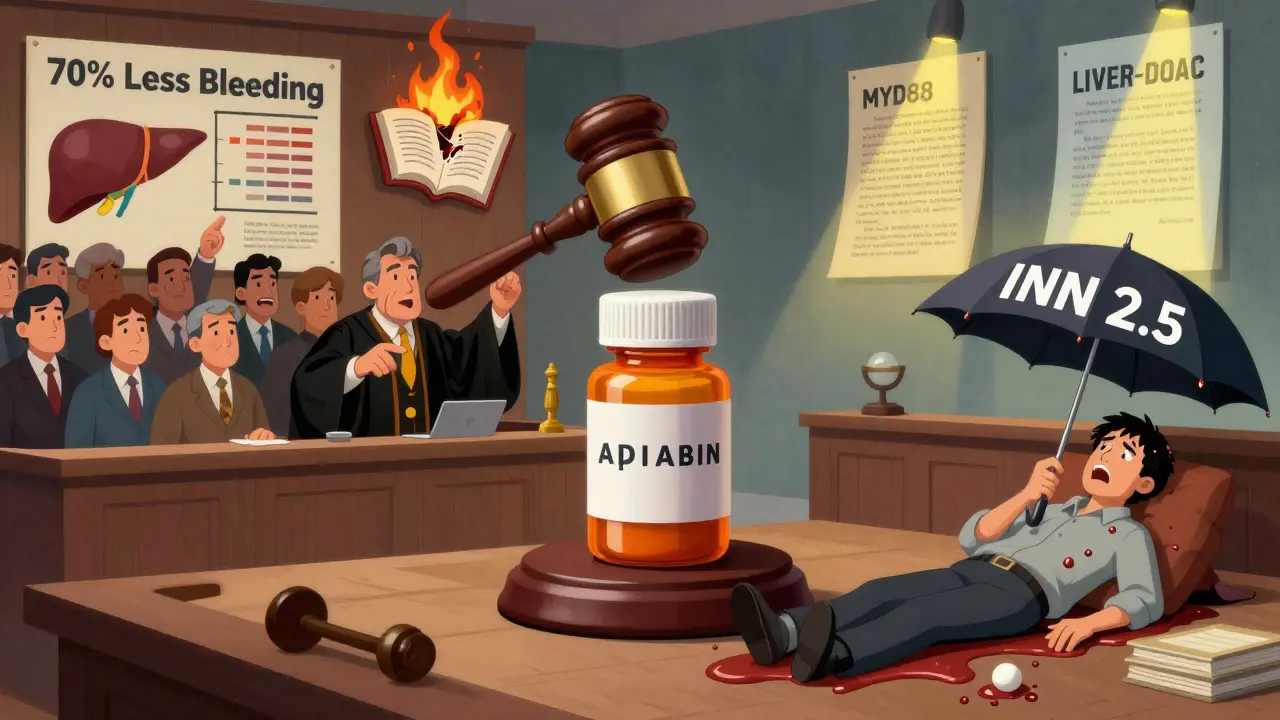
When to Stop
There’s no magic number. But here’s what experienced teams use:- Kidney disease: If eGFR drops below 15 and the patient is on dialysis, reconsider the need for anticoagulation. If they’re stable and not having clots, stopping might be the safest move.
- Liver disease: If platelets fall below 50,000/μL or MELD score climbs above 20, stop DOACs. If INR is over 2.5 and the patient is bleeding, stop warfarin.
Don’t wait for a crisis. Monitor eGFR every three months in stage 3b or worse. Check platelets monthly in cirrhosis. If the patient’s condition is declining, assume the anticoagulation plan needs rethinking.
The Future Is Coming
Two big studies are underway. The MYD88 trial is randomizing 500 dialysis patients to apixaban versus warfarin. Results come in 2025. The LIVER-DOAC registry is tracking 1,200 cirrhotic patients on DOACs worldwide. We’ll finally know what works. The FDA is also considering updating apixaban’s label for end-stage kidney disease based on pharmacokinetic modeling. That could make prescribing easier. Until then, the rule is simple: anticoagulation in kidney and liver disease isn’t about following a guideline-it’s about knowing your patient, knowing your limits, and knowing when to say no.Can DOACs be used in patients on dialysis?
Yes, but only apixaban is commonly used, at 2.5 mg twice daily. It’s off-label and not FDA-approved for dialysis, but real-world data shows it’s safer than warfarin for stroke prevention with less bleeding. Rivaroxaban and dabigatran are avoided. Edoxaban has no reliable data in this group. Many nephrologists avoid all DOACs due to lack of formal approval, but guidelines are shifting.
Is warfarin safer than DOACs in advanced liver disease?
Not necessarily. Warfarin has reversal agents, but its INR is unreliable in cirrhosis. Patients spend less time in the therapeutic range, increasing both clot and bleed risk. DOACs offer more predictable levels but have limited reversal options. For Child-Pugh C patients, most experts avoid all anticoagulants unless there’s an urgent reason like portal vein thrombosis.
Why is apixaban preferred over other DOACs in kidney disease?
Apixaban is only 27% cleared by the kidneys, so it builds up less than dabigatran (80%) or edoxaban (50%). It’s also metabolized by the liver, giving it a backup clearance pathway. In ARISTOTLE trial subgroups, apixaban showed a 70% lower bleeding risk than warfarin in patients with eGFR under 30. That’s why it’s the only DOAC with any real-world support in advanced kidney disease.
Should I check platelets before starting anticoagulation in liver disease?
Absolutely. Thrombocytopenia is common in cirrhosis-76% of patients have platelets under 150,000/μL. If platelets fall below 50,000/μL, the risk of major bleeding skyrockets. Many hepatologists won’t start or will stop anticoagulants at this level. Platelet count is just as important as INR in liver disease.
What’s the biggest mistake doctors make with anticoagulation in these patients?
Assuming that because a drug is approved for atrial fibrillation, it’s safe for patients with advanced organ failure. The trials didn’t include them. Using standard doses without adjusting for kidney or liver function. Ignoring platelet counts in cirrhosis. Relying on INR alone in liver disease. Not monitoring closely enough. The biggest mistake? Not having a plan at all.
Can I reverse DOACs if a patient bleeds?
Yes, but it’s complicated. Idarucizumab reverses dabigatran and costs about $3,500 per dose. Andexanet alfa reverses apixaban and rivaroxaban but costs $19,000 and is only available in 45% of U.S. hospitals. For edoxaban, no specific reversal agent exists. In emergencies, activated charcoal (if taken recently), dialysis (for dabigatran), or four-factor prothrombin complex concentrate (PCC) may be used, but evidence is weak. Prevention is better than reversal.
Comments
Janette Martens December 29, 2025 at 22:02
this is why canada's health system is a joke. we got docs guessing like it's 1985 and we still don't have proper guidelines for dialysis patients. someone's gonna die because some pharma company didn't test their drug on people who actually need it. #canadianhealthcarefail
Marie-Pierre Gonzalez December 30, 2025 at 19:03
Thank you for this incredibly thorough and compassionate breakdown. 🙏 It's rare to see such nuanced clinical insight shared so clearly. I hope this reaches every resident and primary care provider who struggles with anticoagulation decisions. Your work matters more than you know.
Louis Paré January 1, 2026 at 00:55
So let me get this straight. We have a $19,000 reversal drug that only 45% of hospitals stock, and we're still using a 70-year-old blood thinner because it's "safe"? This isn't medicine. This is financial engineering with a stethoscope. The entire system is rigged to avoid liability, not save lives.
Julius Hader January 2, 2026 at 03:27
I'm a nurse in Ohio and I see this every day. Docs just prescribe apixaban 2.5 mg because it's "the least bad option." But no one talks about the fact that half these patients are on 10+ meds already. We're not treating disease-we're playing whack-a-mole with side effects.
James Hilton January 2, 2026 at 13:47
Apixaban for dialysis? Bro, we're just winging it with a 2.5 mg pill like it's a magic bean. The FDA hasn't approved it, the trials didn't include them, but we're doing it anyway because we're too scared to say "I don't know."
Bradly Draper January 3, 2026 at 04:27
I just had a patient die from a bleed after starting apixaban. He was 72, on dialysis, had no history of clots. We thought it was safe. We were wrong. I don't know what to do anymore.
Gran Badshah January 3, 2026 at 21:09
in india we dont even have access to these drugs. we use warfarin and pray. if INR is 2.5 and patient is bleeding, we give vit k and hope. no tge, no reversal agents, no guidelines. just faith and a stethoscope.
Samantha Hobbs January 4, 2026 at 02:02
so wait… if INR is useless in liver disease and platelets are low, why are we even bothering? why not just let nature take its course? i mean, if the liver can't make clotting factors, why are we trying to force it?
Nicole Beasley January 5, 2026 at 18:57
this is why i became a nurse 😭 the system is broken but we still try. apixaban 2.5mg twice daily for dialysis patients... it's like giving a toddler a car key and saying "drive safely". we need better data. 💔
sonam gupta January 6, 2026 at 17:05
doctors dont know anything they just follow pharma ads. in india we use warfarin because its cheap and we dont care if they bleed. if they die its their karma
Vu L January 6, 2026 at 20:14
Wait, so apixaban is the best option because it's the *least* cleared by kidneys? That's not a win. That's just the least terrible option. This isn't medicine, it's damage control. We're not treating patients-we're minimizing lawsuits.