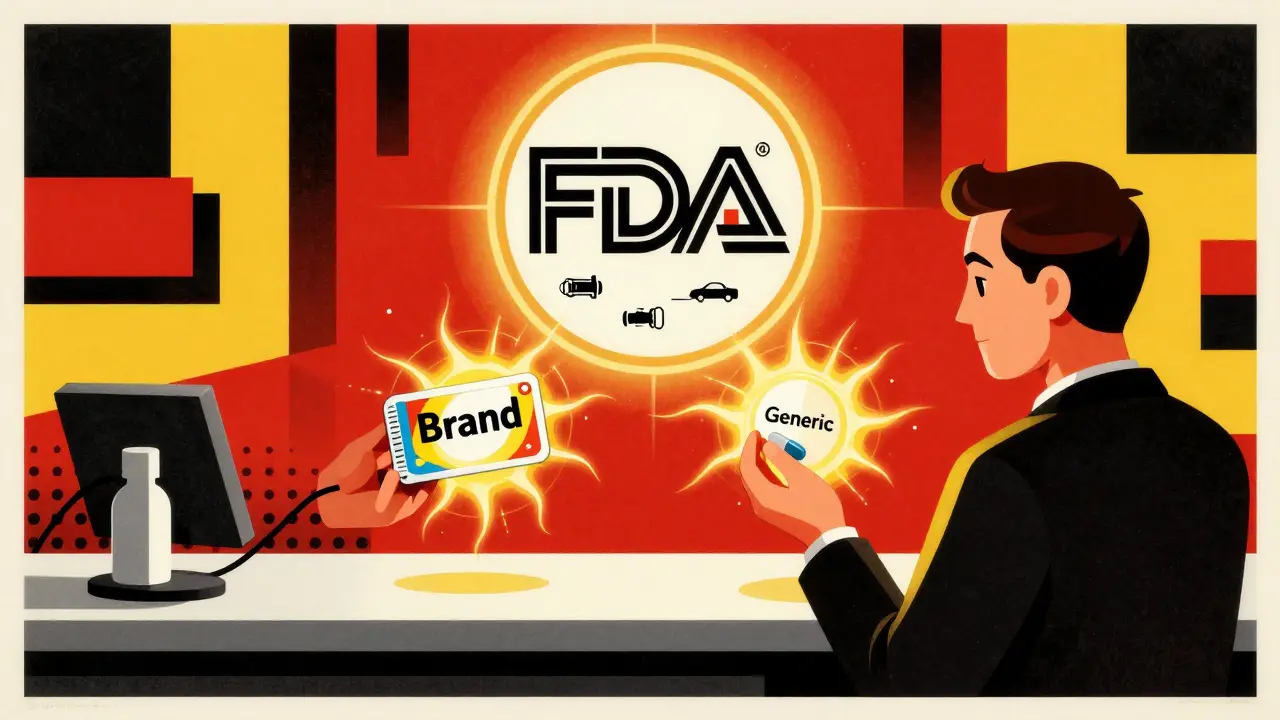
When your doctor prescribes a medication, you might see a different name on the bottle than what you expected. That’s because it’s likely a generic drug-and you’re not alone if you’re wondering whether it’s really the same. Many patients worry: Is it weaker? Could it be unsafe? Will it make me feel worse? These concerns are real, and they come up often. The good news? Most of them are based on myths, not facts.
Are generic drugs really the same as brand-name drugs?
Yes. By law, a generic drug must contain the exact same active ingredient, in the same amount, and work in the same way as the brand-name version. The U.S. Food and Drug Administration (FDA) doesn’t approve a generic unless it proves it delivers the same amount of medicine into your bloodstream at the same speed as the original. This is called bioequivalence. The FDA requires that the absorption rate of the generic falls between 80% and 125% of the brand-name drug. That’s not a wide gap-it’s a tight, scientifically proven match.
Think of it like two identical cars with the same engine. One might have a different paint job or interior fabric, but under the hood? Same thing. Generic drugs might look different-different color, shape, or size-but that’s only because of inactive ingredients like dyes or fillers. Those don’t affect how the medicine works.
Do generic drugs cause more side effects?
No. Side effects come from the active ingredient, not the brand name. If a brand-name drug gives you a headache or nausea, the generic version will too-because it’s the same drug. Some people report feeling worse after switching, but that’s often because they’re noticing side effects they didn’t pay attention to before, or because their body is adjusting to a new pill shape or coating. In rare cases, differences in inactive ingredients (like lactose or gluten) can cause reactions in people with allergies, but pharmacists check for that before dispensing.
One common myth is that generics have "more in them to make them stronger." That’s not how it works. If a generic had more active ingredient, it would be over the legal limit-and the FDA would never approve it. The active ingredient is identical. The difference is in cost, not chemistry.
Can generic drugs be counterfeit or fake?
No, not if they’re sold legally in the U.S. The FDA requires every generic drug manufacturer to meet the same strict standards as brand-name companies. Facilities are inspected, ingredients are tested, and production is monitored. In fact, about half of all generic drugs are made by the same companies that make the brand-name versions. So when you pick up a generic, you might be getting a product made in the same factory as the brand-name one.
The real risk of counterfeit drugs comes from buying medicine online without a prescription. That’s true for both brand-name and generic pills. Always get your meds from a licensed pharmacy. If a pharmacy doesn’t require a prescription or offers prices that seem too good to be true, walk away.
Why are generic drugs so much cheaper?
Brand-name drugs cost a lot because the company spent years and millions developing the drug, running clinical trials, and patenting it. Once the patent expires, other companies can make the same drug. They don’t need to repeat expensive trials-they just have to prove it works the same way. That cuts costs dramatically.
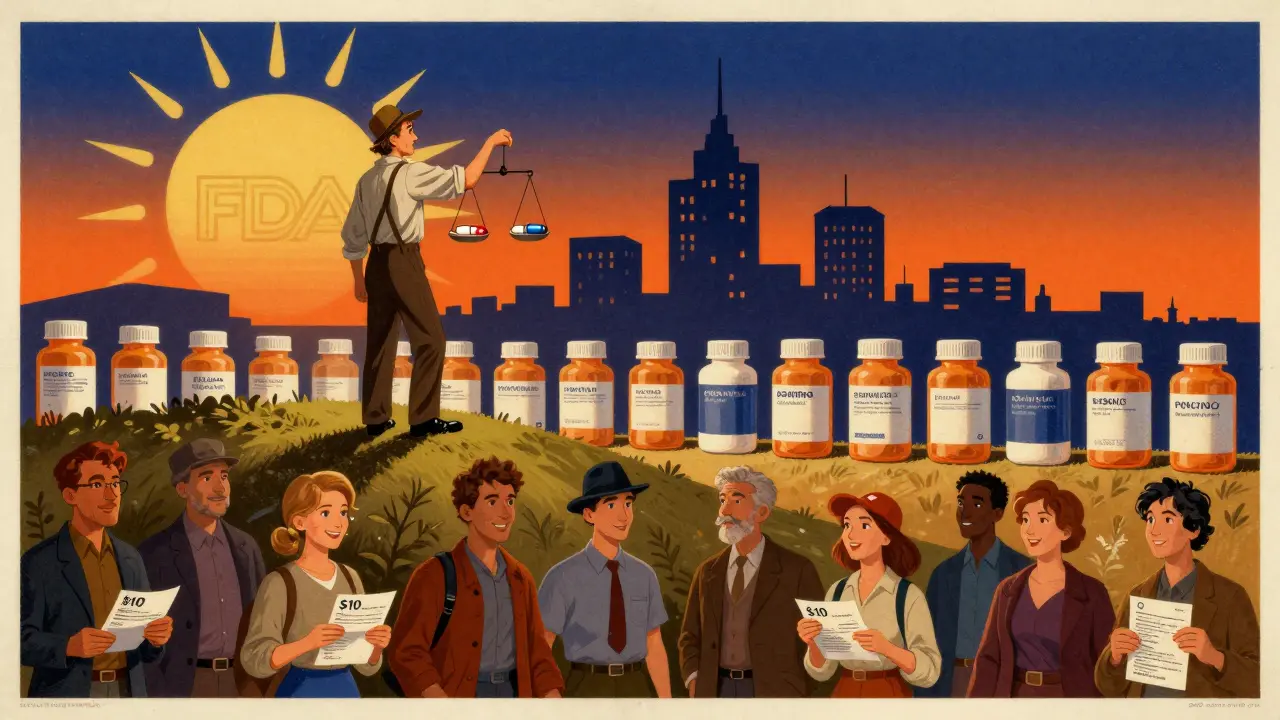
With multiple companies making the same generic, competition kicks in. Prices drop even further. On average, generics cost 80-85% less than brand-name drugs. Over the past decade, generics have saved the U.S. healthcare system more than $2.2 trillion. For patients, that means paying $10 instead of $100 for a month’s supply. That difference can mean the difference between taking your medicine or skipping it.
Are there any exceptions? When should I stick with the brand?
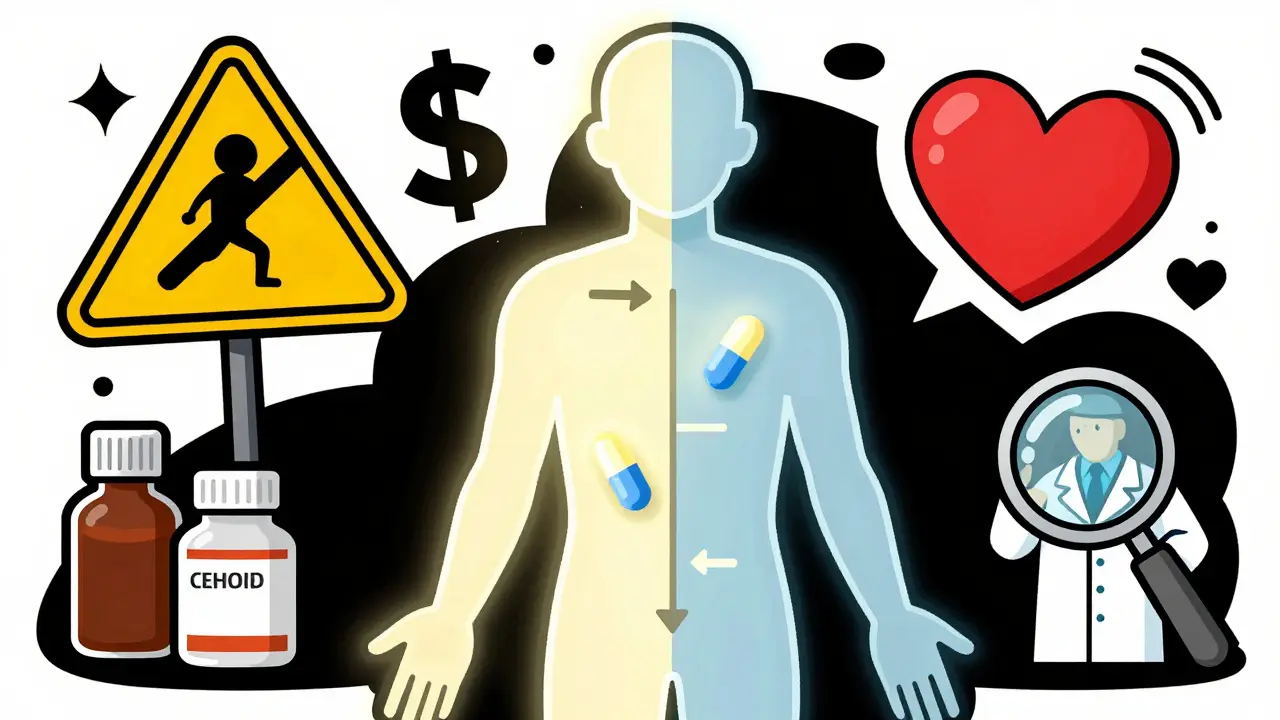
Yes. Some medications have a narrow therapeutic index-meaning the difference between a helpful dose and a harmful one is very small. These include:
- Warfarin (a blood thinner)
- Levothyroxine (for thyroid conditions)
- Phenytoin and levetiracetam (for seizures)
For these drugs, small changes in how your body absorbs the medicine can matter. Doctors may recommend sticking with one version-brand or generic-to keep levels stable. But even here, switching isn’t unsafe. It just requires closer monitoring. If you’re on one of these medications and your pharmacist switches you to a generic, your doctor should check your blood levels a few weeks later to make sure everything’s still on track.
Why do some people distrust generics?
It’s not just about science. Cultural beliefs, personal experiences, and misinformation play a big role. A 2014 study found that non-Caucasian patients were significantly more likely to ask for brand-name drugs. Some patients believe generics are "second-rate" because they’re cheaper. Others heard a friend say their generic didn’t work. But those stories are often based on coincidence-not cause.
One rural patient told researchers, "My friend was having bad effects, so she went back to the doctor." But when they looked at her records, she’d also changed her diet, started a new job, and was under stress-all things that could cause symptoms. The generic wasn’t the problem. The timing just made it seem that way.
Pharmacists are often the best resource for clearing up these myths. They can explain why the pills look different, how the FDA ensures safety, and why switching to a generic could save you hundreds each year.
What should I do if I’m worried?
If you’re unsure, talk to your pharmacist or doctor. Don’t stop taking your medicine. Here’s what you can do:
- Ask your pharmacist: "Is this a generic? How do I know it’s safe?" They’re trained to answer these questions.
- Check the FDA’s website for approved generics. They list every approved generic and its brand-name match.
- Don’t assume a change in how you feel is caused by the switch. Track your symptoms for a few weeks. Sometimes your body just needs time to adjust.
- If your doctor wrote "Do not substitute" on the prescription, the pharmacy must honor that. But if they didn’t, the law allows substitution.
Most people switch to generics without any issues. In fact, 90% of all prescriptions filled in the U.S. are for generics. That’s not because they’re cheap-it’s because they work.
What if I want to stay on the brand-name drug?
You can. If you or your doctor prefer the brand-name version, your prescription can be written to say "Do not substitute." That means the pharmacy must give you the brand-name drug, even if a generic is available. But be aware: you’ll pay more. And in some cases, your insurance might not cover the brand-name version unless you’ve tried the generic first.
Some patients choose to stay on the brand because they’ve been on it for years and feel comfortable. That’s okay. But don’t assume it’s safer or more effective. The science says otherwise.
How do I know if a generic is working?
Same way you know if the brand was working. Did your blood pressure drop? Are your headaches less frequent? Is your cholesterol improving? If your condition is stable after switching, the generic is doing its job. If you notice new or worsening symptoms, tell your doctor. It could be the medicine-or it could be something else entirely.
For drugs like thyroid or seizure meds, your doctor may order a blood test a few weeks after switching to check levels. That’s normal. It’s not because the generic is risky-it’s because precision matters in those cases.
Final thought: Your health matters more than the label
Generic drugs aren’t "second choice." They’re the standard. They’re tested, approved, and used by millions every day. Choosing a generic doesn’t mean you’re settling. It means you’re making a smart, safe, and affordable choice.
If you’re still unsure, talk to your pharmacist. They’ve seen this question a hundred times. They know the answers. And they’re there to help-not to sell you something.
Comments
Elaine Parra March 22, 2026 at 23:17
Generic drugs are a scam pushed by Big Pharma and the FDA to control the population. They cut corners on manufacturing and use cheap fillers that mess with your hormones. I know someone who took a generic and ended up in the ER. They said it was a coincidence-but I’ve seen the pattern. You think you’re saving money, but you’re trading your health for corporate profits. Wake up.
Rama Rish March 23, 2026 at 20:46
My mom switched to generic thyroid med last year. No issues. Cheaper. Same results. Why overpay?
Kevin Siewe March 23, 2026 at 21:26
It’s really helpful to see the FDA’s bioequivalence standards laid out like this. A lot of people don’t realize how tightly regulated generics are. Pharmacists are the unsung heroes here-they’re the ones who can explain the difference between inactive ingredients and active ones. If you’re nervous, ask them. They’ve seen it all.
Chris Farley March 24, 2026 at 02:01
Oh please. "Same active ingredient." That’s what they want you to believe. But chemistry isn’t just about molecules-it’s about how they interact in your body. Different binders, different coatings, different pH levels in the gut. You think the FDA’s 80-125% range is tight? That’s a 45% swing. That’s not science. That’s corporate compromise.
Sean Bechtelheimer March 26, 2026 at 01:58
Ever wonder why generics are always made in India or China? 🤔 FDA inspections? More like "photo ops." They don’t check half the factories. And don’t get me started on the 50% that are made by the same companies as brand names-sounds like a shell game to me. 💉
Seth Eugenne March 26, 2026 at 14:06
Thank you for this. I used to be scared of generics too-until my doctor explained it to me. Now I save over $800 a year. My anxiety didn’t get worse. My bank account did. 💙
Alex Arcilla March 27, 2026 at 11:46
Bro, the fact that you’re still debating this in 2024 is wild. We’ve been using generics since the 80s. My grandpa took generics for 20 years and lived to 98. Meanwhile, I’m paying $120 for my brand-name insulin and my cousin in Mexico pays $4. Same pill. Different label. The system is rigged. 🤷♂️
Jefferson Moratin March 27, 2026 at 19:25
The philosophical underpinning of the generic drug debate lies not in pharmacology but in epistemology: how do we assign value to efficacy when the perceptual experience of the patient diverges from the empirical data? The body does not register bioequivalence-it registers change. And change, even when statistically insignificant, is psychologically salient. Thus, the placebo effect, reversed: the nocebo of the generic label. The science is sound, but the human experience is not reducible to it.
Caroline Dennis March 29, 2026 at 10:01
Therapeutic index matters. Narrow TI drugs require precision. Switching generics without monitoring = clinical negligence. Pharmacies aren’t trained to flag this. Patients need to advocate. TSH, INR, drug levels-don’t assume it’s fine. Test. Track. Verify.
Zola Parker March 29, 2026 at 11:40
Oh so now generics are fine? But what about the time my cousin’s BP spiked after switching? And the FDA approves everything? LMAO. They approved Vioxx too. 🤡
florence matthews March 29, 2026 at 19:57
I love how we all get so worked up about pills. The real issue is access. If people could afford brand-name meds without stress, none of this would matter. But we live in a system where $10 vs $100 determines whether someone takes their meds. Let’s fix that. ❤️
Kenneth Jones March 31, 2026 at 04:49
Stop lying. Generics are inferior. I’ve taken both. I know the difference. The brand works. The generic doesn’t. End of story.
Mihir Patel April 1, 2026 at 04:58
Bro I switched to generic and my legs started tinglin and I felt like I was in a dream and my dog barked at me like I was a ghost?? I think the generic is haunted 😭